

A polished listing can still make the wrong home look right. When comparing quality duplex rentals, attractive finishes and a long feature list matter less than whether a property is well maintained, comfortable and practical for everyday routines.
Photos may not reveal maintenance concerns, and two homes with similar layouts can differ in privacy, usable space, running costs and tenancy terms. A careful assessment helps you look beyond first impressions and focus on what your household needs.
This guide explains how to evaluate a duplex rental’s condition, comfort, costs and agreement terms. You’ll learn which features can support family life, how to compare homes using consistent criteria, and what to clarify before deciding. A practical checklist can help you weigh each property against your family’s routines and set clear expectations.
Key Takeaways
- Look beyond attractive finishes to assess whether a home’s layout, condition and upkeep support your family’s daily routines.
- Evaluate quality duplex rentals using four criteria: layout, physical condition, facilities and clarity of tenancy terms.
- Separate essential household needs from preferences, then compare each property using the same checklist.
- During a viewing, inspect rooms, try features used in everyday life and note any differences from the listing description.
- Use your priorities to guide your search for duplex rental opportunities through Citacle Realtors.
What makes quality duplex rentals suitable for family life?
A quality rental is more than a good-looking home. For a family, quality duplex rentals combine a practical layout, sound condition and clear expectations about how the property will be used and maintained. A duplex generally contains two dwelling units in one building, though the arrangement can vary. The overview of What is a Duplex (building)? offers helpful context before you assess a particular home.
A quality duplex rental supports a family’s daily routines, is in sound usable condition, and comes with clear expectations for the tenancy.
That definition shifts attention from appearance to lived experience. Fresh paint or stylish finishes can make a strong first impression, but they don’t show whether bedrooms offer enough privacy, shared spaces work for the household, or doors, windows and fittings are properly maintained. Treat presentation as one observation, not proof of overall suitability.
Before comparing listings, write down your non-negotiables and separate them from preferences. A household with children who need separate study areas may prioritise bedroom arrangement and quiet corners. Another may value storage for everyday belongings or a shared living area where everyone can gather. This short list helps you judge homes against your routines instead of being swayed by features that add little practical value.
Which duplex features matter most to a family?
Consider how bedroom placement affects privacy, how easily family members move between rooms, and whether there is enough storage for daily essentials. Ask whether the layout can accommodate work or study, rest and family gatherings without forcing everyone to compete for the same space. An advertised amenity is useful when it meets a household need; otherwise, a comfortable, straightforward layout may matter more.
Picture a typical weekday, from getting ready in the morning to settling down in the evening. Are shared areas accessible without interrupting someone’s rest? Can children study while another family member works or prepares a meal? Consider visitors, too. A home that lets family members spend time together while preserving some privacy may feel more comfortable over time.
How does property condition affect rental quality?
Look closely at finishes, fittings, doors, windows and any shared areas. Cosmetic wear, such as minor scuffs, differs from a fault that interferes with ordinary use. Note sticking doors, damaged fittings or windows that don’t close properly, and record what you observe rather than relying on an overall impression of neatness.
Look for signs that the property is consistently cared for, not just freshly presented. Your viewing notes can help distinguish a surface-level issue from something that could affect comfort or day-to-day use. For a structured visit, use this duplex inspection checklist for tenants to guide your observations.
Finally, compare what you see with the listing description and tenancy terms. A feature matters when it suits your household and its condition and use are clear. This practical standard makes it easier to recognise a home that fits family life, not simply one that photographs well.
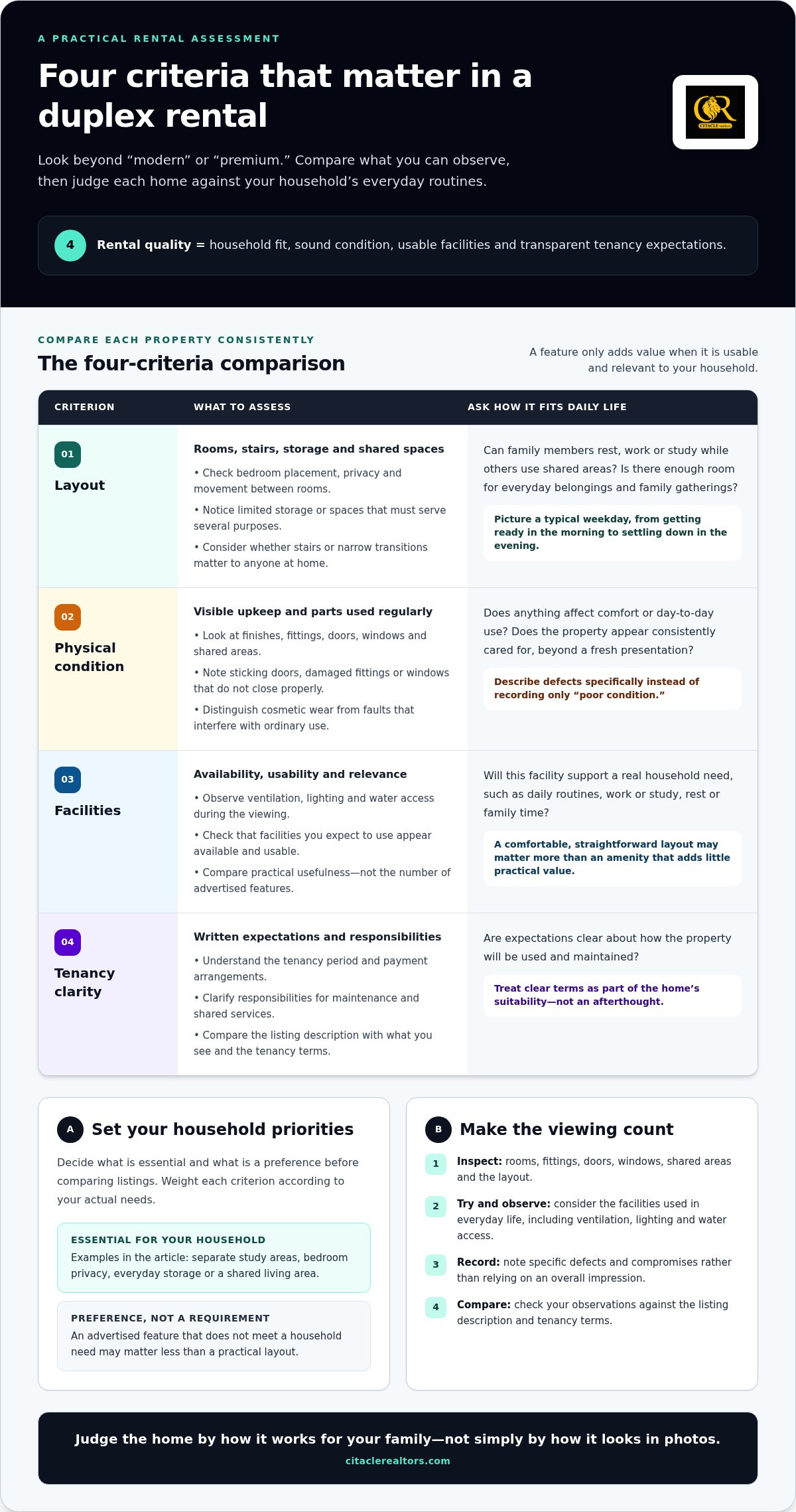
How to assess a quality duplex rental: four criteria that matter
A consistent assessment makes it easier to compare homes without being distracted by broad descriptions such as “modern” or “premium.” Record what you can observe, then judge each point by how much it matters to your household. One family may prioritise a bedroom near a young child, while another may place greater weight on a separate study area or clear arrangements for property upkeep.
Rental quality depends on household fit, sound condition, usable facilities and transparent expectations.
- Layout: Consider whether rooms, stairs, storage and shared spaces work with everyday routines.
- Physical condition: Note the state of visible finishes, fittings, doors, windows and other elements used regularly.
- Facilities: Assess whether available facilities are usable and relevant to your household, rather than relying on the listing’s feature count.
- Tenancy clarity: Understand the written expectations, including the tenancy period, payment arrangements and responsibilities for maintenance or shared services.
Give each criterion a weight based on your actual needs. A feature that is essential for one household may be a minor preference for another. This keeps quality duplex rentals grounded in practical family fit, not assumptions about which features should matter most.
How should renters evaluate layout and everyday usability?
Map the bedrooms, bathrooms, stairs, storage and shared areas against a normal day at home. Consider whether movement between rooms feels manageable for children, older relatives or guests, and whether stairs or narrow transitions are a concern for anyone in the household. Write down compromises, such as limited storage or a shared space that must serve several purposes, and decide whether they’re acceptable before comparing properties.
Think about how the layout supports activities happening at the same time. If one person needs quiet for work or study while others use the living area, check whether there is a practical way to separate those routines. The goal isn’t to find a perfect floor plan, but to understand how the home will function for your family.
What should a renter observe about condition and facilities?
Look at visible finishes and fixtures, and note signs of wear, damage or inconsistent upkeep. Consider ventilation, lighting and water access during the viewing. Observe whether the facilities you expect to use appear available and in usable condition. Describe defects specifically rather than writing “poor condition”; for example, record a loose fitting or a window that does not close properly. Separate observations that may affect ordinary use from minor cosmetic marks.
Property management provides useful context for ongoing oversight, since maintenance and care continue beyond a viewing. Citacle’s professional residential property management guide explains this broader perspective.
Finally, compare your notes with the written tenancy terms. If a facility or maintenance responsibility affects your decision, make sure the relevant expectation is clear before you commit. Use your criteria to explore duplex rental opportunities through Citacle Realtors.
How to compare duplex rentals beyond the listing photos
Photos and property descriptions are useful starting points, but they present each home on its own terms. To compare fairly, use the same criteria for every option and record observable details rather than impressions such as “beautiful” or “premium.” A simple comparison table can show whether a home’s features genuinely fit your family or simply make a strong first impression.
Set up these columns for each property:
- Household fit: Does the home meet your family’s essential needs?
- Layout: How well do the rooms and shared spaces support your routines?
- Condition: What did you observe about upkeep and features used every day?
- Facilities: Which facilities are present, usable and relevant to your household?
- Tenancy terms: What rent, payment schedule, responsibilities and other expectations are documented?
Use consistent notes, such as “storage available in bedrooms” or “maintenance responsibility not stated,” rather than assigning a vague overall score. If information is missing, mark it as not stated. Don’t assume a facility, service or responsibility is included just because the photos suggest it.
Which rental features should be essentials rather than bonuses?
Define essentials based on your household’s size, routines, accessibility and privacy needs. A bedroom arrangement that works for your family may be non-negotiable, while an extra entertainment feature may be a bonus. Treat an amenity as essential only if it solves a real day-to-day need. Apply the same criteria to every viewing so attractive presentation or elaborate extras don’t distort the comparison.
For example, one family may need a layout that makes it easier for an older relative to move between frequently used rooms; another may prioritise a quiet place for study. Once you’ve marked each requirement as essential or preferred, note whether each home meets it. This makes trade-offs visible before a favourite listing starts to feel like the only choice.
How can families compare tenancy expectations fairly?
Read the written terms alongside the property features. Compare the stated rent and payment schedule, the tenancy period, and documented responsibilities for maintenance or shared facilities. Focus on how complete and clear each property’s expectations are, not on market-rate predictions. If a term is absent or unclear in the information you have, record that gap rather than treating an assumption as an agreement.
A modestly featured duplex may be the stronger family choice if its rooms work well, its condition is sound and its tenancy expectations are clearly set out. A more elaborate option may offer extras your household rarely uses while leaving practical needs unmet. Compare the whole proposition, not the number of features. The aim is to identify quality duplex rentals that align with your priorities and offer a clear basis for deciding what suits your family.
What to check during a duplex viewing before making a decision
A viewing is most useful when you follow the same sequence each time. Start by revisiting your household’s priorities, then inspect the rooms, try ordinary-use features where appropriate, and record what you observe. This turns a walk-through into a practical assessment and helps you avoid relying on a quick first impression.
Keep the listing description and proposed tenancy terms available during the visit. Compare each stated feature with what you can actually see, and note anything you can’t assess during the viewing. For quality duplex rentals, clear observations are more useful than assumptions about a home’s condition or what the tenancy includes.
What should tenants inspect room by room?
Move through the property in a consistent order, from entrance to living spaces, bedrooms, bathrooms and other areas included in the viewing. In each room, check visible walls, ceilings, floors, fixtures, doors and windows. Look for signs of moisture or damage, and observe ventilation, lighting and water availability. Pay particular attention to spaces your family will use often, since a defect there may affect daily routines more than a minor mark in a less-used area.
Write notes against the room name, not in a general list. For example, record “bedroom window does not close smoothly” rather than “window issue.” If you take photographs, do so appropriately and keep them organised with your notes. This makes it easier to remember what you saw and compare the property with the listing later.
Before leaving, review your notes and identify observations that need clarification. If you notice damage or a feature that doesn’t work as expected, describe it specifically and record any explanation or commitment provided. Don’t treat a verbal comment as a completed repair or settled responsibility; capture the agreed next step in writing.
How can a family review terms and next steps?
Read the tenancy terms carefully, including payment timing, the tenancy period and stated responsibilities for maintenance or shared facilities. Compare those written details with the listing and what you observed. If a responsibility or feature is unclear, keep it on a short list of points to resolve before proceeding rather than filling the gap with an assumption.
Use the duplex inspection checklist for tenants during the viewing to keep your review structured. Afterward, organise notes under condition, facilities, listing differences and tenancy terms. Consistent records make it easier for family members to discuss the same evidence and compare separate viewings without confusing one property’s details with another’s.
Before making a decision, make sure any agreed observations or commitments are documented in writing and that you understand the stated terms. Citacle Realtors facilitates duplex rentals, which you can explore through its rental opportunities.
Finding quality duplex rentals through Citacle Realtors
With your priorities and comparison notes in place, you can begin a more focused search. Citacle Realtors is a Nigerian real estate firm that facilitates duplex rentals and residential property opportunities. A clear household profile helps connect your family’s needs with property features as you explore options across Nigeria, while keeping condition, everyday usability and written expectations in view.
How can renters turn their checklist into a focused search?
Summarise your requirements in a short household profile before reviewing rental options. Include who will live in the home, the routines the layout must support, any accessibility or privacy needs, and which features are essential rather than simply preferred. This gives you a practical reference when listings use different descriptions or highlight different features.
Then use the same comparison framework for each property. Record what the listing says, what you observe during a viewing, and what the written tenancy terms specify. Keep three questions at the centre of your assessment:
- Condition: Does the property appear suitably maintained for ordinary use?
- Layout: Can your household move through and use the rooms comfortably?
- Expectations: Are the rent, payment timing and stated responsibilities clear?
Separate confirmed details from unanswered points in your notes. If an important feature or responsibility isn’t stated, mark it for clarification rather than assuming it’s included. This measured approach helps you assess each home consistently and keeps a polished listing from outweighing factors that will matter after move-in.
What makes Citacle a relevant partner in a rental search?
Finding a home is a significant family decision, and a structured search can make the process more manageable. Citacle’s property and facilities management services provide context for the role of ongoing property oversight, while its duplex rental service offers a way to explore residential opportunities. Assess each home on its own features and stated terms, using your household profile as the guide.
As you review opportunities, keep your essential requirements visible and compare each option against them. A property’s appeal is strongest when its layout, condition and documented expectations align with your family’s practical needs. This makes it easier to move from browsing to a considered shortlist, with fewer assumptions and clearer expectations about what each rental offers.
Use your checklist to guide your search for duplex rental opportunities with Citacle Realtors.
Take the next step toward a home that fits
Your rental search can be a shared family decision, not a rushed choice between appealing listings. Before moving forward, agree on the one or two requirements you’re least willing to compromise on, then use them to guide your shortlist. This can keep your priorities clear as new options catch your attention.
Choosing quality duplex rentals is ultimately about finding a home that supports the way your family lives and gives you clear expectations from the start. Citacle Realtors facilitates duplex rentals in Nigeria and also provides property and facilities management.
When you’re ready to explore residential opportunities, use your household priorities as the starting point. Explore duplex rental opportunities with Citacle Realtors.
Frequently Asked Questions
What makes a duplex rental a quality home for a family?
A quality duplex rental suits the way a family lives now while leaving room for everyday needs to change. Consider whether adults can supervise children without losing privacy, whether household members can rest while others are active, and whether shared areas support time together. For example, a family that regularly hosts relatives may value a comfortable gathering space more than an extra feature used only occasionally. The right fit depends on your household, not a standard checklist.
How can I tell if a duplex rental is well maintained?
Look beyond a tidy appearance to see whether the property’s upkeep seems consistent. Ask about any visible or reported defect, whether it has been addressed, and how maintenance concerns are handled during the tenancy. A freshly painted wall, for instance, doesn’t explain whether a past leak was resolved. Clear, specific answers and written records can help you distinguish routine wear from an issue that may need attention.
What should I check before renting a duplex in Nigeria?
Before committing, make sure you understand the full amount payable and what each payment covers, with all figures stated in Nigerian naira (₦). Review the tenancy period, payment timing, deposit arrangements, utility responsibilities and any shared charges in the written terms. Confirm who is authorised to let the property and keep copies of payment records and signed documents. Clear paperwork helps prevent misunderstandings about what you agreed to pay or manage.
Is a duplex better than a flat for a family?
Not automatically. A duplex may suit a family that values distinct levels or separation between living and sleeping areas, while a flat may be more convenient if stairs are difficult or a single-level layout better suits daily routines. Neither property type guarantees more privacy, space or comfort. Compare the specific homes by how household members move through them, who needs quiet, and what responsibilities come with each tenancy.
What questions should I ask when viewing a duplex rental?
Ask what happens if a defect appears after move-in, who handles repairs, and how to report a maintenance concern. Clarify which facilities are included for your use, how shared spaces are managed, and whether any work is planned before the tenancy begins. If a feature shown in a listing is not apparent during the viewing, ask for its status to be explained and reflected in the written details where relevant.
How do I compare two quality duplex rentals fairly?
Choose a few factors that matter most to your household and assess both homes using the same scale, such as whether each fully meets, partly meets or misses a need. Give essential needs more weight than optional extras. If one property has unclear terms or an unobserved feature, mark that separately instead of giving it an assumed advantage. This makes the trade-offs visible and helps family members explain why one option is the better fit.
Should I inspect a duplex before signing a tenancy agreement?
Yes, an in-person inspection can help you understand the property beyond its listing and identify details to resolve before you commit. If you can’t attend, arrange for a trusted representative to view it and share clear notes or photographs. Record defects, compare the home with the written description, and make sure any agreed repairs or other commitments are documented. Keep a copy of the final agreement and related records for reference during the tenancy.