

A receipt alone does not establish land ownership in Nigeria. The documents required for selling land in Nigeria depend on the title and transaction history, but may include a Certificate of Occupancy, deed of assignment, survey plan and, where applicable, Governor’s Consent. Request records that link the seller to the specific parcel.
Clear paperwork matters before a land sale proceeds. Understanding how the documents required for selling land in Nigeria fit together helps clarify what each record establishes and why one document cannot necessarily replace another.
This guide explains the key ownership and transaction documents to request, including a Certificate of Occupancy and Governor’s Consent. It also covers deeds, survey plans, receipts and supporting records, helping you prepare for an informed discussion before proceeding.
Key Takeaways
- Match the ownership papers to the land’s title and transaction history; no single document serves every purpose.
- Understand what the Certificate of Occupancy establishes and when a transfer may also involve Governor’s Consent.
- Use the deed of assignment to document the transfer, alongside the supporting records relevant to the transaction.
- Consider how a survey plan, receipts, and other supporting documents can help clarify the land and its ownership trail.
Certificate of Occupancy
In Nigeria, a Certificate of Occupancy, or C of O, is a state-issued document recording a statutory right of occupancy granted by the Governor under applicable laws. For a land sale, assess it alongside records linking the seller to the specific parcel and describing its boundaries.
Ownership Evidence
A Certificate of Occupancy is evidence of a granted right of occupancy and supports a claim to land ownership. Because the state issues it for identified land, check that its property description matches the survey plan and records linking the seller to the title. If the seller’s name differs, the transaction records should explain the connection. A purchase receipt alone is not sufficient proof of ownership.
Occupancy Rights and Consent
A right of occupancy is the statutory interest in land indicated by a Certificate of Occupancy. The document is not simply a payment receipt; it records the Governor’s grant under applicable laws. The relevant title documents depend on the land’s history. For land in a rural area, a customary right of occupancy is issued by the local government chairman.
For a transfer, distinguish the existing certificate from the later transaction. Governor’s Consent is required when land ownership is transferred in Nigeria. A subsequent purchaser does not need a new Certificate of Occupancy; the transfer requires a deed of assignment with Governor’s Consent. Request the consent record alongside the seller’s certificate and other transaction papers.
Use the C of O as one part of assessing the seller’s authority to transfer the land. Confirm that it describes the parcel being sold, then compare it with the survey plan and records linking the seller to that title. These documents support due diligence and title registration. If the seller relies on another ownership document, such as a deed of assignment, consider it as part of the land’s full title history.
Deed of assignment
A deed of assignment is a legal instrument that records a land sale and transfers an interest and title between parties. Land search, Governor’s Consent, stamp duty and registration costs depend on the applicable state process and transaction details, so there is no single nationwide charge. The usual sequence is to prepare and execute the deed, obtain required consent, stamp the instrument, then submit it for registration.
Assignment and Title Transfer
A deed of assignment records the transfer of a land interest from an assignor to an assignee. It identifies the parties and land, creating a formal transaction record rather than serving merely as a purchase receipt. For a buyer, it links the seller’s interest to the new ownership claim. The deed is an important document in a sale, including land within an estate.
A sale agreement can record the parties’ terms, while the deed records the transfer itself. Keep both with the other transaction records so the sale terms and transfer instrument can be considered in context.
Preparation and Execution
Preparation means drafting the deed with the transfer details; execution means the parties signing it. A qualified legal practitioner should prepare the deed, and both parties should execute it. The deed should accurately describe the land and identify the assignor and assignee, matching the transaction and title records.
At least two people should witness the deed. Keep the executed copy with related agreements and payment receipts. Together, these records document the transaction and provide a coherent file for registration.
Stamping and Registration Costs
Stamping is the process of paying applicable stamp duty on a registrable instrument. A deed of assignment intended to transfer land must be stamped within 30 days of execution. Under section 23 (3) (a) of Nigeria’s Stamp Duty Act 1939, an unstamped instrument is not accepted for registration at the land registry.
After stamping, submit the deed for registration under the process that applies to the land’s location. Section 2 of the Lagos State Lands Registration Law 2015 requires registration of instruments seeking to transfer an interest or title to land. Requirements and charges depend on the relevant state’s registry and the transaction.
Governor’s Consent
Governor’s Consent is government approval recorded for a land transaction involving the transfer of an interest in land. Nigeria’s Land Use Act 1978 is cited in connection with this requirement, and sections 21 and 22 address consent for alienation. For a transfer, the consent record belongs with the deed and title documents.
For an application, the listed documents include tax-clearance documents covering 3 years for both the assignor and assignee. A company transaction also requires corporate records: a board resolution, memorandum and articles of association, certificate of incorporation, proof of annual-returns payment, tax-clearance certificates covering 3 years for two or more directors, and Form CAC 1.1.
These documents help show who is transferring the interest and, for a company, whether it has taken the necessary internal steps. Keep names and property details consistent across the deed, application papers and existing title records. The application process depends on the state where the land is situated.
For family or community land, “Omonile” commonly refers to indigenous landowners, but the term alone does not establish who can sell a particular parcel. Request documents showing the seller’s authority and the basis of any family or community approval recorded for the transaction. If someone acts for another owner, the seller should provide a power of attorney showing authority to sell.
A subsequent purchaser does not need a new Certificate of Occupancy; the transfer requires a deed of assignment with Governor’s Consent. A purchase receipt records payment, but it does not replace the deed or government consent. Keep each record together to make the acquisition trail clear.
In short, tax-clearance documents covering 3 years for both parties, the deed, and Governor’s Consent are central transfer records. For a corporate party, include the listed company documents, while any family or community authority should be reflected in the transaction papers.
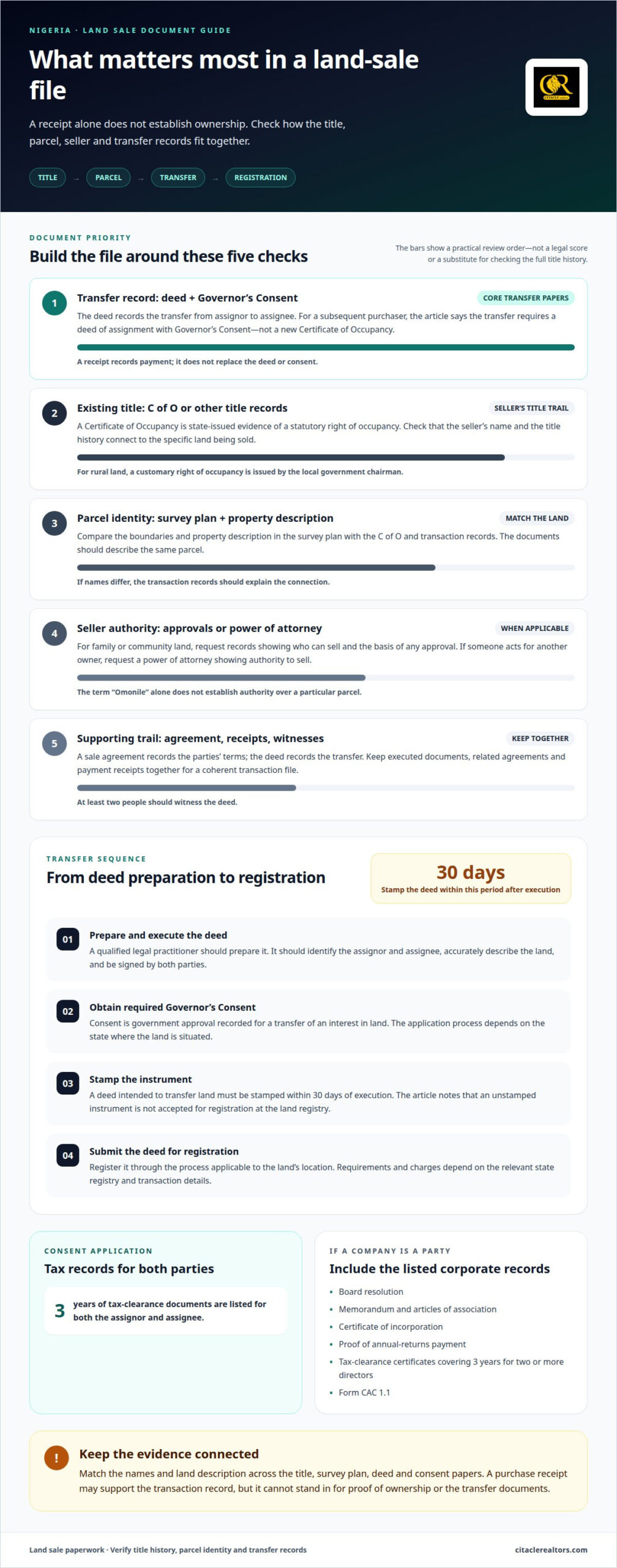
Land documents required for a Nigerian property transaction
A land transaction file brings together title records, transfer documents and records identifying the parcel. The right combination depends on the property’s title and location.
State-Specific Requirements
State-specific requirements are the land-document and registration procedures that apply where a parcel is located. Requirements vary according to the property and its title; procedures for one state should not be assumed to apply in another. Follow the relevant land registry’s process and organise the transaction file around the parcel’s title and transfer history.
Survey Plans and Sale Contracts
A survey plan describes a parcel’s location and measurements, while a sale contract records the parties’ agreed terms. For a land sale, assemble the survey plan, existing title documents, sale agreement and deed of assignment. Compare the plan’s boundaries and location with the seller’s description. If the land descriptions do not match, resolve the discrepancy before finalising the transfer papers. These documents serve different purposes and do not replace one another.
Registry Searches and Title Verification
A land registry search checks recorded ownership and may identify mortgages, liens or third-party interests. Before a sale proceeds, search the relevant state Land Registry and compare its records with the seller’s title papers. Confirm that the survey plan describes the same parcel and that the seller’s documents link them to it. This review can reveal conflicting interests or gaps in the title record before signing or payment.
Defective Titles and Missing Consent
A defective title is an ownership record that fails to establish a clear, transferable interest in the parcel. In a Nigerian land sale, inconsistent names, boundaries or ownership records can lead to disputes during or after acquisition. Missing Governor’s Consent also matters where consent is required for the transfer. An unregistered transfer instrument may have equitable rather than legal effect, although it can still evidence an equitable interest and payment.
Before completing the sale, organise the title, survey and transaction papers for review by a qualified legal practitioner. This can help identify document gaps and consent issues while the transfer can still be addressed.
Citacle Realtors: Residential Land Sales
Citacle Realtors offers Residential Land Sales for people considering a land purchase and wanting to understand the property documents involved. The title, survey plan and transfer records each serve a different purpose, so reviewing how they relate to a specific residential land opportunity is a practical next step after learning what to request from a seller.
If you are assessing land for a future home or residential investment, Citacle Realtors can help you explore residential land opportunities in line with your plans. Bring your questions about the property and its transaction documents to the discussion, so you can make a more informed decision about whether the land suits your needs.
Contact Citacle Realtors to discuss residential land sales.
Make your next property decision with clarity
Paperwork is one part of a land decision. Also consider how the property fits your plans, from its intended residential use to the practical responsibilities that follow acquisition. Keeping these questions in view can help you move from reviewing documents to making a considered choice.
The documents required for selling land in Nigeria can guide your discussions, but the right opportunity also depends on your goals. Citacle Realtors offers Residential Land Sales, as well as Property Management and Facilities Management for needs beyond acquisition. These services may be relevant as your plans develop, whether you are considering land or thinking ahead to ongoing property care.
For a conversation about your next step, contact Citacle Realtors for guidance. Take your questions and plans forward with care and confidence.
Frequently Asked Questions
What documents should I request from the seller before buying land in Nigeria?
Request copies of the seller’s title papers, survey plan, deed of assignment, relevant Governor’s Consent, and receipts or sale agreements linked to the land. If someone represents the owner, request the power of attorney showing their authority to sell. Compare the parcel description and names across the records, then search the relevant state Land Registry for recorded interests.
What documents are required to sell land in Nigeria?
The documents depend on the land’s title and transaction history. A seller may need to provide the existing title record, survey plan, deed of assignment and relevant consent records, alongside receipts or agreements supporting the ownership trail. Tax-clearance documents may be needed for a Governor’s Consent application. If a representative handles the sale, include evidence of their authority to act for the owner.
What documents prove ownership of land in Nigeria, such as a Certificate of Occupancy or deed of assignment?
A Certificate of Occupancy or deed of assignment can support an ownership claim, depending on the land’s title history. A survey plan identifies and describes the parcel, while a purchase receipt records payment; neither is a complete ownership record on its own. A Land Registry search can provide further context by showing recorded title details and interests that may affect the ownership claim.
Is Governor’s Consent required to sell land in Nigeria?
Consent requirements can depend on the land and transaction, so check what applies before proceeding. For a subsequent purchase, the buyer generally relies on the deed of assignment with Governor’s Consent rather than receiving a new Certificate of Occupancy. Keep the consent record with the transfer documents so the transaction file shows both the title history and later transfer.
What documents are needed to sell family or inherited land in Nigeria?
For family or inherited land, the seller should provide title records showing the land’s ownership history and documents establishing their authority to sell. If someone acts for another owner, a power of attorney should show that authority. Include any family or community approval relevant to the transaction among the supporting records. Names, parcel description and signing authority should align across the sale papers.