

A plot can look ready to buy while its title, boundaries or permitted use tell a different story. A due diligence checklist for buying land in Nigeria should cover the seller’s ownership documents, a registered survey plan, land-use restrictions, existing leases, water rights, easements and legal access. Have a real estate solicitor review the title and transaction documents before you commit to closing.
It’s sensible to look beyond the land’s appearance and the seller’s assurances. A surveyor can check the survey coordinates and boundaries, assess access and waterlogging, and chart the land to identify possible government acquisition. Searches at relevant registries can help reveal ownership history, competing claims or disputes, while zoning and development checks help establish whether your intended use is permitted.
This guide takes you through these checks in a practical order, including what to look for in leases, water rights and easements. It also explains where a solicitor’s advice matters most, so you can identify issues that may affect your plans before deciding whether to proceed.
Key Takeaways
- Use a survey and physical inspection to assess boundaries, access, drainage and possible land hazards before proceeding.
- Check the land’s permitted use and consider whether nearby development could affect your plans.
- Review leases, easements and water rights to understand who may use the land and what obligations could continue after purchase.
- Have a real estate solicitor examine the title and transaction documents, and consider Citacle Realtors’ residential land sales when assessing land to buy.
What is Due Diligence in Land Transactions?
Land due diligence involves checking ownership, boundaries, physical condition and intended use before completing a purchase. A due diligence checklist for buying land helps organise these checks, but each finding must match the particular plot and its documents.
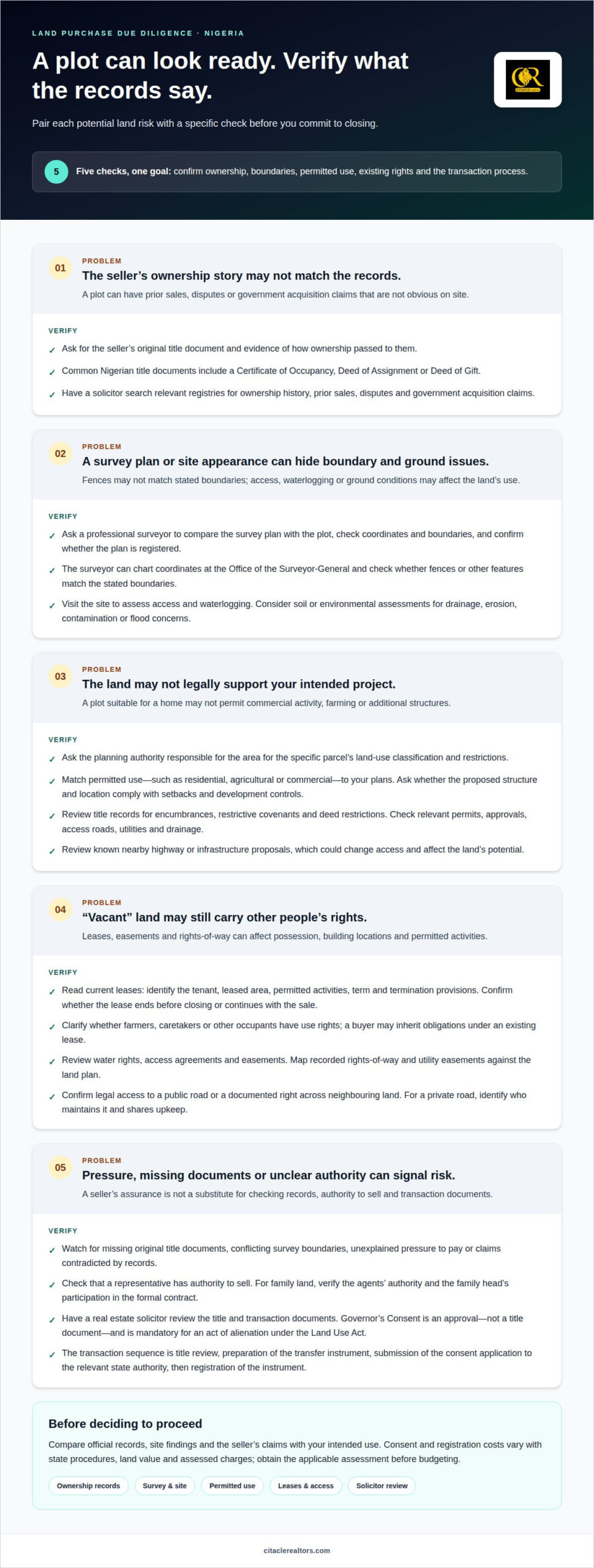
Start with the seller’s original title document and evidence of how ownership passed to them. Common Nigerian title documents include a Certificate of Occupancy, a Deed of Assignment or a Deed of Gift. A solicitor can search relevant registries for ownership history, prior sales, disputes and government acquisition claims.
Ask a professional surveyor to compare the survey plan with the land itself. The surveyor can chart its coordinates at the Office of the Surveyor-General, check whether the plan is registered, and inspect whether fences or other features match the stated boundaries. A site visit can also reveal access problems or waterlogging.
Check the survey and title records for easements or rights-of-way. These may let neighbours or utility companies use part of the land for a road, power line or pipeline, affecting your plans. Inspect drainage and ground conditions; soil or environmental assessments can identify poor drainage, erosion, contamination or flood concerns. For farming, consider soil quality and drainage. Low-lying or wet areas may constrain development.
Governor’s Consent is an approval, not a title document. Under the Land Use Act, it is mandatory for an act of alienation in land. A practical transaction sequence is for a solicitor to review the title, prepare the transfer instrument, submit the consent application to the relevant state authority, then register the instrument. Consent and registration costs vary with state procedures, land value and assessed charges, so obtain the applicable assessment before budgeting.
Warning signs include a seller who cannot produce original title documents, conflicting survey boundaries, unexplained pressure to pay, or claims that the land has no disputes despite contrary records. Check that a representative has authority to sell, and ask neighbours about known disputes. For family land, verify the agents’ authority and the family head’s participation in the formal contract.
Zoning, land-use restrictions, and future development plans
Before buying, establish whether the land can legally support your intended development. A plot suitable for a home may not permit commercial activity, farming or additional structures. Ask the planning authority responsible for the area about applicable land-use classifications and restrictions. Compare its guidance with the seller’s description and your proposed plans.
To check zoning, permitted use, access roads, utilities and development restrictions, consult the relevant planning authority and review applicable land records and approvals. Then assess physical access and nearby infrastructure, such as roads, drainage and utility connections, against your project’s needs.
Request planning information for the specific parcel, not just the wider neighbourhood. Review recorded title documents for encumbrances, restrictive covenants and deed restrictions. These may limit construction, land clearing or other uses even where the general zoning appears suitable. A road easement, for example, could affect where a building can sit.
- Permitted use: Match the official land-use classification to your plans, such as residential, agricultural or commercial use.
- Buildability: Ask whether the proposed structure and its location comply with applicable setbacks and development controls.
- Infrastructure: Check road access, utility connections and drainage needs; missing services may require additional work.
- Future plans: Review known highway or infrastructure proposals nearby, as they could change access and affect the land’s potential.
Include property taxes and recurring obligations in your purchase review. If the seller claims an agricultural tax exemption, examine the supporting records and establish whether that treatment can transfer with the land. Don’t assume the previous owner’s tax status will apply to a new owner or a different land use.
Before committing, compare the planning information and title restrictions with your intended use. If a planning approval, permit or development right is relevant to your project, include its status and any transfer requirements in the transaction review. A gap between the seller’s claims and official records deserves attention before closing.
Review farm leases, water rights and conservation easements
A field that looks vacant may still carry a tenant’s rights or recorded use restrictions. Review every lease, access agreement and easement affecting the land before completing the purchase. These documents can shape when you take possession, which activities you can conduct, and what obligations continue after transfer.
- Read current leases: Identify the tenant, leased area, permitted activities, term and termination provisions. Confirm whether the lease ends before closing or continues with the sale.
- Clarify possession: Check whether farmers, caretakers or other occupants have use rights. A buyer may inherit obligations under an existing lease unless its terms are changed.
- Map easements: Compare recorded rights-of-way and utility easements with the land plan. A road, pipeline or power line may limit where you can build or conduct activities.
- Confirm legal access: Establish that access connects to a public road or rests on a documented right across neighbouring land. If a private road serves the plot, identify who maintains it and shares upkeep obligations.
- Review water arrangements: List wells, streams and irrigation systems tied to the property. Confirm whether related water rights transfer with the land and whether proposed water infrastructure needs permits.
- Check conservation terms: Look for restrictions on clearing, livestock, logging or hunting. Such conditions can affect farming plans and the land’s future use.
For a farm purchase, match lease terms to the intended handover date and planned activities. If a tenant’s agreement remains active, establish whether it allows the use you expect, such as changing crops or accessing irrigation. Written possession terms help clarify the seller’s responsibilities before closing.
Utility easements also deserve practical attention. A buried line may cross a proposed building area, while a shared access route can bring maintenance obligations. Have the recorded documents and relevant plans reviewed together, then resolve unclear rights in the sale terms. Overlooking an access or water restriction can become costly once work begins.
Record every continuing lease, easement and water arrangement in your transaction review. This gives you a clear view of who may use the land after transfer and which rights could shape future plans.
Engaging a real estate solicitor
A real estate solicitor can examine the transaction before you commit, identify title gaps and explain their effect on ownership. In Nigeria, Section 22 of the Legal Practitioners Act provides for a penalty of up to 2 years’ imprisonment for a non-lawyer who prepares an instrument relating to immovable property. Legal drafting and title review belong in a qualified practitioner’s hands.
For family land, verify that the agents have authority to sell and that the family head signs the formal contract. For inherited land, have a solicitor trace the ownership documents and check the authority of anyone acting for the estate. If a legal representative is selling, request and review the power of attorney. For company land, confirm that the people signing are bona fide company officers.
Give the solicitor the title documents, survey plan, draft sale contract and records of any leases or claims. The review should trace the root of title, search relevant registries and identify prior sales, government acquisition, liens or disputes. The solicitor can then provide a written opinion on the issues and whether proceeding to close is appropriate.
- Before signing: Ask for a review of the seller’s identity, authority and ownership documents.
- During the investigation: Have the solicitor compare the contract with title and survey records, and raise defects in writing.
- Before closing: Resolve outstanding objections and confirm the agreed transfer documents and handover requirements.
A contract and deposit may be agreed while the solicitor investigates the vendor’s title, but the contract should explain how title or survey defects affect the transaction. Read the objection and termination terms carefully. If an issue cannot be resolved, those clauses determine whether you must waive the objection or may end the agreement.
For a residential land purchase, explore land purchase options after your solicitor has reviewed the title issues and transaction documents.
Citacle Realtors: Residential Land Sales
Citacle Realtors offers Residential Land Sales for buyers considering a residential plot in Nigeria. After reviewing title, survey, access and permitted use with your solicitor, consider land options that fit your plans. Legal advice remains essential: a real estate firm’s land offering does not replace a solicitor’s title review or a surveyor’s inspection.
Use your findings to clarify what kind of plot you need, where it should be, and what you intend to use it for. This gives your land search a practical direction while keeping legal and physical risks in view.
If you’re ready to explore residential land options, contact Citacle Realtors.
Make your next land decision with clarity
Turn your due diligence checklist for buying land into a decision record, not just a stack of papers. Note each unresolved issue, the document or inspection it relates to, and how it affects your intended use. This makes it easier to distinguish matters that need clarification from those that could change whether the purchase suits your plans.
Once your solicitor has reviewed the legal documents, you can move to the practical next step: finding residential land aligned with your intended use. Citacle Realtors offers Residential Land Sales, alongside Property Management and Facilities Management for property owners. These services address different needs, so focus on the one that fits your plans.
For help exploring residential land options, contact Citacle Realtors today. Take the next step at a pace that allows you to make a considered decision.
Frequently Asked Questions
How do I verify land ownership and title at the state land registry in Nigeria?
Ask a solicitor to conduct a search using the land’s identifying details and the seller’s title documents. Compare registry entries with the documents presented, checking the recorded owner, prior transfers and any registered interests. If names, plot details or transaction records differ, have the discrepancy explained before relying on the title or proceeding with payment.
How can I check for government acquisition, encumbrances, disputes, or court cases on land?
Use the survey coordinates for a charting inquiry at the relevant Surveyor-General’s office to assess possible government acquisition. Have a solicitor search the land registry for recorded encumbrances and review relevant court records for disputes involving the land or seller. Tie the search details to the exact parcel, since similar plot descriptions can cause confusion.
What is a survey plan, and how do I verify land boundaries with the Surveyor General?
A survey plan records a parcel’s location, boundaries and coordinates. A professional surveyor can chart those coordinates with the Office of the Surveyor-General and assess whether the parcel falls within government acquisition. Ask the surveyor to compare the plan with a physical inspection and explain any mismatch between its plotted boundary and visible site features.
What taxes, fees, and other costs should I budget for when buying land in Nigeria?
Build a budget around applicable transaction taxes and charges, title transfer and registration expenses, and professional costs for legal review and surveying. Amounts depend on the state, land value, required approvals and assessed charges. Separate purchase-related payments from ongoing property obligations, and request a written breakdown of expected items before agreeing to the transaction.
Should I hire a property lawyer, surveyor, and valuer, and what should each verify?
Each professional addresses a different risk. A property lawyer examines ownership documents, seller authority, registry records and contract terms. A surveyor checks the plan’s coordinates, boundaries and physical site conditions. A valuer assesses the land’s market value, considering its location, size, access and permitted use. Their separate findings help you judge legal, physical and financial suitability.