

A property’s value isn’t determined by size alone. To understand how to calculate property valuation for a house, a professional considers comparable local sales alongside the property’s location, condition, layout and features. For a shop, rental income and operating costs may also matter. The right approach depends on the property and the purpose of the valuation.
It’s natural to want a clear figure before making a property decision, but an online estimate or asking price may not reflect the property’s current market value. A professional assessment brings relevant evidence together and explains how the property’s specific characteristics affect the estimate.
This guide explains how professionals assess houses and shops in Nigeria, including the sales comparison, income and replacement-cost approaches. You’ll also learn what automated valuation tools can and can’t show, and why the method used matters when interpreting an estimate.
Key Takeaways
- See how comparable sales help a professional estimate a property’s market value, and why differences between properties matter.
- Understand which features of a house can influence its valuation, from condition and layout to location and nearby amenities.
- Learn what the replacement-cost approach accounts for when estimating a building’s value.
- Discover why a shop’s income potential calls for a different valuation perspective, and where automated estimates fit in.
Can a professional use an automated valuation tool for commercial property?
Yes. A professional can use an automated valuation tool to organise market evidence and produce an initial estimate. For a commercial property, however, that estimate is a starting point for research, not a substitute for a professional appraisal. Its usefulness depends on the quality of the comparable sales data and how well the tool accounts for differences between properties.
Under the direct comparison method, the valuer identifies similar properties and analyses their sale prices. For a commercial comparison, three to five solid comparable sales are recommended, preferably from the trailing six to twelve months. A house or shop should be compared with properties sharing relevant features, such as location, size, condition and amenities. A useful comparison seeks properties with at least 70% similar features, then adjusts for differences such as internal condition or outlook.
The market approach uses comparable transactions and market trends to estimate current value. A comparative market analysis can organise local listings and historical sales, but asking prices and completed sale prices aren’t interchangeable. The professional considers what similar properties actually sold for, how closely they match the property being valued, and whether local conditions affect the relevance of those transactions. For example, a shop with different access or condition may need an adjustment when compared with a nearby sale.
Automated tools can speed up this comparison, particularly when records include enough relevant sales. They may be less informative for a commercial property with unusual features, mixed uses or income conditions that comparable sales don’t capture. The professional selects methods that fit the available evidence rather than treating an automated figure as definitive.
A property’s valuation can be reviewed every six to twelve months as prices and market trends change. The right timing also depends on the decision, such as a sale, purchase or investment review.
Valuation fees in Nigeria depend on the property’s type, size, location, complexity and inspection requirements; a quote follows a request. Professionals calculate value using adjusted comparable sales, not a simple average of unrelated prices.
How Does a Professional Calculate the Valuation of a House?
A professional combines a property inspection with evidence about the local market. For an income-producing shop, the estimate may also account for operating income and investment risk.
Factors That Affect Property Value
Property value reflects both the features buyers consider and conditions in the surrounding real estate market. Location, neighbourhood amenities, size, layout, age, condition, fittings and renovations can all influence a house estimate. A well-maintained home with functional rooms may compare favourably with one needing substantial repairs. For commercial property, access to business districts, income potential and future development prospects can also affect value. Interest rates and wider economic conditions influence buyer demand, so estimates for the same property can shift as the market changes.
Value Calculation Using Net Operating Income
The income approach estimates the value of an income-producing property by dividing net operating income by its capitalisation rate. Net operating income is effective gross income minus direct operating expenses; effective gross income accounts for vacancy and credit losses. The calculation is: property value = annual net operating income ÷ cap rate. If operating income stays steady while the cap rate rises, the estimated value falls. This relationship helps buyers assess a shop as an investment instead of relying only on its appearance or asking price.
Market, Fair Market, and Assessed Value
Market value estimates what a property may be worth in the open real estate market, taking location, facilities and market trends into account. Fair market value can be understood as a potential price agreed by a buyer and seller, without necessarily committing either to a sale. An assessed value is assigned for a particular assessment purpose and may differ from current market value. These terms aren’t interchangeable: a house’s asking price, an assessment figure and a professional market estimate can each inform different decisions.
Valuation Roles and Required Documents
For a formal Nigerian valuation, engage a registered estate surveyor and valuer. The surveyor inspects the property, analyses its characteristics and applies suitable valuation methods. To assess a house, the professional needs its location, land and building size, layout, condition, age, fittings and upgrades. Ownership or title information, a survey plan and building details can help identify the property and understand its physical attributes. For a shop, rental and operating information also supports an income-based estimate; incomplete records can limit the evidence available for that calculation.
Cost approach and replacement cost
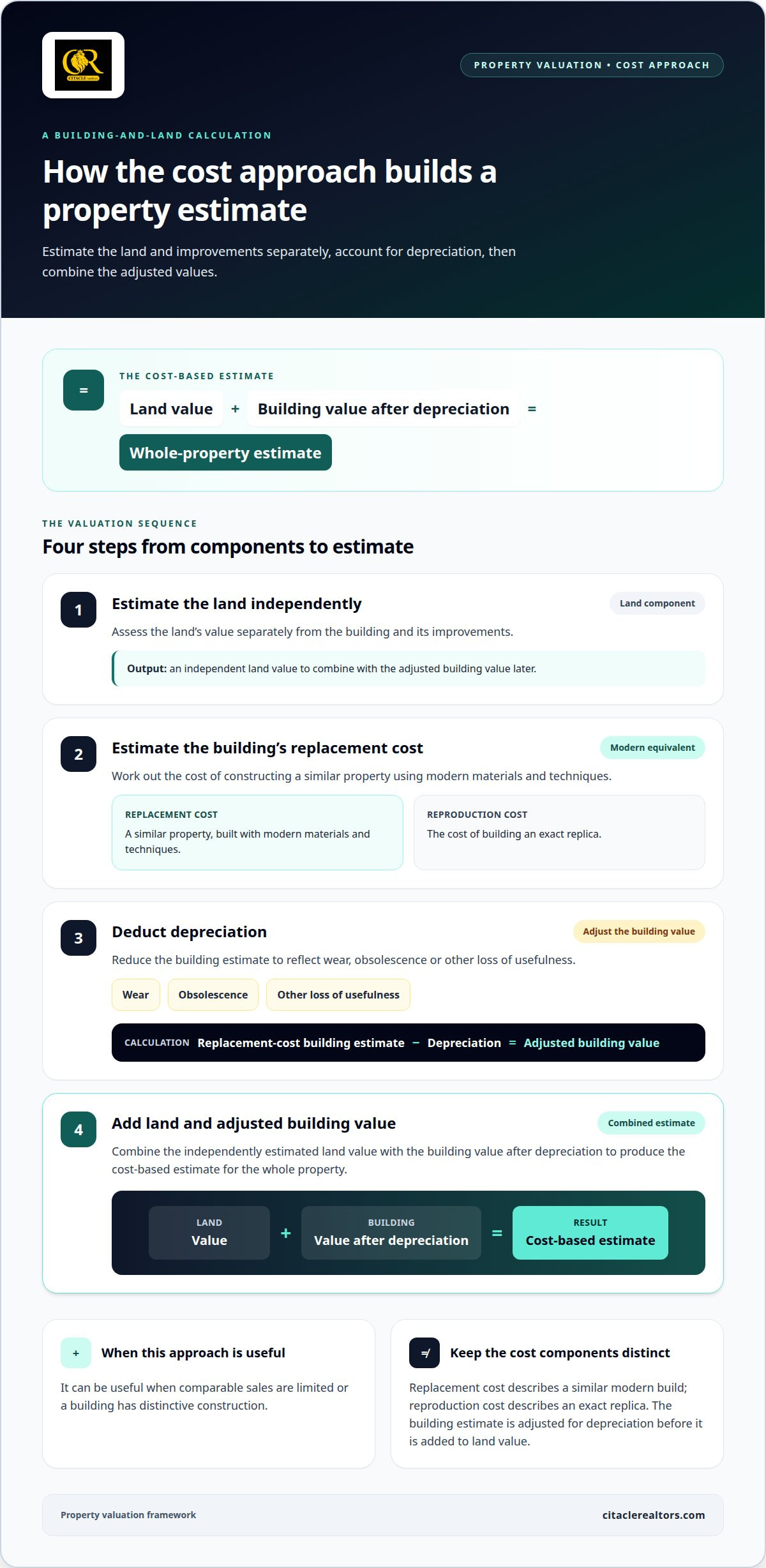
The cost approach estimates a property’s value from the cost of replacing its improvements, less depreciation, plus the land value. It’s useful when comparable sales are limited or a building has distinctive construction. In real estate valuation, replacement cost means constructing a similar property with modern materials and techniques. Reproduction cost, by contrast, estimates the cost of building an exact replica.
To calculate land value and building value separately, a professional estimates the land’s value independently, then assesses the building and its improvements. The building estimate uses replacement cost and deducts depreciation for wear, obsolescence or other loss of usefulness. Adding the adjusted building value to the land value gives the cost-based estimate for the whole property.
Depreciation matters because a new building and an older building don’t provide the same utility. A professional considers the structure’s condition and age, and whether its layout or components have become outdated. Renovations may improve usefulness, but their effect depends on the work and the property. Inspection is therefore essential to an accurate cost approach; construction specifications alone aren’t enough.
The income approach suits real estate that earns rent. Direct capitalisation converts a property’s net operating income into an estimate by dividing income by a capitalisation rate. The professional uses annual income after operating expenses, then applies a rate that reflects expected return and investment risk. A higher cap rate produces a lower estimated value when income stays constant. Interest rates and market conditions can influence investor expectations, but the selected rate must fit the property and available evidence.
Cost and income methods answer different questions. The cost approach focuses on land, construction and depreciation; direct capitalisation focuses on income and return. A professional weighs the method that best fits the property, its condition and its use, rather than assuming one approach will give an accurate result for every property. For a rented shop, income may be central; for a specialised building, replacement cost may provide useful evidence.
Residential and commercial property valuation
Residential and commercial properties call for different emphasis because buyers value different benefits. For a house, the professional considers square footage, bedrooms, layout and curb appeal, then assesses how those features compare with the local market. For a shop, income potential, business-district location and development prospects may carry more weight. The purpose matters too: an investment purchase may require closer attention to income, while a seller may need a market-based estimate.
Residential valuation can use comparable sales to estimate what similar homes indicate, with adjustments for differences in condition, size and features. Hedonic pricing, commonly used to analyse house-and-land prices, separates the influence of individual property characteristics; the United Nations Statistics Division describes its use for this purpose. This helps explain why two houses on the same street can have different values, even when their land areas are similar.
Commercial valuation often considers income alongside market evidence. The gross rent multiplier formula estimates value by multiplying annual gross rental income by a suitable multiplier. The income approach instead divides net operating income by a capitalisation rate, accounting for operating expenses and the return expected from the property. These calculations support investment decisions but answer different questions: gross rent provides a broad screening tool, while net income accounts for expenses.
A professional doesn’t simply average the results from different methods. Each method is weighted according to its reliability for the property and the available evidence. For a rented shop with dependable income, income analysis may be especially relevant; for a property with limited income records, comparable transactions may provide stronger evidence. The approach should fit the property’s use and the reason for the valuation.
For a purchase or sale, the practical takeaway is to match the method to the asset: a family home calls for residential evidence, while a commercial property may require income analysis. Request a professional asset valuation to assess the property using methods suited to its characteristics and purpose.
Citacle Realtors: Asset valuation
Citacle Realtors provides asset valuation for property owners and investors who need a professional estimate to inform a sale, purchase or investment decision. The valuation considers the property’s characteristics and the evidence relevant to its type, helping you understand how its value has been assessed.
A valuation can also support property management decisions by helping owners plan and oversee their assets. Whether you’re assessing a house, shop or other property, a professional valuation gives you a considered basis for your next step.
For support with your property valuation needs, contact Citacle Realtors.
Put Your Valuation to Work
Once you understand how to calculate a property valuation, connect the estimate to a clear property decision. A valuation can help frame discussions about whether to sell, purchase, retain or manage an asset, while keeping its intended use in view.
The decision may lead beyond valuation itself. Property Management and Facilities Management can support ongoing oversight, while Residential Land Sales may be relevant when your plans involve acquiring residential land. Considering these needs alongside the valuation can help you plan a practical next step instead of treating the estimated value as an isolated figure.
For guidance on your next property decision, contact Citacle Realtors about asset valuation. A considered next step can help you move forward with greater clarity and confidence.
Frequently Asked Questions
What Common Valuation Mistakes Cost Investors the Most?
Overstating income or overlooking property-specific costs can distort an investment decision. For investors asking how to calculate property valuation for a shop, starting with gross rent instead of income after vacancies and operating expenses can mislead. Investors can also misread a result by relying on an asking price instead of completed sales, or by using evidence from a property with different access, use or condition.
What are the Commercial Real Estate Appraisal Methods?
Commercial appraisals commonly use sales comparison, income analysis and the cost approach. The most useful method depends on the property and available evidence. For an occupied shop with reliable rental records, income analysis may offer useful investment insight. A specialised building with few close sales may call for more attention to construction and land. A professional can weigh the methods instead of treating every result equally.
What is Property Value?
Property value is an estimate of what a property is worth for a particular purpose and under relevant market conditions. It isn’t automatically the same as the seller’s asking price or a buyer’s offer. For example, a house with recent upgrades may attract a different estimate from a similar home needing repairs. The valuation date and intended use help determine which evidence matters most.
Property valuation vs property appraisal: what’s the difference?
Property valuation is the process of estimating a property’s worth; an appraisal is a particular assessment or opinion of that worth. In everyday property discussions, the terms can overlap, so the document’s purpose matters. A brief agent estimate may help frame a sale discussion, while a formal valuation report is prepared for a defined purpose and explains the evidence and approach behind its conclusion.
What Are Secondary or Quick-Estimate Valuation Methods?
Secondary estimates include automated valuation tools, price-per-area comparisons and gross rent multipliers. They can help screen a property or provide an early reference before a more detailed assessment. For instance, an automated estimate may draw on recorded sales, while a price-per-area comparison can help compare homes of similar size. These shortcuts may miss unusual features, recent renovations or property-specific income risks.
What Are the Three Core Methods for Valuing Commercial Property?
The three core methods are sales comparison, income capitalisation and the cost approach. Understanding how to calculate property valuation with each method helps explain why their results may differ. For a commercial property with established rental records, income capitalisation focuses on earning capacity. Sales comparison is useful when relevant transactions exist, while the cost approach can inform the assessment of a specialised building. The valuer weighs the evidence that best fits the property.