

A lease agreement sets out the terms of a landlord-tenant relationship, including rent, responsibilities, and how the tenancy may end. Understanding common landlord-tenant disputes and solutions starts with knowing what the agreement says and keeping communication clear. In Nigeria, the applicable rules can also depend on the state where the property is located.
Disagreements over rent, repairs, deposits, or unclear terms can unsettle both parties. Reviewing the agreement and having a calm, documented conversation can help move matters forward. This guide explains how clear lease terms and defined repair responsibilities can prevent conflict, and outlines practical steps for resolving disputes. It also clarifies that Rental Housing Tribunals are part of South Africa’s system, alongside dispute-resolution approaches relevant in Nigeria.
Key Takeaways
- Review the tenancy agreement to understand rent obligations, payment expectations and the steps for addressing late or unpaid rent.
- Set out repair responsibilities clearly and keep written records of requests, inspections and completed work.
- Clear terms and prompt, documented communication can help prevent disagreements over rent, utilities, renewals or property changes.
- Use a resolution route that applies to the property’s location; Rental Housing Tribunals are part of South Africa’s system, while Nigerian disputes require locally relevant procedures.
1. What is a lease agreement?
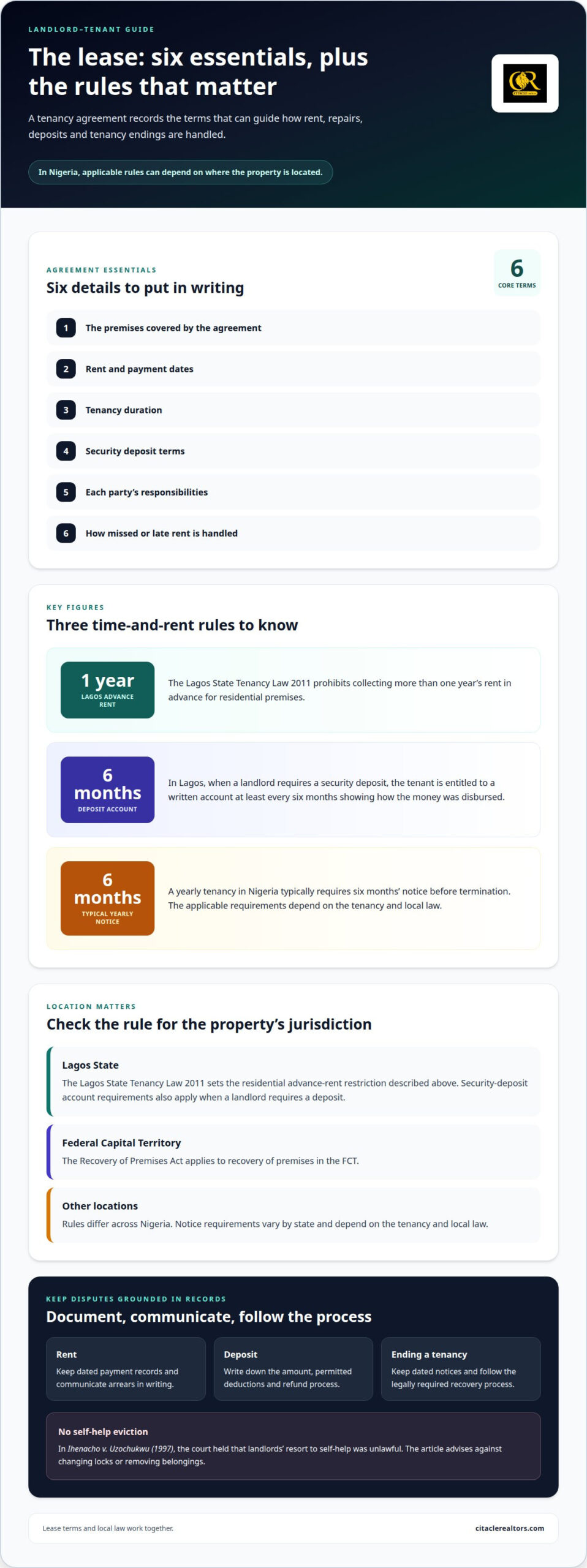
A lease agreement, often called a tenancy agreement in Nigeria, records the terms between a landlord and tenant. It should identify the premises, rent, payment dates, tenancy duration, security deposit terms, and each party’s responsibilities. As a contract, its wording can guide how the parties handle rent conflicts, property damage, inspections, and eviction disputes.
Late or partial rent payments can cause disputes, especially when a tenant faces financial difficulty or withholds rent during another conflict. The agreement should state when rent is due, how to pay, and what process applies if an instalment is missed. A tenant expecting a delay can contact the landlord promptly and propose a practical payment arrangement. Landlords can keep dated payment records and communicate arrears in writing rather than relying on verbal exchanges.
Rules differ across Nigeria, so the property’s location matters. The Lagos State Tenancy Law 2011 prohibits collecting more than one year’s rent in advance for residential premises; in the Federal Capital Territory, the Recovery of Premises Act applies to recovery of premises. A yearly tenancy in Nigeria typically requires six months’ notice before termination, but applicable requirements depend on the tenancy and local law.
The agreement should explain the deposit amount, permitted deductions, and refund process. When a landlord in Lagos requires a security deposit, the tenant is entitled to a written account at least every six months showing how the money was disbursed, according to Lagos State Government. These rules do not set one nationwide deadline for refunds.
For rent arrears, property damage, or nuisance, landlords should document the issue, communicate the breach, and follow the legally required recovery process. In Ihenacho v. Uzochukwu (1997), the court held that landlords’ resort to self-help was unlawful. Clear records, timely notices, and relevant inspections can help address the dispute without changing locks or removing belongings.
2. Maintenance and repair responsibilities
Maintenance disputes often begin when no one is clearly responsible for a repair or there is no plan for responding. A tenancy agreement should assign responsibility for structural issues, essential systems, appliances, routine upkeep, and shared areas. For example, it can distinguish a leaking roof from a blocked drain caused by tenant misuse. Clear terms help both parties act before a minor fault causes further damage.
Tenants should report maintenance issues promptly, describing where the problem is, what damage is visible, and when it began. A dated message about water entering through a ceiling gives the landlord a useful record and helps assess urgency. Landlords can acknowledge the request, arrange an inspection, and document the repair, materials, and completion date. These records provide a clear account if a disagreement later arises.
Property condition matters when deciding whether a cost reflects damage or ordinary wear and tear. Compare move-in and move-out inspection notes, photographs, and repair records. Faded paint from ordinary use differs from a broken door or damaged fixture. Tenants should keep the property in reasonable condition, while landlords should distinguish tenant-caused damage from deterioration over time.
For recurring maintenance, the agreement can explain who handles routine tasks, such as clearing a tenant-caused blockage or maintaining a shared corridor. It should also set out how to report urgent plumbing or electrical faults. Tenants should not assume repair costs can be deducted from rent, as the lease may restrict rent abatement. Written approval and payment records can stop a repair dispute from escalating into a rent-arrears or eviction issue.
Property Management can help coordinate requests, inspections, and repair records across a rental property. For a structured approach to these responsibilities, explore property management support.
3. Miscommunication and clear lease terms
A clear lease agreement sets expectations in writing and reduces disagreements about rent, utilities, renewals, subletting, and property changes. Before signing, both parties should read every clause and clarify ambiguous wording. For example, “tenant handles minor repairs” should specify which tasks that covers. Keep the signed agreement and written follow-up messages together so the record shows what both parties accepted.
Renewal terms should state how and when either party must communicate an intention to renew or end the tenancy. Communicate rent changes at renewal in advance and consider the applicable state rules. Mid-tenancy increases can cause conflict if the lease does not allow them. A written renewal record can capture the new rent, start date, and any revised terms.
Specific restrictions can prevent disputes over lease violations. State whether a tenant needs written permission to sublet, keep a pet, or alter a fixture. Identify who pays each utility and how shared charges are handled. If a tenant installs a new lock or paints a room without approval, refer to the relevant clause before deciding how to resolve the issue. Record any agreement to correct the change.
When ending a tenancy, clear communication and careful attention to the agreement can help avoid disputes. A yearly tenancy typically requires six months’ notice, while notice periods differ between states; some require two weeks, while others require a month or more. In Coker v. Adesanya (1976), the court held that a notice to quit must state the correct tenancy duration and match the parties’ contractual terms. Ibiyemi v. Bamidele (1967) likewise held that a quit notice must comply strictly with the tenancy agreement and relevant laws.
Keep dated copies of notices, renewal messages, inspection reports, and photographs of damage. These records help distinguish agreed deductions from disputed claims and give both parties a factual basis for discussion. If someone challenges the wording or method of a notice, the agreement and correspondence help clarify what was communicated and when.
4. Rental Housing Tribunal dispute matters
The Rental Housing Tribunal belongs to South Africa’s rental dispute system, not Nigeria’s. South African Tribunal matters can include unpaid rent, deposit refunds, neglected maintenance, illegal eviction, or unlawful service disconnection. Under section 13(13) of the Rental Housing Act 50 of 1999, a Tribunal ruling is deemed an order of a Magistrate’s Court. This distinction matters: Nigerian tenants need a resolution route relevant to their property’s location.
In Nigeria, landlords must follow the applicable state’s recovery-of-premises procedure to end a tenancy. Any notice must comply with the tenancy agreement and relevant law, followed by formal proceedings where required. Changing locks or removing belongings is not a lawful substitute for due process. Notice requirements vary, so the tenancy type, agreement, property location, and reason for termination determine the next step.
For unlawful entry, harassment, or utility disconnection, tenants can preserve dated messages, photographs, payment records, and witness details. They can raise the issue in writing, refer to the relevant tenancy terms, and pursue mediation, arbitration, customary resolution, or legal proceedings as appropriate. These are identified options for tenancy disputes in Nigeria; a solicitor can advise how the evidence and local rules apply.
Before court proceedings, organise the lease, rent-payment history, deposit records, notices, repair requests, and a concise timeline. Costs and duration depend on the dispute’s location, evidence, procedural route, and need for legal representation. There is no single cost or timeline for every Nigerian tenancy case. Court action can prolong a disagreement, while mediation may help the parties reach an agreed resolution outside court.
For a rental dispute, first identify the applicable local process and gather the relevant documents. A Rental Housing Tribunal may address complaints in South Africa. In Nigeria, parties should follow locally applicable procedures and consider appropriate resolution options.
Citacle Realtors: Residential Land Sales
Citacle Realtors offers Residential Land Sales for people considering a land purchase as their next property decision. If a tenancy dispute has prompted you to reassess your housing plans, first clarify your priorities, including location, intended use, and whether you are seeking land or a rental home.
For landlords who need help overseeing rental properties, Property Management is a relevant option. Citacle Realtors also offers Duplex Rentals for those seeking a home to rent. These services address different needs, so choose the path that fits your circumstances rather than treating a land purchase as a remedy for an active tenancy dispute.
Please contact Citacle Realtors to discuss your property needs.
Choose a clearer path for your property plans
A tenancy disagreement can prompt a broader decision about how you want to manage, occupy, or invest in property. Rather than letting conflict dictate your next move, consider which arrangement fits your priorities and capacity. Resolving common landlord-tenant disputes starts with clear communication, while your longer-term property plans can shape what comes next.
Citacle Realtors offers Property Management and Facilities Management for property oversight, as well as Residential Land Sales for those considering land ownership. These services address different needs, whether you plan to retain a rental property or explore a separate investment. Choose the next step that matches your goals.
For a discussion about your property needs, contact Citacle Realtors. A considered decision today can help you move forward with greater clarity and confidence.
Frequently Asked Questions
What is a lease agreement?
A lease agreement records the terms under which a landlord lets a property to a tenant. Alongside rent and tenancy duration, it can identify the premises, permitted use, included fixtures, utility arrangements, and how notices must be delivered. For example, an attached inventory can record furniture or appliances at move-in. Both parties should keep the complete signed agreement, including schedules and later written amendments.
What is the first step in solving landlord and tenant disputes?
Start by identifying the specific issue and the outcome each party wants. A tenant disputing a charge can set out the amount, date, and reason they believe it is incorrect. The landlord can respond to those points and propose a specific remedy. Keeping the discussion focused on one issue at a time makes it easier to reach agreement or identify what remains contested.
What are the most common landlord-tenant disputes in Nigeria?
Common conflicts involve late rent, proposed increases, repair delays, deposit deductions, property damage, noise, and disagreements about ending a tenancy. One issue can trigger another: an unresolved leak may lead a tenant to question rent payments, while a disputed deduction may arise after move-out. Understanding common landlord-tenant disputes and solutions helps both parties separate the original concern from related disagreements.
What does Nigerian law say about rent increases and rent review?
Rent changes depend on the tenancy agreement and applicable state rules. During a fixed term, a landlord should not increase rent unless the agreement allows it. At renewal, communicate a proposed change in advance and review the renewal terms. A tenant who receives a new rent demand can compare it with the existing agreement and raise any disagreement in writing before accepting revised terms.
Who is responsible for repairs and maintenance under Nigerian tenancy law?
The tenancy agreement is a practical starting point for identifying who handles particular repairs, but parties should also consider the rules that apply where the property is located. For example, the agreement may assign routine upkeep to the tenant while setting out how to report a faulty roof or plumbing. Clear reporting, access arrangements, and records of completed work help establish how the parties handled each issue.
How are tenancy disputes resolved through mediation, tribunals, or courts in Nigeria?
In Nigeria, parties can first seek a negotiated settlement, then consider mediation, arbitration, customary resolution, or court proceedings, depending on the dispute. The Rental Housing Tribunal discussed in this article belongs to South Africa’s system, so it should not be treated as Nigeria’s national tribunal. For court action, organise the agreement, payment records, notices, and supporting evidence; a solicitor can advise on the relevant local procedure.