

Land ownership in Nigeria is shaped by rights of occupancy, not outright private ownership of land. Understanding the Land Use Act in Nigeria starts with its central rule: enacted in 1978, it vests land in each state in the governor, in trust for the use and common benefit of Nigerians. The Act also provides for compensation when government acquires land for public purposes.
It’s understandable to focus on what these rules mean for the security and cost of owning property. Costs and compensation can vary depending on the transaction and the circumstances of an acquisition. This guide explains how the Act shapes land administration, what can add cost and delay to transactions, how acquisition compensation works, and where property owners may find both opportunities and challenges. You’ll gain a clearer foundation for assessing how the rules affect your property decisions.
Key Takeaways
- Understand how rights of occupancy shape landholding and the governor’s role in administering land across each state.
- Learn what compensation may apply when government acquires land for public purposes and how owners can challenge an amount in court.
- Plan for transaction costs and administrative steps, including the role of Governor’s Consent and government agencies in title transfers.
- Recognise the Act’s aims alongside practical challenges, so you can make more informed property decisions and identify when professional guidance may help.
Compensation for government land acquisition
Under the Land Use Act, land in each state is vested in its governor, held in trust for Nigerians’ use and common benefit. Section 1 of the Land Use Act 1978 establishes this arrangement. Individuals hold rights of occupancy to use and occupy land under applicable terms and conditions. A clear understanding of the Land Use Act in Nigeria helps property holders distinguish their occupancy rights from outright ownership.
Section 28 of the Land Use Act 1978 empowers a governor to revoke a right of occupancy in specified cases. When government acquires land for public purposes, the Act provides for compensation. The amount depends on the applicable statutory assessment; it should not be assumed to equal the property’s full sale price. A compensation assessment may be disputed, and seeking advice can help clarify the available options.
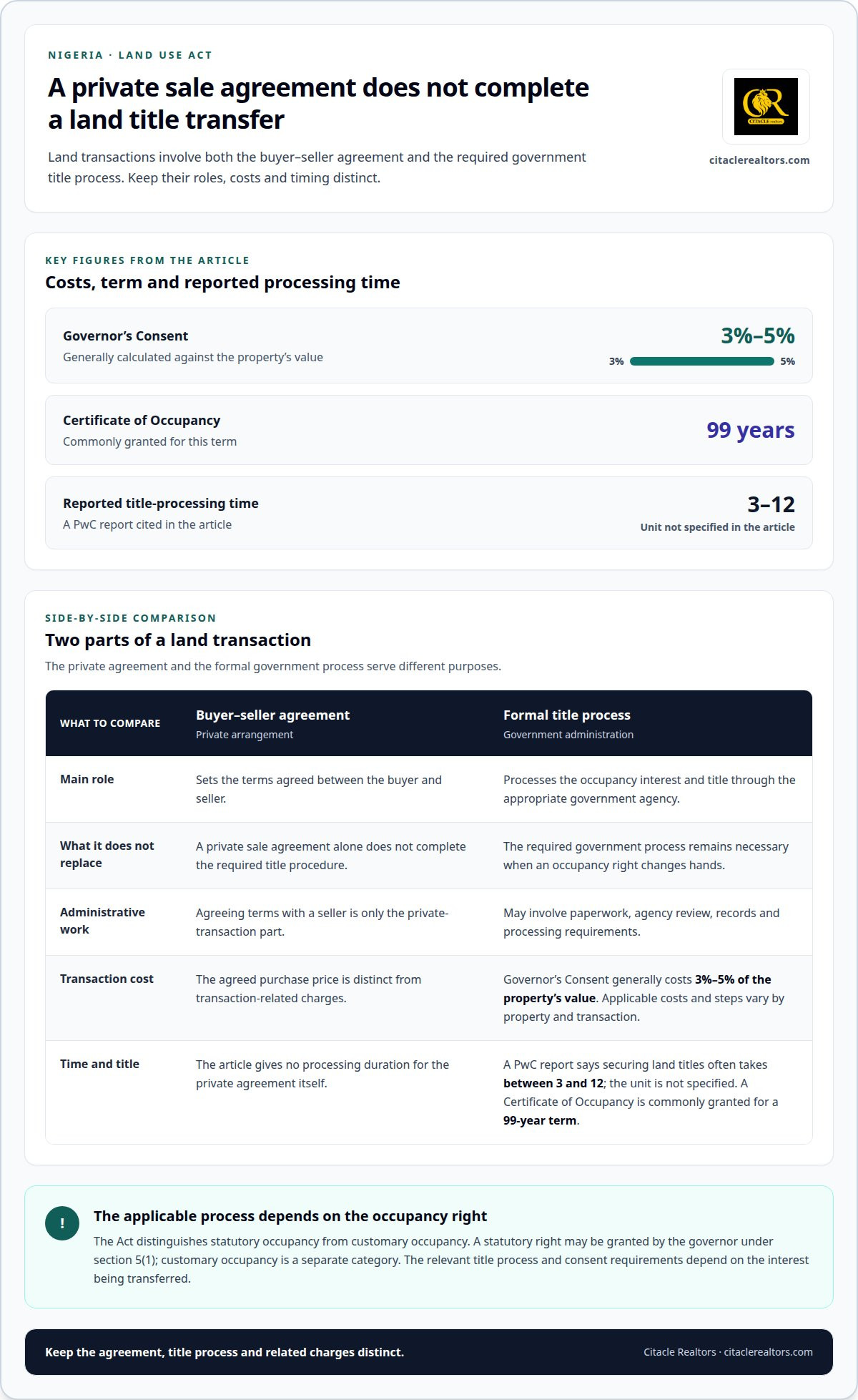
Governor’s Consent forms part of Nigeria’s land-administration framework, while the relevant government agency handles title processes. The Land Use Act requires titles to be obtained and transferred through the appropriate government agency. When an occupancy right changes hands, a private agreement alone does not replace the required government process. State land offices and agencies manage records and applications under the governor’s administration.
Customary land rights remain subject to the Act’s occupancy framework and its terms. Inheritance does not convert a right of occupancy into unrestricted ownership; the inherited interest remains tied to the relevant occupancy conditions. Local government responsibilities relate to local land administration, but the governor’s authority and state agencies remain central. For urban land, the Land Use and Allocation Committee advises the governor under section 2(2).
If you dispute a land allocation or revocation, seek legal advice about challenging the decision in court, supported by relevant records. The Act expressly allows owners to challenge compensation amounts. In a dispute over an allegedly wrongful allocation, the specific claim and evidence matter. Understanding the Land Use Act in Nigeria can help owners recognise when legal advice may support their interests.
Costs and bureaucracy in land transactions
A governor may grant statutory occupancy under section 5(1) of the Land Use Act 1978. Customary occupancy is a distinct right, and title applications and transfers must pass through the appropriate government agency.
Obtaining and Transferring Land Titles
Obtaining or transferring a land title means processing the occupancy interest through the appropriate government agency. This process matters because a private sale agreement does not replace the government’s title procedure. A Certificate of Occupancy is commonly granted for a term of 99 years. The relevant agency’s records and processing requirements shape the transaction, so applicants should allow for administrative steps beyond agreeing terms with a seller.
Title work can involve paperwork, agency review and associated transaction costs. The Land Use Act requires titles to be obtained and transferred through the appropriate government agency. That requirement applies to the formal title process, not merely to the buyer and seller’s private arrangements. A PwC report states that securing land titles in Nigeria often takes between 3 and 12, although it does not specify the unit.
Consent in Land Transactions
Governor’s Consent is an approval associated with a land transaction involving an occupancy right. It matters because consent is part of formalising a transfer, alongside processing the title through the appropriate agency. Obtaining Governor’s Consent generally costs between 3% and 5% of the property’s value. For a transaction, this percentage can materially affect the funds needed beyond the agreed purchase price.
Costs and processing steps vary according to the property and transaction documents. Buyers should distinguish the purchase price from transaction-related charges, including consent costs. The relevant state agency manages title procedures, while the governor’s statutory powers underpin the consent framework. Because consent costs are linked to property value, a change in valuation can affect the expense even when other transaction details remain similar.
Statutory rights are granted by the governor under section 5(1); customary occupancy rights fall under a separate category governed by the Act. That distinction helps explain why the applicable title process and consent requirements depend on the interest being transferred.
Land administration and the objectives of the Act
The Land Use Act reorganised land administration in Nigeria and shaped how individuals hold rights to land. Its history helps explain the balance between public oversight, access and tenure security.
Background of the Act
The Land Use Act was enacted in 1978, against a backdrop of changing land pressures and fragmented tenure arrangements. The Public Lands Ordinance was introduced in Nigeria in 1903, while rapid urbanisation and industrial growth by the late 1960s and early 1970s increased demands on land. Before the Act, tenure systems could encourage fragmented ownership, speculative hoarding and imprecise documentation. This background matters because the Act sought a coordinated framework for managing competing land interests.
Objectives of the Act
The Act aims to make land more accessible, simplify management and ownership, support government development, improve tenure security, and curb speculative purchases of communal land. It also seeks efficient land use and to prevent land speculation. These objectives help explain why land rights operate within an administrative system rather than as unrestricted private ownership. For property holders, the intended balance is clearer oversight alongside recognised rights to occupy and use land. Section 6(2) also sets limits on customary rights of occupancy for agricultural use and grazing unless the governor consents.
Land Administration Under the Act
Land administration under the Act assigns defined roles to state governors and government bodies. Section 1 vests land in each state in the governor, in trust for Nigerians’ use and common benefit. Under section 2(2), the Land Use and Allocation Committee advises the governor on urban land management. Section 5(1) empowers a governor to grant statutory rights of occupancy. These responsibilities shape how land is allocated and administered across each state.
Other provisions address specific situations. Section 34(2) covers people holding developed urban land when the Act commenced, treating their holding as if the governor issued a statutory right of occupancy. Section 46(1) provides for implementation regulations. Section 315 of the 1999 Constitution integrates the Act into the Constitution, making amendment subject to the constitutional amendment process.
Challenges and opportunities for property owners
Common risks include unclear documents, competing claims and discrepancies between a seller’s account and agency records. Due diligence means reviewing the title and transaction records through the appropriate government agency and seeking legal advice before buying.
Risks When Buying Land
Land purchases can be complicated by imprecise records, fragmented ownership or competing claims. These issues reflect problems associated with earlier tenure arrangements in Nigeria, including unclear documentation and uncoordinated land transfers. The scale of title coverage adds another consideration: fewer than 5 per cent of land in Nigeria is covered by the certificate of occupancy regime. That figure makes it unwise to treat one certificate as the only measure of an interest in land.
Before buying, understand what right the seller claims to transfer and how that interest is recorded. If a document does not match the claimed interest, the transaction and future use of the land may be uncertain. Under the Land Use Act’s occupancy framework, the nature and terms of the right matter, not simply the fact that the land is offered for sale.
Due Diligence Before Purchase
Due diligence involves reviewing the claimed interest in a property, its supporting records and its transaction history before purchase. This matters because the seller’s account may not match the records held by the appropriate government agency. First identify the interest being offered, then review the title documents alongside available transaction records. Seek legal advice to assess the documents, the seller’s authority and the applicable requirements.
Focus your review on the specific parcel and the right being transferred. For example, if the seller presents a Certificate of Occupancy, compare its details with the land and the transaction records available through the relevant agency. Resolve any discrepancies before proceeding rather than treating them as minor paperwork issues. This helps you understand both the opportunity and the limits attached to the land interest.
For support with property decisions and ongoing oversight, take the next step on your property plans.
Citacle Realtors: Residential Land Sales
Citacle Realtors offers Residential Land Sales for people considering a land purchase in Nigeria. If you’re weighing a property opportunity against the Act’s occupancy framework, explore residential land options with a clear understanding of your intended use and ownership goals.
After acquisition, Property Management can support ongoing oversight of a property, while Facilities Management addresses the operation of its facilities. These services meet different needs: land buyers may be focused on acquisition, while property owners may need management support over time. The right next step depends on your plans for the property.
Please contact Citacle Realtors to discuss your residential land requirements.
Make your next property decision with clarity
Understanding the Land Use Act in Nigeria can help you approach property decisions with a clearer sense of the rights and responsibilities involved. Connect your plans for a property with the practical support you need, whether you’re considering residential land or managing an existing asset.
Citacle Realtors offers Residential Land Sales, Property Management and Facilities Management. These services support different stages of a property journey, from considering a land purchase to overseeing a property and its facilities. Choose the service that fits your current plans and contact Citacle Realtors to discuss your next step.
Contact Citacle Realtors for assistance with your property plans. A considered next step can help you move ahead with greater confidence.
Frequently Asked Questions
What is the Land Use Act of 1978 in Nigeria and what does it provide?
The Land Use Act of 1978 provides Nigeria’s framework for administering land and recognising rights of occupancy. It places land in each state under the governor’s trusteeship for Nigerians’ use and common benefit, while allowing individuals to occupy and use land under applicable terms. It also addresses allocation, revocation and compensation, so a property interest is defined by its legal conditions, not simply possession.
What powers do state governors and local governments have over land under the Act?
State governors administer land in their states and may grant statutory rights of occupancy. The Act also empowers governors to revoke occupancy rights in specified cases. For urban land matters, the Land Use and Allocation Committee advises the governor. Local government roles concern customary land administration; the relevant land category and procedures determine how an application or allocation is handled.
What is a Certificate of Occupancy (C of O) and how do you obtain one in Nigeria?
A Certificate of Occupancy is a document evidencing a right to occupy land under the applicable land administration framework. To seek one, apply through the relevant state government land agency, which handles title matters and the required application process. Requirements depend on the land and the agency’s procedure. A C of O is commonly granted for a term of 99 years, subject to its terms.
How do you transfer, sell, or mortgage land under the Land Use Act?
A transfer or sale involves documenting the transaction and processing the title through the appropriate government agency. The interest being transferred, its existing terms and applicable consent requirements affect the process. A mortgage also concerns the rights attached to the land; it does not convert occupancy into unrestricted ownership. Have a legal professional review the title and transaction documents to ensure the proposed deal reflects the interest actually held.
When is governor’s consent required for land transactions, and how do you apply?
Governor’s Consent is relevant to transfers of land interests when the applicable title and procedure require it. The relevant state land agency handles the application as part of the title-transfer process. Required documents and steps depend on the property’s records and the transaction. Confirming the type of occupancy right and the applicable state process helps clarify what the application must cover.
How are land rent, consent fees, and other charges calculated across Nigerian states?
Charges depend on the applicable state process, the land interest and the transaction. Consent fees are generally linked to property value, while land rent and other charges follow relevant administrative requirements. Request an itemised assessment from the responsible government agency before budgeting, and distinguish government charges from the property’s purchase price. This clarifies which costs relate to title processing and which arise from the transaction itself.