

A building can keep running while small maintenance problems quietly become costly disruptions. If you’re asking what do facility management companies do, the short answer is that they coordinate the people, processes, and building services needed to support day-to-day operations. The exact work depends on the property and, importantly, the service agreement.
It’s understandable to expect one provider to take charge of every building issue, but facility management doesn’t automatically include leasing, tenant relations, cleaning, security, or every repair. Those responsibilities need to be confirmed. Without clear boundaries, owners can be left unsure who handles a problem, how work is approved, and what updates they should receive.
This guide explains common facility management duties and service areas, then clarifies how facility management differs from property management. It also covers what to define in a service agreement, including responsibilities, reporting, and the limits of the provider’s role. Citacle Realtors provides day-to-day operational oversight for residential and commercial assets. Confirm the specific tasks and responsibilities directly with the provider.
Key Takeaways
- Learn what do facility management companies do and how an agreed scope shapes the building operations and services they coordinate.
- Identify common areas of oversight, while checking whether the provider coordinates specialist work or performs it directly.
- Compare facility management with property management to see which service best fits your property’s needs.
- Use a practical sequence to define priorities, assign responsibilities, and agree on clear reporting before engaging a provider.
- Recognise when recurring service issues may call for professional oversight, and clarify decision-making and owner involvement.
What Facility Management Companies Do for Buildings
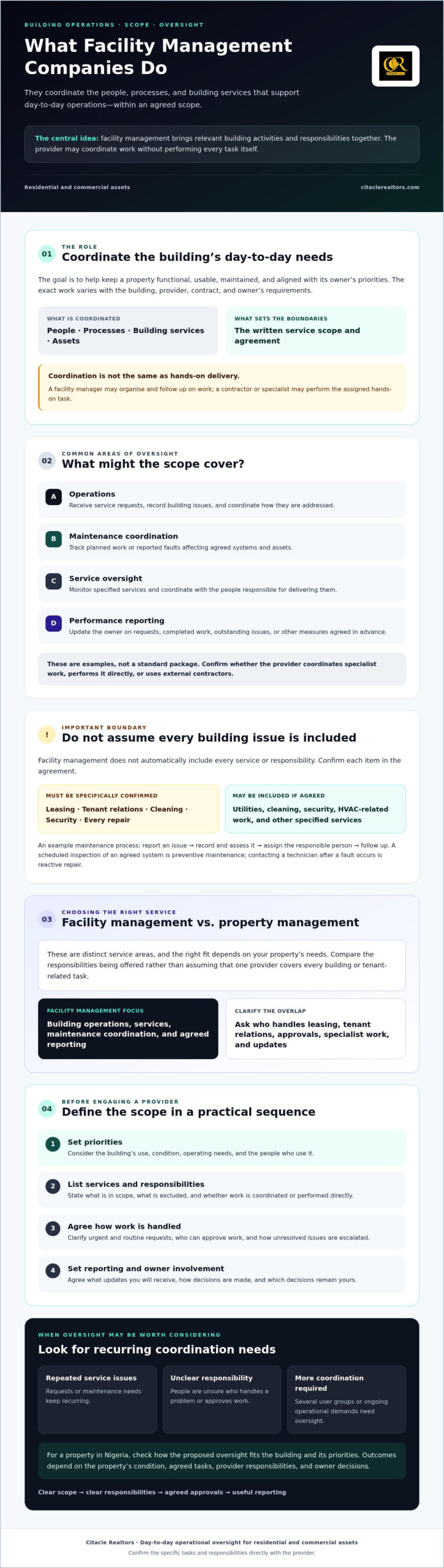
Facility management companies coordinate building operations, services, and assets within an agreed scope. In practical terms, facility management is the organised oversight of a building’s day-to-day needs so it can serve the people who use it. If you’re asking what do facility management companies do, their role is to bring relevant activities and responsibilities together, not necessarily to perform every task themselves. A broader overview of facility management also describes its connection to buildings, people, and operational processes.
The aim is to help keep a property functional, usable, maintained, and aligned with its owner’s priorities. The precise work varies with the building, provider, contract, and owner’s requirements. One agreement may focus on coordinating daily operations; another may define different responsibilities. The written scope sets those boundaries.
Which buildings and stakeholders may need facility management?
Residential and commercial properties may both need coordinated oversight. People involved can include owners, occupiers, tenants, staff, contractors, and service providers, each with different needs. A residential building’s operating priorities may differ from those of a workplace or another commercial property.
Building size, use, condition, and operating needs all influence the scope. A property with several user groups or recurring operational demands, for example, may need more coordination than one with simpler needs. These factors help owners identify what support to request, but they don’t determine which tasks a provider will include.
What outcomes should the service support?
A well-defined service should support practical outcomes: operations that are easier to coordinate, spaces that remain usable, maintenance needs that receive appropriate attention, and a better-organised experience for occupants. It can also help owners track asset care by making responsibilities and operational priorities clearer.
These are intended outcomes, not guaranteed results. The property’s condition, agreed tasks, provider responsibilities, and owner decisions all matter. Confirm how maintenance needs will be identified and communicated, what work is in scope, and which decisions remain yours. If you’re considering a provider in Nigeria, ask how its proposed oversight fits your property and priorities before agreeing to the service.
What Tasks Can a Facility Management Company Handle?
The answer to what do facility management companies do depends on the agreed scope. A provider may organise day-to-day operations, coordinate maintenance, oversee agreed services, and report on building performance. The work may involve in-house staff, external contractors, or both. The International Facility Management Association’s What is Facility Management? overview provides useful context, but your contract determines the provider’s specific responsibilities.
What task areas might the scope cover?
- Operations: receiving service requests, recording building issues, and coordinating how they are addressed.
- Maintenance coordination: tracking planned work or reported faults affecting agreed systems and assets.
- Service oversight: monitoring specified services and coordinating with the people responsible for delivering them.
- Performance reporting: updating the owner on requests, completed work, outstanding issues, or other measures agreed in advance.
These are examples, not a standard package. A company may coordinate work without directly employing every specialist who carries it out. The facility manager coordinates and follows up; the contractor performs the specialist hands-on work assigned to them.
How do operations and maintenance coordination work?
A process may begin when an occupant or owner reports an issue. The provider can record the request, assess its priority, assign it to the responsible person, and follow up. For example, arranging a scheduled inspection of an agreed building system is preventive maintenance; contacting a technician after a fault occurs is reactive repair. HVAC equipment is one possible example, but its inclusion depends on the contract.
Owners should clarify how urgent and routine requests are classified, who can approve work, and how unresolved issues are escalated. These details show everyone who is responsible for the next step.
Can facility management include utilities, cleaning, or security?
It may, if those responsibilities are specifically agreed. Utilities oversight and soft services such as cleaning and security aren’t automatically included in every facility management arrangement. Ask who supplies staff and materials, what the provider monitors, how service issues are reported, and who handles incident escalation.
For any proposed facilities management support, confirm the tasks and reporting directly with the provider rather than assuming a particular service is included. A clear scope gives owners and service teams a shared understanding of what is coordinated, what is delivered, and what remains outside the agreement.
Facility Management vs. Property Management: What Is the Difference?
Facility management focuses on how a building and its agreed services operate. Property management is generally more owner-facing, with responsibilities that may include overseeing tenancies and rental-related matters. The distinction matters because arranging a response to a building issue isn’t the same as managing the landlord-tenant relationship. IFMA’s overview of what is facility management offers useful context for the operational side of the comparison.
| Area | Facility management | Property management |
|---|---|---|
| Primary purpose | Coordinate building operations and agreed services. | Oversee the property on behalf of its owner. |
| Typical focus | Operational needs, service coordination, and the building’s use and care, as defined by contract. | Tenancy and rental-related responsibilities, where included in the agreement. |
| Who the service supports | Owners, occupiers, tenants, staff, and others using or working with the building. | Primarily the owner, while also handling agreed matters involving tenants. |
These are broad distinctions, not fixed packages. A provider may offer both services, but they remain separate areas of responsibility. Ask for each service to be described and documented rather than assuming one contract includes the other.
Where do the two services overlap?
A maintenance issue can involve both roles. If a shared building system develops a fault, facility management may coordinate the operational response if that task is in scope. Property management may separately handle communication with the owner or tenant, depending on its agreement. Clear handovers can help prevent missed updates, but this overlap doesn’t mean every provider offers both services.
Which service should an owner ask about?
Start with the problem you need addressed. Is your main concern building performance, tenant administration, rental oversight, or a combination? If you’re unsure what do facility management companies do compared with a property manager, describe the issue and ask who would be responsible for each step.
Before engaging a provider, confirm the responsibilities, exclusions, reporting lines, and escalation arrangements. Clarify who receives an issue, who coordinates a response, who updates you, and which decisions remain yours. If rental and tenancy oversight is your focus, Citacle Realtors’ Professional Residential Property Management Guide covers that separate topic.
How to Assess a Facility Management Company’s Scope
A clear scope shows what you’re asking a provider to coordinate and what remains your responsibility. Rather than relying on a broad service label, assess the proposed work against your property’s actual needs. To clarify what do facility management companies do for your building, use this sequence before agreeing to an engagement:
- Define your needs. List recurring issues, essential building systems, user groups, and the outcomes you want the service to support.
- Inspect the scope. Match each need to a task in the written proposal, or ask how it will be handled if it isn’t included.
- Assign responsibilities. Establish who receives requests, coordinates contractors, approves work, and communicates with occupants.
- Agree reporting. Decide which records and updates you’ll receive, from whom, and how often.
- Review performance. Set a suitable review process and agree how concerns, unresolved tasks, or changing needs will be addressed.
Evaluate written responsibilities, not broad service labels. A detailed agreement helps you identify what the provider has accepted, what is excluded, and where your involvement is required.
What should a clear service scope specify?
Ask the provider to identify included tasks, excluded work, service frequency, responsible parties, and approval requirements. Find out how requests are recorded, prioritised, communicated, and closed. The scope should also explain how extra work is proposed and approved, how specialist contractors are coordinated, and who can be contacted to escalate an urgent issue. These details make responsibilities clearer when a new need arises.
Which records and performance updates should owners discuss?
Ask what documentation may be shared, such as maintenance records, inspection notes, issue logs, and updates on open or completed requests. Agree on a reporting frequency that suits the property and identify the measures you’ll use to review the arrangement. For example, you might ask to see outstanding requests or planned work if those items are within scope. Don’t assume a particular report or performance target is included unless the provider confirms it in writing.
If the proposed work touches on applicable Nigerian requirements, confirm the relevant obligations with a qualified professional. General service descriptions aren’t a substitute for checking legal responsibilities.
Before signing, ask the provider to walk through a typical request from initial report to resolution, including approval, contractor involvement, updates, and escalation. If you’re considering professional oversight for a residential or commercial asset, discuss facility management scope with Citacle Realtors and confirm directly which responsibilities fit your needs.
When to Consider Professional Facility Management in Nigeria
Professional facility management may be worth considering when building operations are becoming difficult to organise consistently. The question of what do facility management companies do matters most when recurring needs, multiple service providers, or unclear responsibilities are affecting how a property is cared for. This can apply to residential and commercial properties across Nigeria, though the right arrangement depends on the building and its owner’s requirements.
What signals that a property may need coordinated oversight?
Look for patterns rather than a single inconvenience. Repeated maintenance requests, fragmented contractor communication, unresolved issues, or limited records of work can point to a need for better coordination. These signs don’t automatically mean you need ongoing management. A one-off repair, for example, may be handled as a standalone task rather than a reason to engage continuing oversight.
Consider the property’s condition and operating needs alongside your own capacity. Ask whether someone has the time and information to track requests, coordinate the people involved, and follow up. If responsibilities are already clear and needs are occasional, a broader arrangement may not be necessary. If recurring issues are difficult to track, professional oversight may be worth assessing.
What is the next step for an owner?
Prepare a short property overview before speaking with a provider. Include the building’s use and condition, recurring concerns, essential systems, groups who use the property, and the outcomes you want to support. Then ask about scope: which tasks are included, what is excluded, who can approve work, how updates are shared, and where your involvement is expected.
Review these points against any proposed service. A provider should explain how its suggested scope relates to your needs, but confirm the responsibilities and reporting arrangements directly. For broader context, the Facility Management Services in Nigeria: 2026 Guide may also help you frame your questions.
If you’re ready to explore whether professional oversight suits your property, you can discuss your facility management needs with Citacle. Citacle provides day-to-day operational oversight for residential and commercial assets; confirm directly which tasks are currently available and whether the proposed scope fits your requirements.
Make Your Next Property Decision with Clarity
Knowing what do facility management companies do helps you decide whether coordinated building oversight fits your property. Responsibilities depend on the agreed scope, so confirm which tasks are included, what remains yours, and how work and performance will be reported.
Keep the distinction clear: facility management focuses on building operations and agreed services, while property management may cover tenancy and rental-related responsibilities. A provider may offer both, but each service should have defined duties and boundaries. Clear expectations help owners make informed decisions and support the property’s ongoing functionality and care.
Citacle provides facilities management for residential and commercial assets, including day-to-day facility operations and professional oversight. Confirm directly which responsibilities are available and whether they suit your needs. Discuss your property and facility management needs with Citacle.
Frequently Asked Questions
What do facility management companies do on a daily basis?
Facility management companies coordinate day-to-day building operations within the responsibilities set out in their agreement. In practical terms, what do facility management companies do may include receiving service requests, recording issues, arranging agreed maintenance, following up on work, and updating the owner. Activities depend on the property and contract. A provider may coordinate specialists without employing them or performing every service itself.
What services are usually included in facility management?
There isn’t one standard package. Depending on the agreement, facility management may include operational coordination, maintenance planning, contractor oversight, utilities monitoring, or performance reporting. Cleaning and security may also be included if specifically agreed, but they aren’t automatic parts of every service. Before engaging a provider, ask for a written list of included tasks, exclusions, service frequency, approval requirements, and reporting arrangements. Then compare the proposed scope with your property’s needs.
What is the difference between facility management and property management?
Facility management centres on building operations and the coordination of agreed services. Property management is generally owner-facing and may include tenancy, rental, or other property-related responsibilities, depending on its agreement. A maintenance issue can involve both: one provider may coordinate the operational response, while another handles communication with the owner or tenant. A company may offer both services, but confirm each role, responsibility, and reporting line separately.
Can a facility management company coordinate repairs and contractors?
Yes, if contractor coordination and the relevant repair process are included in the agreed scope. A provider may record a reported fault, contact or assign a suitable specialist, track progress, and update the owner. Coordination doesn’t necessarily mean the facility management company employs the contractor or performs the repair. Confirm who selects and approves contractors, who authorises work, how extra work is handled, and how unresolved issues are escalated.
Do facility management companies handle cleaning, security, and utilities?
They may coordinate these services when the owner and provider explicitly include them in the agreement. Cleaning and security aren’t universal facility management duties, and utilities oversight also varies by contract. Ask who supplies staff and materials, what is monitored, how service problems are reported, and who handles incident escalation. Check whether the provider coordinates a third-party service or delivers it directly, and make sure that distinction is clear in writing.
When should a property owner hire a facility management company?
Consider professional oversight if recurring building issues, fragmented contractor communication, or unclear task ownership are making operations difficult to coordinate. Assess the property’s condition and operating demands, along with your capacity to manage requests and follow up. An isolated repair may not justify an ongoing arrangement. Before deciding, identify the support you need and confirm the provider’s scope, your decision-making responsibilities, reporting expectations, and any work outside the agreement.
How can I assess a facility management company in Nigeria?
Start by listing your property’s recurring concerns, essential systems, users, and priorities. Review the written scope for included tasks, exclusions, responsible parties, approvals, contractor coordination, reporting, and escalation processes. Ask what records and performance updates you can expect, then confirm applicable Nigerian requirements with qualified professionals. Citacle Realtors provides facilities management and day-to-day operational oversight for residential and commercial assets; confirm directly which specific tasks are currently available and included in a proposed agreement.