

In Nigeria’s evolving real estate market, a handshake and a payment receipt are no longer enough to protect your future. We understand the deep anxiety that comes with investing your hard-earned capital, especially when the fear of “Omonile” interference or sudden government acquisition looms in the background. Understanding the specific documents needed to buy land in Nigeria is the only way to transform that uncertainty into absolute confidence. It’s about more than just owning a plot; it’s about the perfection of your title through a recognized hierarchy of legal proof.
You deserve a transition into land ownership that feels secure, transparent, and professional. In this 2026 verification guide, we’ll demystify the complex world of Nigerian land titles, from the Certificate of Occupancy to the latest digital Gazette updates. You’ll gain a comprehensive documentation checklist and learn exactly how to verify these papers with government authorities. We’ll also explore how to navigate the new Fair Market Value frameworks and electronic portals with ease. By the end of this article, you’ll have the expert knowledge required to secure a verified investment that stands the test of time.
Key Takeaways
- Discover why legal documentation serves as your only true protection against common property scams and land grabber interference.
- Access a definitive checklist of the documents needed to buy land in Nigeria, focusing on the critical survey plan and state ministry search.
- Master the hierarchy of land titles so you can distinguish between a Certificate of Occupancy and a Right of Occupancy with ease.
- Learn the perfection process required to move your ownership from a simple purchase receipt to a legally binding Deed of Assignment.
- Understand how expert asset valuation and a rigorous verification protocol ensure you’re investing in land that’s both safe and fairly priced.
Why Land Documentation is Your Only Shield Against Scams in Nigeria
In the Nigerian property market, a beautiful plot with a cleared perimeter and a friendly seller can often be a mirage. You might stand on the soil, but without the right papers, you don’t truly own it. Legal ownership is entirely paper-based. The government doesn’t recognize physical presence as proof of ownership; it only recognizes specific, verified records. If your name isn’t in the official registry, you’re essentially a squatter on your own investment.
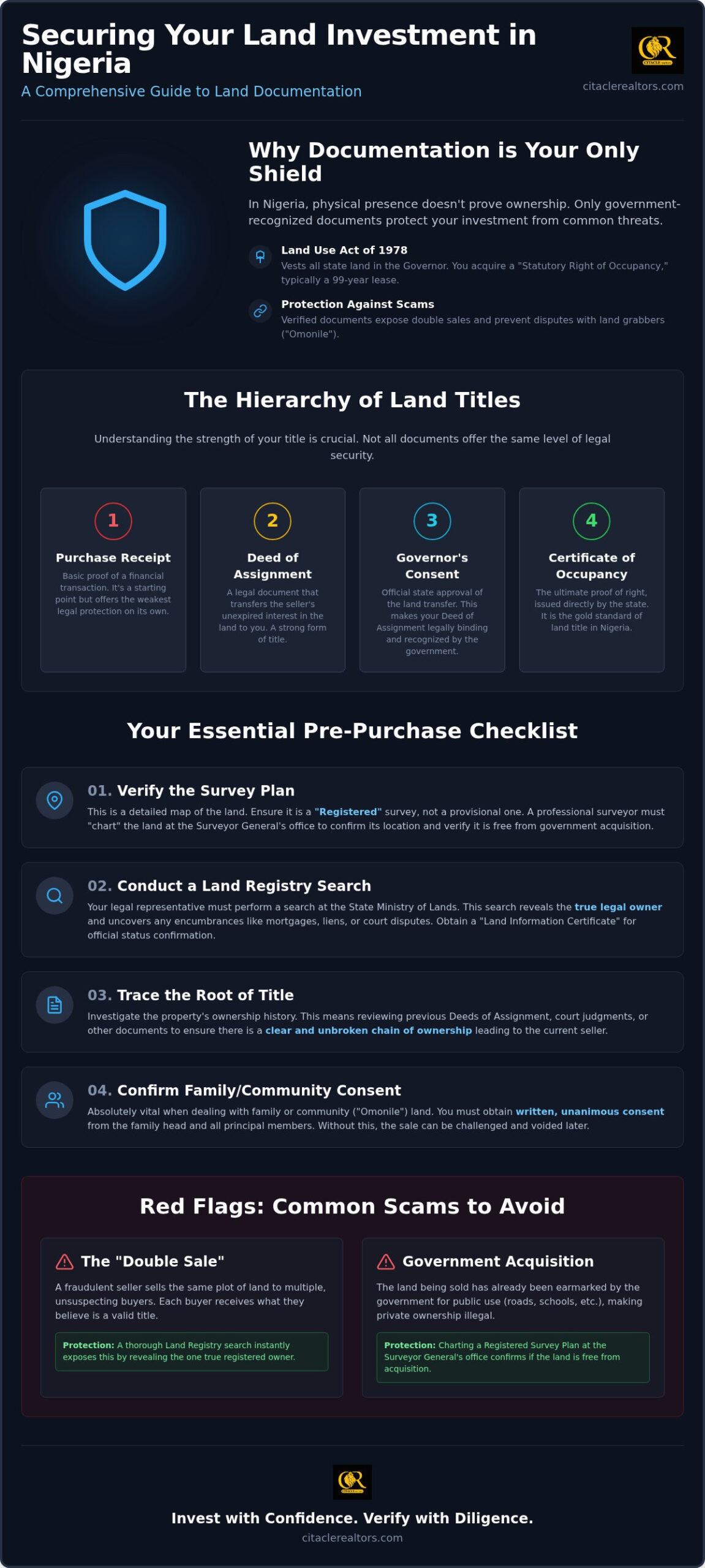
The foundation of every property transaction in the country is the Land Use Act of 1978. This legislation is a core part of Nigerian Land Law, and it fundamentally changed how we view property. It vests all land within a state in the Governor, who holds it in trust for the people. A “valid title” is a government-sanctioned document proving the Governor has granted you the right to use that specific portion of land. Buying land with defective or forged documents isn’t just a mistake; it’s a financial catastrophe that often leads to total loss of investment and years of exhausting litigation.
The Concept of Statutory Right of Occupancy
When you search for the documents needed to buy land in Nigeria, you’ll quickly realize you aren’t buying the land forever. Under the 1978 Act, you’re granted a Statutory Right of Occupancy. This is technically a 99-year lease from the government. Because the Governor is the ultimate landlord, any transfer of land requires their consent to be fully legal. This is why collecting the correct chain of titles is vital. Without them, you can’t prove your lease is legitimate or secure your interest against future claims.
Common Land Scams and How Documentation Prevents Them
Scammers often rely on a buyer’s lack of due diligence. The “Double Sale” trap occurs when a seller sells the same plot to multiple people. A thorough search at the State Ministry of Lands reveals the true registered owner, exposing this fraud instantly. Another risk is buying in “Government Acquisition” zones, where the state has already earmarked land for public projects like roads or schools. A Survey Plan is your first line of defense here. It allows a surveyor to “chart” the land and confirm it’s free for residential use. In the context of Nigerian land law, an encumbrance refers to any legal claim, mortgage, or liability attached to a property that restricts the owner’s ability to transfer the title.
Pre-Purchase Due Diligence: Key Documents to Verify
Identifying the correct documents needed to buy land in Nigeria is only half the battle. You must also know how to verify them. This due diligence phase is where many investors falter, yet it’s the most critical step in ensuring your peace of mind. We recommend a systematic approach that begins long before you sign a contract of sale.
The Vital Role of the Survey Plan
A Survey Plan is a detailed map of the land. It must contain specific coordinates, beacon numbers, and the exact plot size. Never rely on a “Provisional” survey, which is merely a draft. Insist on a “Registered” survey lodged with the state. Your first move is to take this document to a qualified surveyor to “chart” the land at the Surveyor General’s office. This process confirms the land’s actual location and whether it falls under any government acquisition zones.
Conducting a Professional Search at the Land Registry
Once the survey is clear, your legal representative should conduct a search at the State Ministry of Lands. This report clarifies who owns land in Nigeria in the eyes of the law. It will also highlight any existing mortgages, liens, or active court disputes. You’ll want to obtain a “Land Information Certificate” to officially confirm the land’s status. With the 2026 digital registry updates across several states, these searches are faster, but they still require expert interpretation. At Citacle Realtors, we prioritize these rigorous checks to offer verified land investment opportunities that protect your capital.
Step 3 involves verifying the “root of title.” You need to see the chronological history of how the seller acquired the property. This could be a previous Deed of Assignment or a court judgment. If it’s a family or community land, often called “Omonile” land, Step 5 is absolutely vital. You must confirm that the family head and all principal members have given their unanimous, written consent. Without this, the sale could be voided by other family members in the future. Finally, Step 4 requires checking for any “Caveat Emptor” (Buyer Beware) notices or active court judgments. These legal warnings indicate that the land is currently under dispute. By strictly following this checklist of documents needed to buy land in Nigeria, you eliminate the guesswork and move forward with total clarity.
The Essential Hierarchy of Nigerian Land Titles
While many people talk about land ownership, few understand that titles exist in a specific hierarchy. This structure determines the level of security your investment enjoys. The documents needed to buy land in Nigeria aren’t just a random pile of papers; they’re a chain of legal authority that proves your right to hold a plot. Understanding where your document sits in this hierarchy is the difference between a secure asset and a legal nightmare.
Understanding the C of O vs. Other Titles
The Certificate of Occupancy (C of O) remains the “Gold Standard.” It’s the first document issued by the state government to a person or entity for a specific plot. It’s unique because a single piece of land can only have one C of O ever issued for it. If you’re buying land that already has one, you won’t get a new one; instead, you’ll receive a Deed of Assignment. For a deeper dive into this specific title, you can explore our resource on C of O Meaning: A Guide to Nigerian Land Titles. The Right of Occupancy (R of O) is often a precursor to this, signaling the government’s intent to grant a full C of O once certain conditions are met. This is common in newly developed areas where the state is still formalizing land grants. To fully appreciate why this document matters so much, it’s worth understanding the dangers of buying land without a C of O and how the absence of this title can expose your investment to devastating financial loss.
The Importance of the Deed of Assignment
In the secondary market, the Deed of Assignment is the most common document you’ll sign. It acts as the primary bridge between the previous owner and you. It must contain specific clauses to be legally binding. The “Operative” part states the seller’s intent to transfer interest, while the “Habendum” part defines the extent of that interest, usually the remaining years of the 99 year lease. Crucially, a Deed is only fully perfected once it receives Governor’s Consent. Without this final seal of state approval, your ownership remains legally incomplete, a nuance many investors overlook until they try to resell or use the land as collateral.
Gazettes and Excisions: Buying from Communities
Buying from local communities often involves “Excised” land. Excision occurs when the government releases land from its global acquisition back to the traditional owners. This release is officially recorded in a Gazette. You should always verify the Gazette publication number at the Ministry of Lands. Buying “unexcised” land is incredibly risky; you’re essentially paying for land that the government still legally claims. We always advise our clients to stick to land with a clear, excised status to ensure a peaceful and secure ownership journey. By verifying these documents needed to buy land in Nigeria, you ensure your investment rests on a stable legal foundation.
Post-Transaction Essentials: Securing Your Legal Ownership
You’ve verified the history and confirmed the coordinates. Now, the focus shifts to the final stack of documents needed to buy land in Nigeria that move you from a “prospective buyer” to a “legal owner.” This phase is about locking down your interest so no one can challenge it in the future. It starts with two immediate papers: the Purchase Receipt and the Contract of Sale. While the Receipt confirms the financial exchange, the Contract of Sale outlines the specific terms and conditions of the transaction before the final Deed of Assignment is executed.
Why Perfection of Title Cannot Be Ignored
Signing the Deed is only the beginning. To be recognized by the state as the legitimate holder of the right of occupancy, you must “perfect” your title. In Nigerian courts, an unperfected title is often viewed as a mere “equitable interest” rather than a “legal interest.” This means if a seller fraudulently resells the land to someone who perfects their title first, you could lose the property entirely. Perfection involves three distinct stages: stamping the Deed at the relevant tax office to pay Stamp Duties, obtaining Governor’s Consent, and final registration at the Land Registry. This process also settles Capital Gains Tax, ensuring your transaction is fully compliant with current national laws.
As of July 2026, the launch of improved electronic portals across many states has significantly streamlined this journey. You can now track your application for Governor’s Consent online, with processing times currently averaging between 4 to 8 weeks. The application fee typically ranges from ₦50,000 to ₦150,000 depending on the state’s specific registry. Completing these steps ensures your name is permanently etched into the government’s digital records, providing an airtight defense for your investment. For families seeking a safe land investment in Nigeria that will stand up to legal scrutiny, completing this perfection process is non-negotiable.
Securing Physical Possession
Documentation is your legal shield, but physical possession is your practical one. We always advise our clients to establish a presence immediately after the purchase is finalized. This includes erecting a perimeter fence, building a gatehouse, or at the very least, installing a “Caveat Emptor” (Buyer Beware) sign that displays your contact details. This discourages encroachment and alerts any other potential buyers that the land is already secured. It’s also worth noting that holding undeveloped land now carries higher surcharges in several regions, so beginning a small project can be a savvy financial move. For a detailed breakdown of these associated expenses, see The Complete Guide to the Cost of Buying Land in Nigeria. If you’re ready to start your journey with a team that handles the heavy lifting of verification, browse our latest residential land sales today.
How Citacle Realtors Streamlines Your Land Acquisition Journey
The complexities of the Nigerian property market don’t have to be a barrier to your dreams of ownership. We’ve spent years refining a process that prioritizes your security and peace of mind above all else. By managing the rigorous verification of all documents needed to buy land in Nigeria, we remove the burden of due diligence from your shoulders. Our visionary local experts act as your professional partners, ensuring that every residential plot we list has already passed our stringent “Verified Land” protocol before it ever reaches your attention.
Professional Title Verification Services
Our team takes the lead in the administrative heavy lifting. We don’t just ask for papers; we actively conduct the search at the State Ministry of Lands to confirm the current status of every title. We maintain strong partnerships with certified surveyors to handle accurate charting at the Surveyor General’s office, confirming that the land is free from government acquisition. Citacle Realtors is deeply committed to ensuring a completely scam-free experience for every client seeking safe land investment for families in Nigeria. We understand that your trust is our most valuable asset, and we protect it through transparent, expert-led verification.
Beyond simply checking papers, we provide expert asset valuation services. In a market where prices can fluctuate wildly, our valuation team ensures you pay a fair market price based on 2026 economic realities. This objective oversight prevents the common trap of overpaying for land that hasn’t yet reached its full developmental potential. We combine this technical expertise with a warm, hospitable approach that makes you feel like a valued partner rather than just another transaction.
Beyond the Sale: Managing Your Real Estate Asset
Our commitment to your success doesn’t end when the Deed of Assignment is signed. We recognize that securing physical possession is just as vital as securing the legal title. Our facilities management services are designed to protect your investment from encroachment and unauthorized access. Whether you need site preparation, professional fencing, or property renovations, our team is equipped to handle the transition from raw land to a developed home. We provide the professional oversight necessary to maintain and enhance your property’s value over time.
As an indigenous firm with a modern, professional touch, we bridge the gap between traditional community knowledge and global real estate standards. We’re here to guide you through the 2026 digital registry updates and the perfection of your title with ease. If you’re ready to move forward with a team that values excellence and personal connection in equal measure, we’re ready to assist you. Start your secure land journey with Citacle Realtors today and invest with the confidence you deserve.
Build Your Future on a Verified Legal Foundation
Mastering the documents needed to buy land in Nigeria is the most important step you can take to protect your financial legacy. As we’ve explored, legal ownership isn’t just about making a payment; it’s about the meticulous perfection of your title through Governor’s Consent and official registration. By prioritizing pre-purchase due diligence and understanding the hierarchy of land titles, you transform a high-risk venture into a secure, appreciating asset. You don’t have to walk this path alone. Our team of expert asset valuation specialists and property managers is here to ensure your journey is transparent and successful.
At Citacle Realtors, we take pride in offering 100% verified residential land opportunities that have passed our rigorous internal protocols. From initial title verification to comprehensive property management, we provide a professional sanctuary for your investments. It’s time to move forward with the steady assurance that your property is legally sound and professionally overseen. Secure Your Investment with Citacle Realtors Verified Land Listings today. We look forward to helping you achieve your real estate goals with excellence and personal care.
Frequently Asked Questions
Is a Purchase Receipt enough to prove land ownership in Nigeria?
A Purchase Receipt is absolutely not enough to prove legal ownership. While it acts as evidence of a financial transaction, it doesn’t transfer the legal right of occupancy to you. To be recognized as the owner, you must obtain a Deed of Assignment and proceed with the perfection process. Without these additional papers, your interest remains equitable and vulnerable to future claims or fraudulent resales by the original seller. Physical possession alone cannot replace these legal requirements.
What is the difference between a C of O and Governor’s Consent?
The main difference lies in the stage of the land’s history. A Certificate of Occupancy (C of O) is the very first document the government issues for a plot. Every subsequent transfer of that same land requires Governor’s Consent instead of a new C of O. This consent is the state’s formal approval of the new deal, ensuring that the transition from the previous owner to you is fully recorded and legally binding.
Can I buy land in Nigeria without a Survey Plan?
You should never buy land without a Registered Survey Plan. This document is one of the most critical documents needed to buy land in Nigeria because it defines the exact boundaries and coordinates of your plot. Without it, you can’t verify if the land falls within a government acquisition zone or if the seller is actually offering you the correct portion of land. It’s your primary defense against boundary disputes and overlapping claims.
How long does it take to get Governor’s Consent in 2026?
In 2026, obtaining Governor’s Consent typically takes between 4 to 8 weeks. This improved timeline is due to the widespread adoption of electronic land registry portals across various Nigerian states. While the process is faster than in previous years, it still requires the submission of a complete application, including stamped Deeds of Assignment and evidence of paid statutory fees. Working with professionals ensures your application isn’t delayed by missing information or incorrect documentation during the filing stage.
What does it mean if land is ‘under government acquisition’?
Land “under government acquisition” means the state has already earmarked that specific area for public projects like roads, hospitals, or schools. Buying such land is a significant risk because the government can take physical possession at any time without paying you compensation. This is why “charting” the coordinates from the survey plan at the Ministry of Lands is an essential step in your pre-purchase due diligence. It prevents you from investing in restricted zones.
Do I need a lawyer to verify land documents in Nigeria?
Engaging a qualified lawyer is essential for a secure transaction. While you might identify the basic documents needed to buy land in Nigeria, a legal professional has the expertise to interpret search reports and identify hidden encumbrances. They also draft the Deed of Assignment with protective clauses that a layperson might overlook. Their oversight acts as a professional shield, ensuring that your investment is built on a solid legal foundation from the very beginning.
What is the ‘root of title’ and why is it important?
The “root of title” refers to the historical chain of ownership that proves how the current seller acquired the land. It’s important because it establishes the seller’s legal authority to transfer the property to you. If there’s a break in this chain or if a previous transfer was fraudulent, your own title could be challenged later. Verifying the root of title ensures you aren’t inheriting a legal mess or a disputed claim from the past.
What happens if I lose my original land documents?
If you lose your original documents, you must act quickly to secure your interest. First, you need to obtain a police report and swear an affidavit at a High Court. With these, you can apply to the State Land Registry for a Certified True Copy (CTC) of the registered documents. This CTC has the same legal standing as the original, allowing you to maintain proof of your right of occupancy and proceed with future transactions.