

Imagine the sinking feeling of watching a bulldozer approach your newly built home because the title you trusted wasn’t actually recognized by the state. We know you’ve spent years saving for a piece of Nigeria to call your own. The complex web of land laws often feels more like a trap than a path to prosperity, and it’s natural to feel anxious about government acquisitions or scams. While the allure of a “cheap” plot is strong, the dangers of buying land without c of o can turn a hopeful investment into a devastating financial loss.
This 2026 guide will demystify the Certificate of Occupancy and provide you with a clear roadmap to protect your hard-earned capital. We’ll explore the specific risks involved with non-titled land, how recent regulations like the revised Land Valuation Benchmark impact your purchase, and the exact steps to verify a property before you pay a single kobo. Our goal is to provide the steady assurance you need to navigate this market with ease. By the end, you’ll have the confidence to make a secure decision that builds a lasting legacy and a stable future for your family.
Key Takeaways
- Understand why the Certificate of Occupancy serves as the ultimate legal safeguard for property owners under the current Land Use Act framework.
- Identify the critical dangers of buying land without c of o, from the threat of global acquisition to the frustration of being denied bank loans.
- Learn how to differentiate between high-risk plots and safer alternatives like officially excised land recorded in a government Gazette.
- Discover the non-negotiable verification steps, including registry searches and coordinate charting, that secure your investment in the 2026 market.
- Explore how expert asset valuation and professional verification can ensure the price you pay matches the true legal status of the land.
Understanding the C of O Meaning and Its Legal Weight
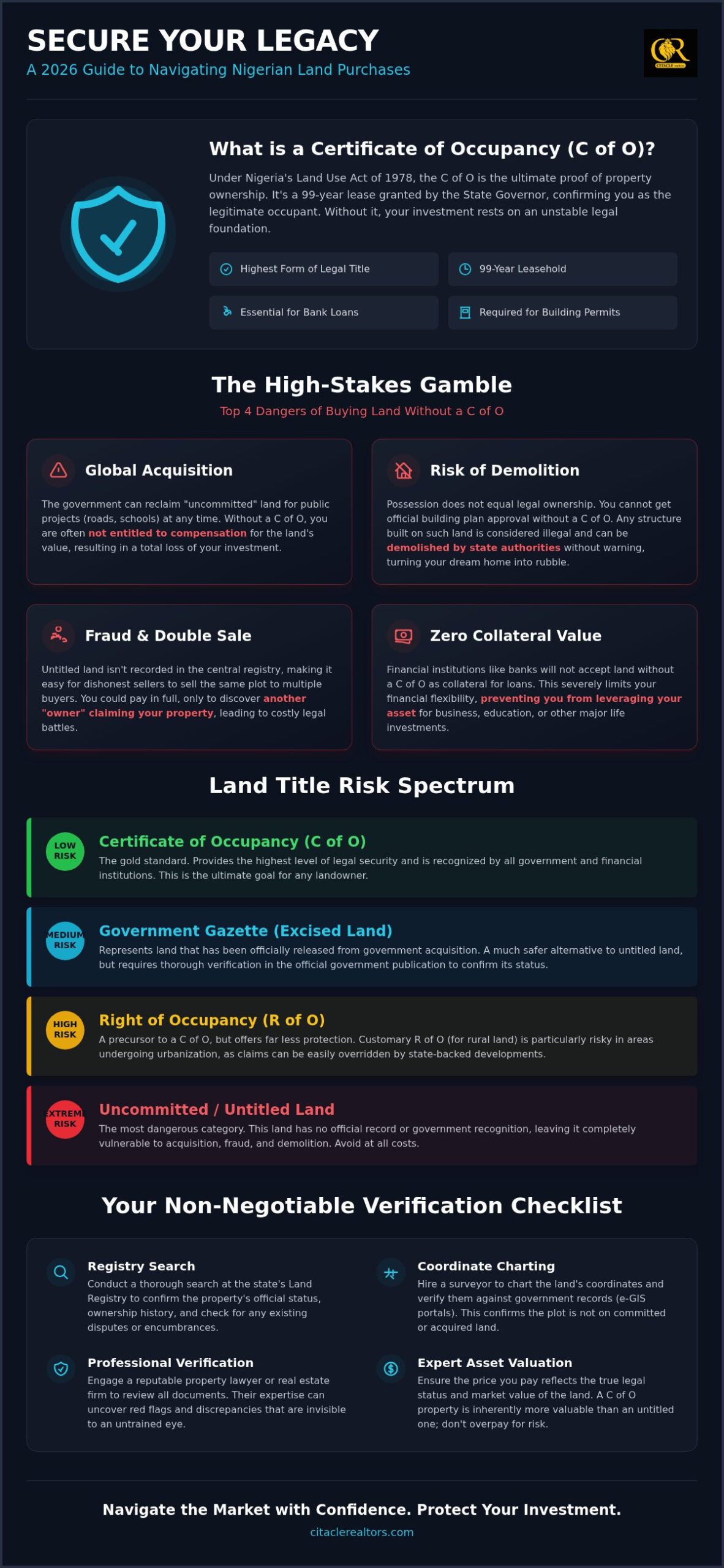
When you’re looking to secure your future through real estate, the Certificate of Occupancy (C of O) stands as the most vital document you’ll encounter. It’s the ultimate proof of ownership in the Nigerian market, providing a level of legal protection that other documents simply can’t match. Under the current legal framework, a C of O is a 99-year leasehold granted by the State Governor to an individual or entity. This document confirms that the person named is the legitimate occupant of the land for a century, minus one year. One of the greatest dangers of buying land without c of o is that you’re essentially building on a foundation of legal uncertainty, which can lead to heartbreaking losses if the title is ever challenged.
It’s also essential to distinguish between a State C of O and a Federal C of O. Most land falls under the jurisdiction of the state government, meaning the Governor of that specific state issues the title. However, certain areas, such as land near federal highways or designated federal estates, require a Federal C of O. At Citacle Realtors, we prioritize transparency; we ensure our clients understand which authority governs their potential investment. In the 2026 market, where digital records are becoming the standard, having this document is no longer just an advantage. It’s a necessity for anyone who values peace of mind and financial security.
The Land Use Act of 1978: Why it Matters Today
The Land Use Act of 1978 remains the cornerstone of property law in Nigeria. It fundamentally changed how land is owned by vesting all land within a state’s territory in the State Governor, who holds it in trust for the people. This law marked a massive transition from customary land ownership, where families held land indefinitely, to a statutory system. Today, this means that for your land to be truly secure, the government must recognize your right to be there. Without a C of O, you’re essentially operating outside this legal trust. In 2026, with over 5 million properties now digitally mapped through e-GIS portals, the government’s ability to track and claim unverified land has never been higher. This makes the dangers of buying land without c of o even more pronounced for the modern investor.
Statutory vs. Customary Right of Occupancy
You might hear sellers mention a “Right of Occupancy” (R of O) as a substitute for a C of O. While they sound similar, they serve different purposes. A Statutory Right of Occupancy is typically issued for land in urban areas, while a Customary Right of Occupancy is granted by local governments for rural land used for farming or traditional housing. While an R of O is often the precursor to receiving a full certificate, it doesn’t offer the same absolute security. Holding only a customary title in an area that’s rapidly urbanizing is risky. As cities expand, what was once “rural” land is often reclassified, and without a transition to a statutory C of O, your claim could be bypassed by newer, state-backed developments. We always advise our partners to look beyond the immediate “deal” and focus on the long-term title status to ensure their assets remain protected.
The Top Dangers of Buying Land Without a C of O
Investing in property is often the most significant financial move you’ll ever make. However, the dangers of buying land without c of o can transform that dream into a stressful liability. One of the most severe risks is Global Acquisition. This occurs when the government earmarks “uncommitted” land for future public projects like schools, hospitals, or highways. Since the state technically owns all land under the trust of the Governor, they can reclaim these plots at any time. Crucially, without a C of O, you may not be entitled to compensation for the land value during government repossession, leaving you with nothing but the memory of your investment.
The “Double Sale” trap is another harsh reality in the local market. Because land without a registered title doesn’t appear in the central registry, it’s tragically easy for unscrupulous sellers to offer the same plot to multiple unsuspecting buyers. You might think you’ve secured a deal, only to find another “owner” clearing the site a month later. Families seeking a safe land investment in Nigeria must prioritize working with verified, professionally screened properties to avoid these devastating double-sale scenarios. To avoid these pitfalls, it’s wise to consult with experts in residential land sales who prioritize verification above all else. This professional oversight ensures that the plot you’re paying for is truly yours and free from competing claims.
The Nightmare of Government Demolition
Possession doesn’t equal ownership in the eyes of the law. You might have the keys, a fence, and even a completed structure, but without a title, you can’t obtain official building plan approvals. In 2026, urban renewal projects are moving faster than ever as the state seeks to modernize infrastructure. If your structure sits on land without a recognized title, it’s often marked for demolition to make way for new developments. Without that certificate, you have no legal shield to stop the bulldozers or claim damages for your lost home.
Financial Losses and Lack of Collateral
Your land should be an active asset, but without a C of O, its utility is severely limited. Nigerian banks strictly reject land as collateral if it lacks a C of O or Governor’s Consent. This effectively freezes your wealth, preventing you from using your property to secure loans for business expansion or personal needs. Additionally, the resale value of untitled land remains stagnant compared to titled plots. Many sellers try to lure buyers with “C of O in view” claims, but these processes often stall for years, leaving your development plans in a state of permanent limbo and draining your financial resources. This risk is especially acute for land investment for diaspora Nigerians who rely on remote intermediaries and may not discover title problems until significant capital has already been committed.
C of O vs. Other Land Titles: Mapping the Risk
Understanding land titles requires a clear view of the safety hierarchy. Many buyers mistake a Survey Plan or a Deed of Assignment for a title. In reality, these are simply transfer documents. They show a transaction happened, but they don’t prove the land is free from government interest. One of the primary dangers of buying land without c of o is assuming these administrative papers provide legal immunity. To truly secure your investment, you must aim for the highest level of title perfection available. We’ve mapped the risk levels below to help you navigate your purchase with confidence.
- Certificate of Occupancy: The peak of security and the gold standard for any investor.
- Governor’s Consent: Equivalent to a C of O for secondary market purchases where the original title already exists.
- Gazette: High safety; it indicates the land is officially excised and recorded.
- Excision in Process: Moderate risk; the government has yet to finalize the release.
- Freehold: Generally safe but requires immediate perfection to avoid future claims.
The Gazette and Excision Explained
Excision occurs when the state government officially “releases” a portion of land back to the original community. This land is no longer under global acquisition, making it a much safer bet for residential development. The Gazette is the official government journal that records this release. Buying excised land is significantly more secure than buying uncommitted land. However, you must verify that your specific plot’s coordinates fall exactly within the boundaries defined in the Gazette. In 2026, digital mapping makes this verification faster, but it still requires a professional eye. Once you have an excised plot, you can then proceed to apply for your own C of O, moving your asset from a community right to a personal statutory right.
Governor’s Consent: The C of O Alternative
If you’re buying land from someone who already holds a C of O, you won’t receive a brand-new certificate. Instead, you must obtain Governor’s Consent. This document validates the transfer of the existing 99-year lease from the seller to you. It’s just as secure as an original C of O but involves different administrative steps at the land registry. While the perfection process involves statutory fees, it’s a vital investment for total peace of mind. For a complete list of what you’ll need, check our guide on Documents Needed to Buy Land in Nigeria. Understanding these nuances helps you avoid the dangers of buying land without c of o or its legal equivalent.
How to Safely Buy Land Without an Existing C of O
Securing a property without an existing title doesn’t have to be a gamble if you approach the process with a methodical mindset. While we’ve highlighted the dangers of buying land without c of o, many seasoned investors still find success by adhering to a strict due diligence protocol. The goal is to move from a state of uncertainty to one of verified security. This begins with a “locus in quo” or physical inspection. You must walk the land to check for signs of existing disputes, such as half-built walls, “caveat emptor” warnings, or local residents claiming ownership. A physical presence often reveals what a paper trail might hide.
Once the physical site is clear, you must trace the Chain of Title. This involves verifying the history of ownership from the original indigenous community down to the current seller. Any gap in this history is a significant red flag. You must also engage a registered surveyor to chart the land coordinates. This professional will take the exact “beacons” of the plot and cross-reference them with government records to ensure the land isn’t sitting on a committed road path or a future public utility zone. Following these steps ensures that your capital remains protected even in a fast-moving market.
Land Registry Search: The Non-Negotiable Step
Your search at the State Land Registry is the most critical part of your verification journey. This process reveals the “Chart” status of the land, telling you exactly if the government has earmarked the area for acquisition. It also uncovers any existing encumbrances, such as mortgages or legal caveats, that might prevent a clean transfer of ownership. Never rely on the seller’s photocopies alone. In 2026, sophisticated forgeries are a reality, so you must insist on a fresh, independent search conducted by your own legal representative. This step confirms that the person selling the land actually has the legal right to do so.
The Role of Professional Asset Valuation
A major risk in the current market is overpaying for land that carries a high title risk. This is where professional asset valuation becomes indispensable. A valuation doesn’t just look at the soil; it assesses whether the asking price reflects the land’s current legal status. For instance, a plot with a Gazette should be priced differently than one with a full C of O. At Citacle Realtors, we assist our partners by determining the fair market value for “untitled” land, ensuring you don’t over-leverage your finances on a risky asset. For a deeper look at budgeting for these nuances, explore The Complete Guide to the Cost of Buying Land in Nigeria. If you’re ready to secure your future, our team provides the expert asset valuation services you need to invest with absolute confidence.
Secure Your Investment with Citacle Realtors
At Citacle Realtors, we believe that your journey toward property ownership should be defined by peace and security. While we’ve discussed the various dangers of buying land without c of o, our mission is to ensure you never have to face those risks alone. We don’t just facilitate transactions; we build partnerships based on steady assurance and professional reliability. Every plot we offer undergoes a rigorous internal verification process before it ever reaches the market. This proactive approach allows us to filter out high-risk properties, connecting you only with verified residential land that promises long-term stability and value retention.
Our team understands that the 2026 real estate market requires more than just a standard brokerage service. It demands a visionary partner who can identify legal gaps and protect your capital from the dangers of buying land without c of o or other unrecognized titles. By combining our expertise in asset valuation with our deep roots in the local community, we provide a protective shield for your investment. We’re eager to assist you in achieving your goals, ensuring that every kobo you invest contributes to a legacy of excellence and personal connection.
Expert Guidance in Land Acquisition
Our approach to real estate is built on a foundation of professional reliability and warm hospitality. Our visionary local experts possess an intimate understanding of the Land Use Act, allowing us to navigate complex statutory requirements with ease. We’ve identified a gap in the market for a more comprehensive, one-stop approach, which is why we integrate residential land sales with expert asset valuation. This ensures that the price you pay is a true reflection of the property’s legal standing and market potential. When you partner with us, you’re not just buying a plot; you’re engaging a consummate professional team dedicated to your success.
Beyond the Purchase: Maintaining Your Land’s Value
Property ownership is a shared journey that continues long after the deed is signed. To ensure your asset remains secure, we offer comprehensive property and facilities management services. These services are designed to prevent encroachment and maintain high standards of oversight, which is especially critical for land awaiting title perfection. Whether you’re looking for duplex rentals or planning future property renovations, our team provides the ongoing support needed to enhance your asset’s value. We invite you to experience a more organized, modern way to build your portfolio. Contact Citacle Realtors for verified land opportunities and take the first step toward a secure, prosperous future.
Build Your Legacy on Solid Ground
Securing your piece of the 2026 Nigerian real estate market should be a journey of excitement rather than one of fear. We’ve navigated the critical importance of the Certificate of Occupancy and the rigorous steps required to verify any property before committing your hard-earned capital. By prioritizing legal due diligence and professional charting, you effectively eliminate the dangers of buying land without c of o that often trap unwary investors. Your financial future is too valuable to leave to chance or unverified promises.
Citacle Realtors is here to serve as your stable partner, offering the expertise of indigenous professionals who understand the nuances of local land laws. From expert asset valuation to comprehensive property management for non-residents, we provide a one-stop solution that prioritizes your security. We’re eager to assist you in discovering opportunities that offer both high quality and total legal peace of mind. Secure your future with verified residential land from Citacle Realtors. Let’s work together to make your dream of secure homeownership a reality.
Frequently Asked Questions
Can I build a house on land without a C of O?
You can physically build a house, but you won’t obtain official building plan approvals from the state authorities. This is one of the major dangers of buying land without c of o, as any structure built without approval is legally considered an illegal development. In the 2026 climate of urban renewal, such buildings are the first targets for demolition. It’s always safer to secure your title before investing in construction to protect your capital.
How long does it take to get a C of O in Nigeria in 2026?
In 2026, the timeline for obtaining a Certificate of Occupancy has improved due to the widespread adoption of digital e-GIS portals. While it varies by state, you should generally expect the process to take between six and twelve months. This assumes all your survey documents and tax clearances are in order. Stricter enforcement of the Nigeria Tax Act 2025 means that any delays are often linked to incomplete financial records or unresolved land disputes.
Is a Deed of Assignment the same as a land title?
A Deed of Assignment is not a land title; it is a legal contract that transfers ownership interest from a seller to a buyer. While it’s a vital part of the transaction, it doesn’t offer the same statutory protection as a C of O. Without perfecting this deed through Governor’s Consent, your claim remains equitable rather than legal. This distinction is crucial for avoiding the dangers of buying land without c of o or registered consent.
What happens if I buy land that is under government acquisition?
If you purchase land under government acquisition, you risk losing the property entirely without any financial compensation for the land itself. The state can reclaim “uncommitted” land at any time for public infrastructure projects. Because you lack a recognized title, the law doesn’t recognize you as a legitimate leaseholder. This often results in total financial loss, which is why professional verification through a registry search is a non-negotiable step for every buyer.
Can I upgrade an Excision or Gazette to a C of O?
You can certainly upgrade land with an Excision or Gazette to a full Certificate of Occupancy. Once land is excised and the release is published in the official Gazette, it’s considered “free” from government acquisition. You can then apply for a statutory Right of Occupancy and eventually a C of O. This process perfects your title and significantly increases the asset’s market value, making it a “titled” property that banks will accept as collateral.
Do I need a lawyer and a surveyor to buy land?
Engaging both a lawyer and a registered surveyor is essential for a safe transaction. Your lawyer conducts the search at the land registry to check for encumbrances, while your surveyor charts the coordinates to ensure the plot isn’t under government acquisition. Skipping these professional services is a recipe for disaster in the complex Nigerian market. At Citacle Realtors, we always insist on these verifications to ensure our clients’ investments remain secure and undisputed.
How much does it cost to process a C of O?
The cost depends heavily on the state and the assessed value of the land. In the Federal Capital Territory, converting a Right of Occupancy to a full C of O costs approximately ₦3.5 million, with additional registration fees around 8% of the value. In other regions, you’ll need to budget for survey fees, stamp duties, and administrative charges. It’s best to consult with a professional to get a specific breakdown based on your location.
Is land with a C of O always 100% safe from scams?
No, a C of O alone doesn’t guarantee 100% safety because sophisticated forgeries still occur in the market. A document might look authentic but could be cloned or revoked by the government. This is why a fresh search at the State Land Registry is vital for every transaction. You must verify that the certificate is currently valid, registered in the seller’s name, and free from any court injunctions or existing bank mortgages.