

A property management report is more than a rent total. It brings together financial performance, maintenance activity, tenant information, occupancy and other details that show how a property is being managed. Understanding property management reports means reading the figures in context and seeing what they reveal about the property’s overall health.
It’s easy to focus on income first, but a strong month of rent collection doesn’t tell the whole story. Expenses, upcoming lease expirations and unresolved repairs can also affect a property’s performance and the decisions an owner may need to make.
This article explains what property management reports are, why they matter and how to interpret key documents such as income and expense statements, rent rolls and lease information. You’ll learn what each report can show, how the details fit together and how they can support clearer oversight of a property in Nigeria.
Key Takeaways
- Read income and expense categories together to see what is driving a property’s financial result, not just how much rent came in.
- Use rent rolls and lease details to spot payment patterns, vacancies and upcoming lease endings that may affect planning.
- Choose a reporting method that keeps transactions and supporting property information organised and easy to review.
- Compare financial, tenant and maintenance information to build a fuller picture of property performance and identify where attention is needed.
Income and expense statements
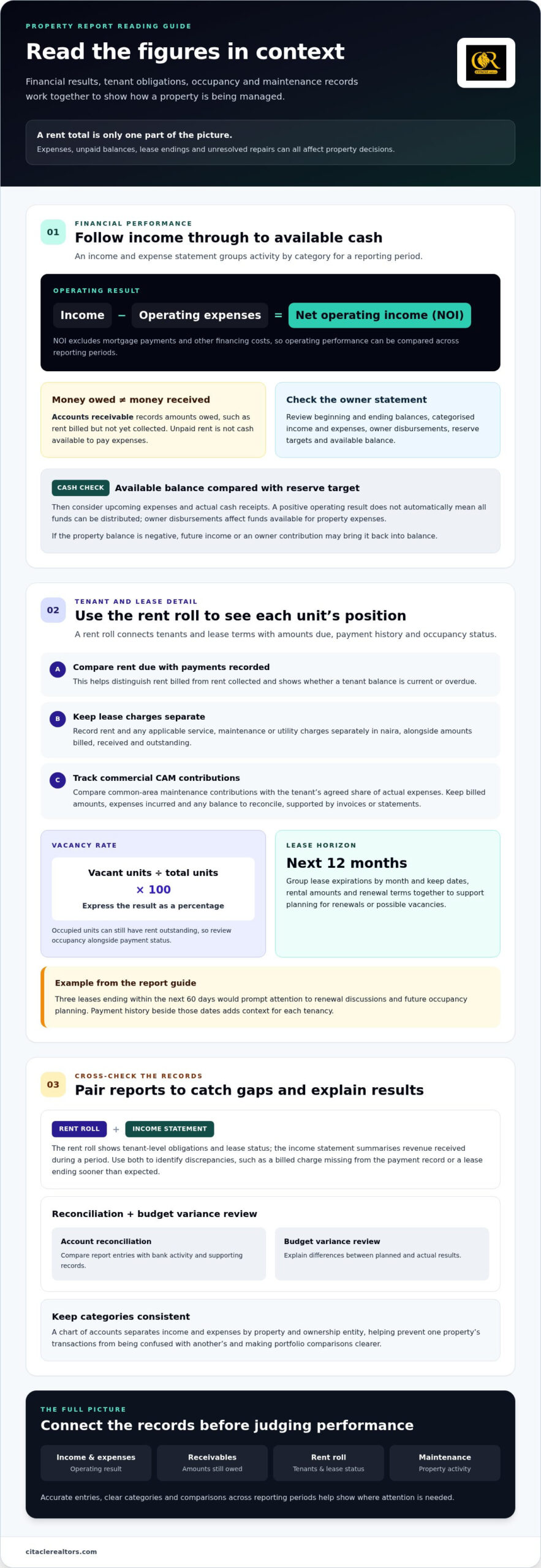
An income and expense statement groups a property’s income and expenses by category, then shows their totals and the difference between them. To understand a rental property cash flow report, compare money received with money paid out during the period, including operating expenses and debt service. This shows whether available cash can cover those outflows.
Income Statements and Net Operating Income
An income statement records property income and operating expenses. Net operating income (NOI) is the amount left after operating expenses are subtracted from income. It lets owners compare operating performance across reporting periods without confusing it with mortgage payments or other financing costs.
For example, a statement might list rental income, maintenance, management and utility expenses as separate categories. Check each category, total income, total expenses and the resulting NOI. Property managers calculate NOI by grouping income sources and operating expenses into categories. The income and expense statement is a key monthly financial report in a property management reporting packet.
Receivables and Owner Statements
Accounts receivable represents amounts owed to the property, such as rent billed but not yet collected. An owner statement summarises the property’s financial activity and available balance. Reviewing both helps owners distinguish income recorded from cash actually received.
Read receivables alongside collected income: an unpaid tenant balance may be recorded as money owed, but it is not available to pay expenses. An owner statement can show beginning and ending balances, categorised income and expenses, owner disbursements, reserve targets and an available balance. Owner disbursements can affect the funds available for property expenses.
Reserve Targets and Rental Cash Flow
A reserve target is the amount an owner intends to retain for property needs rather than distribute. Cash flow shows money moving in and out; the reserve figure helps explain how much remains set aside after expenses and disbursements.
To read the report, compare the available balance with the reserve target, then review upcoming expenses and actual cash receipts. A positive operating result does not automatically mean all funds are available for distribution. If the property balance is negative, future income or an owner contribution may bring it back into balance. Accurate, categorised entries make this comparison clearer. Manual records need careful updating, while automation can organise recurring entries and reporting. In common-interest communities and HOAs where reserve funds require strict accounting, specialized providers like My Arizona HOA Manager demonstrate how dedicated financial reporting keeps long-term balances transparent.
Rent rolls and tenant lease information
A rent roll is a detailed record of tenants, lease terms, rental amounts, payment history and occupancy status. It connects each unit’s agreement with its current position, while an income statement summarises revenue received during a period. To understand which fees and charges belong in a Nigerian property management report, look for rent and any service, maintenance or utility charges that apply under the lease or management arrangement. Record each item separately in naira, alongside amounts billed, received and outstanding.
For each tenant, compare rent due with payments recorded for the reporting period. A rent roll can show whether a balance is current or overdue, helping a landlord distinguish rent billed from rent collected. For a commercial lease, track common-area maintenance (CAM) contributions against the tenant’s agreed share of actual expenses. The record should show amounts billed, expenses incurred and any balance to reconcile, supported by relevant invoices or statements.
Occupancy and lease details add context to payment tracking. A property’s vacancy rate is calculated by dividing vacant units by total units, then expressing the result as a percentage. Compare that measure with tenant payment status: occupied units can still have rent outstanding. Keep lease dates, rental amounts and renewal terms together so the record reflects both current income and upcoming changes.
Lease expirations can be grouped by month for the next 12 months, helping owners plan for renewals or possible vacancies. For example, three leases due to end within the next 60 days would prompt attention to renewal discussions and future occupancy planning. A rent roll can also show payment history beside those dates, giving the landlord a clearer picture of each tenancy.
Use the rent roll alongside the income statement, not as a substitute for it. One shows tenant-level obligations and lease status; the other summarises revenue received. Consistent tracking makes discrepancies easier to identify, such as a billed charge missing from the payment record or a lease ending sooner than expected. Comparing the two helps owners interpret property performance across reporting periods.
What Are Property Manager Reports?
Property management reports bring financial, occupancy and maintenance records together for owners to review. Their usefulness depends on accurate entries, clear categories and comparisons across reporting periods.
Report Formats and Software Connections
Reports can be prepared in spreadsheets or property management software, with accounting integrations transferring transactions into financial records. The format affects how owners compare income and expense information across properties.
A spreadsheet can organise rent, repairs and occupancy, but manual updates need careful checking. Software can automate data collection and generate insights from property records. A chart of accounts separates income and expenses by property and ownership entity, helping prevent one property’s transactions from being confused with another’s. Consistent categories also make portfolio comparisons clearer.
Reconciliation and Budget Variance Review
Account reconciliation compares report entries with bank activity and supporting records. A budget variance review explains differences between planned and actual results. Together, they help owners trace a reported figure to its underlying transaction.
For example, match a recorded rent deposit to the relevant bank entry, then compare maintenance spending with its budget category. Managers can explain variances that exceed a threshold agreed with owners, such as 10% or a set naira amount. A missing receipt, unexplained balance or repeated overspend deserves attention because it weakens the report’s accuracy.
Transparency and Accountability
Reports support transparency by showing the transactions and operating activity behind a property’s financial and occupancy results. They help property owners understand what happened during a period and identify items that need an explanation. Similarly, established HOA management companies Tampa communities work with rely on this consistent documentation to maintain transparency across shared budgets, vendor contracts, and dues collection.
Look for dated entries, clear descriptions and categories that connect amounts to a property or unit. A property management account ledger typically lists the transaction date, description or memo, category and amounts. If a repair entry lacks a work order or a recorded payment cannot be matched to a transaction, request the supporting detail through the established reporting process.
Maintenance Reporting and Review Timing
A property maintenance report records recent repairs, scheduled maintenance and major issues needing attention. It helps owners track work status and understand how maintenance activity relates to the property’s condition and expenses.
Landlords typically receive property management reports monthly; quarterly or annual reports can support broader strategic analysis. Review maintenance entries alongside the income and expense report, noting completed work, open issues and supporting records. Red flags include repeated repair entries without clear descriptions, unresolved major issues and expenses that do not align with the work recorded. A consistent format makes these patterns easier to spot.
Definition and purpose of property management reports
A property management report brings a rental property’s financial performance, maintenance activity, tenant management and occupancy information into one record for review. A monthly report, for example, can connect rent collection and payments with operating expenses, repairs and current occupancy, giving owners more context than a single balance.
The purpose is to turn separate transactions and updates into a clearer picture of property performance. A rent payment shows collection, a maintenance entry documents work, and occupancy details show whether units are in use. Read together, these records help owners compare actual activity with the budget and identify what may need attention. A report is most useful when its figures have supporting documents and clearly defined reporting periods.
Reports also preserve a useful record of property activity. Recent repairs, scheduled maintenance and major issues can be documented alongside financial entries. For example, a maintenance update tied to an invoice helps explain an expense in the income and expense statement. Lease and tenant records add context to rent collection, while dated entries make changes between reporting periods easier to follow.
Reporting frequency depends on the purpose: property managers typically generate reports monthly, while some landlords choose quarterly or annual reports for strategic analysis. Monthly updates help owners follow income, payments, expenses and maintenance as activity unfolds. Quarterly or annual views can make longer-term budget patterns easier to assess. The key is to read financial, occupancy and maintenance details together, then connect unusual changes to their supporting records.
If you would like professional oversight that brings property activity into an organised reporting process, explore property management support for your rental property.
Citacle Realtors: Property Management
Citacle Realtors provides Property Management for owners seeking organised oversight of rental properties. When income, tenant records, maintenance activity and occupancy details need to be considered together, property management offers a practical next step beyond reading reports alone. Clear records help owners review property activity and make informed decisions about ongoing needs.
Consider this support if you want a more structured approach to property oversight or need to bring property-related responsibilities under professional management. Citacle Realtors also offers Facilities Management, Residential Land Sales and Duplex Rentals, serving different property needs without confusing them with the purpose of a management report.
For a conversation about Property Management, contact Citacle Realtors or visit citaclerealtors.com.
Make Your Next Property Decision with Confidence
Reports become more valuable when they inform your next decisions. Set aside time to consider what the property’s records mean for your priorities, whether that means improving oversight, planning maintenance or assessing future investment opportunities. A consistent review habit can help you make those choices with greater clarity.
For support with property oversight, Citacle Realtors offers Property Management and Facilities Management. If your plans extend to land acquisition, Residential Land Sales may also be relevant. The right conversation starts with your goals for the property and the kind of support you’re seeking.
Developing a practical understanding of property management reports is one way to take a more active role in your property decisions. When you’re ready to discuss your plans, contact Citacle Realtors. A clear next step can help you move forward with confidence.
Frequently Asked Questions
What is a property management report and what does it include?
A property management report is a record that helps an owner assess a property’s activity and condition over a defined period. It may bring together collections, payments, occupancy, tenant balances, maintenance updates and supporting documents. For example, an owner reviewing a vacant unit can connect its occupancy status with advertising activity, repair work and any income gap, rather than viewing each item separately.
How to read a property management income and expense statement?
Start by checking the reporting period and whether the figures represent amounts billed or money received. Then compare income and expense categories, looking for entries that changed or need explanation. For example, if repair spending rises, review the related work records and compare them with earlier periods. Understanding property management reports also means separating operating performance from financing payments when assessing net operating income.
What do occupancy rate, vacancy rate, and rent collection rate mean?
Occupancy rate is the share of units occupied; vacancy rate is the share vacant. Rent collection rate compares rent collected with rent billed during the same period. These measures answer different questions: occupancy shows how much of the property is in use, while collection shows whether billed rent became cash. Compare them together, since a property can have occupied units and still have unpaid rent.
How to interpret a rent roll and tenant arrears report?
Use the rent roll to review each tenancy’s agreed rent, lease status and payment record, then use the arrears report to identify unpaid balances by tenant. Check that each reported balance matches the tenant’s ledger and relevant payment period. If a tenant has paid part of the amount due, distinguish the payment received from the remaining balance. This makes follow-up specific and prevents a partial payment from appearing as full settlement.
How to compare actual property expenses with the budget?
Compare each actual expense with its matching budget category for the same period, rather than comparing unrelated totals. Identify whether a difference comes from timing, a changed service requirement or an unplanned repair, then review the supporting records. For example, a maintenance expense recorded this month may relate to work scheduled earlier. Record the reason alongside the variance so owners can distinguish a one-time event from recurring budget pressure.
Which financial metrics should landlords track in management reports?
Landlords can track total rent billed, rent collected, arrears, operating expenses, net operating income and cash flow. Occupancy and vacancy measures add context by showing how much of the property is generating rental activity. Review these measures over consistent periods and at property level, not just across a portfolio. This comparison can reveal whether a change reflects one unit, a particular expense category or a broader operating pattern.