

Self-managing can look cheaper, but the cost-benefit analysis of hiring a property manager depends on more than the monthly fee. A manager may be worthwhile when reduced vacancy, tenant placement, maintenance coordination and fewer hours spent handling issues outweigh the cost; managing the property yourself may make more sense if you have the time, live nearby and can handle these responsibilities effectively.
It’s reasonable to weigh the visible fee against the control and potential savings of doing the work yourself. This comparison will help you assess management fees alongside tenant placement, lost rent, routine maintenance and emergency repairs, then weigh those costs against your time and the demands of your property. By the end, you’ll have a practical way to decide which approach better fits your rental and circumstances in Nigeria.
Key Takeaways
- Compare the full cost of management with the time and tasks self-management requires, not just the monthly fee.
- Assess how tenant screening and placement practices could affect rental continuity and turnover.
- Include vacancy, routine upkeep and urgent repairs in your comparison, since each can change the overall value of professional management.
- Review which services and additional charges are included in a management agreement before weighing its cost against your needs.
- Choose the approach that fits your property, availability and comfort with day-to-day landlord responsibilities.
Tenant screening and faster tenant placement
Self-management involves time spent handling tenant enquiries, applications and tenancy administration. A property manager can take on ongoing property oversight, reducing the time you spend on those responsibilities. The amount of time saved depends on the property’s needs and the management service.
Screening helps a landlord assess applicants consistently before agreeing to a tenancy. A property manager may review employment and rental history, credit information and criminal history, then organise applications and prepare lease agreements. In Nigeria, clear records of the checks, decisions and agreed tenancy terms help keep the process orderly. Screening is not a substitute for a landlord’s final judgement about a suitable tenant.
Tenant placement can involve advertising a vacancy, responding to prospective tenants and arranging viewings. A manager who handles these steps can keep enquiries moving while you focus on other commitments. Clarify how applicants are assessed and what happens between an enquiry and a signed tenancy. Clear steps help both parties understand the process.
Communication matters after move-in, too. Tenants need a clear route for reporting a maintenance issue or urgent concern, while landlords need timely updates. Before agreeing on management responsibilities, establish how routine messages, repair requests and emergency reports are passed on. Prompt, documented responses can help resolve concerns early and support tenant satisfaction.
Compliance is another part of the decision. Landlord-tenant requirements can affect screening, tenancy documents, notices and dispute handling, so owners need to understand the rules that apply to their property. A manager can help administer the tenancy and keep records organised, but the landlord should understand who handles each compliance task. Poor records or missed steps can increase legal and financial risk.
Tenant turnover affects returns through more than lost rent. Each departure can mean new advertising, viewings and preparation before another tenant moves in. If an applicant withdraws late, for example, you may need to repeat those steps and carry the vacancy longer. Consistent communication and a suitable placement process can support retention, although tenant needs and property condition also influence renewals.
Use this comparison to identify where each approach places the work and responsibility:
| Option | Screening and placement | Tenant communication | Compliance and oversight |
|---|---|---|---|
| Self-management | Landlord handles enquiries, checks and lease steps | Landlord responds directly | Landlord organises records and obligations |
| Property manager | Manager coordinates advertising, screening and applications | Manager handles agreed tenant communications | Manager supports administration; landlord retains oversight |
Choose the arrangement that fits your available time, distance from the property and confidence handling tenant decisions and compliance records.
Vacancy reduction and lost-rent costs
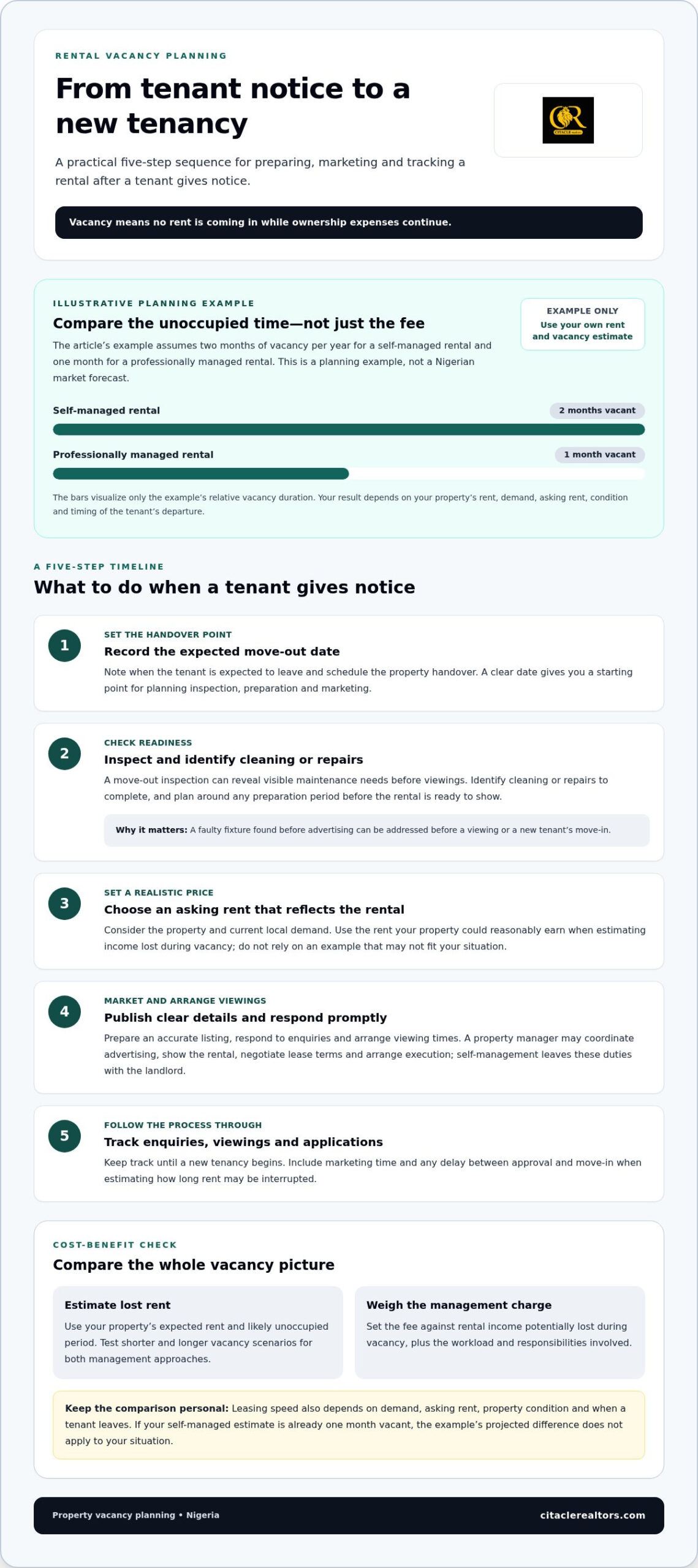
A vacant rental produces no rent while ownership expenses continue. To compare self-management with professional management, estimate the rental income lost during vacancy. Use the rent your property could reasonably earn and count the unoccupied period. A shorter vacancy can improve cash flow, but leasing speed also depends on demand, asking rent, property condition and the timing of a tenant’s departure.
An illustrative comparison might assume two months of vacancy per year for a self-managed rental and one month for a professionally managed rental. Treat this as a planning example, not a Nigerian market forecast. Apply your own expected rent and likely vacancy period to both approaches. If your self-managed estimate is already one month, the example’s projected difference does not apply to your situation.
Marketing vacancies involves more than publishing an advert. The landlord needs to prepare an accurate listing, respond to enquiries, arrange viewings and keep the property presentable. A property manager may coordinate advertising, show the rental to prospective tenants, negotiate lease terms and arrange execution. Each step can affect how quickly a suitable applicant moves from enquiry to tenancy.
Try this practical sequence when a tenant gives notice:
- Record the expected move-out date and schedule the property handover.
- Inspect the unit and identify cleaning or repairs needed before viewings.
- Set an asking rent that reflects the property and current local demand.
- Publish clear marketing details and arrange viewing times promptly.
- Track enquiries, viewings and applications until a tenancy begins.
Inspections connect vacancy planning with the property’s readiness. A move-out inspection can identify visible maintenance needs before a new tenant views the unit. Resolving a faulty fixture before advertising, for example, may make the rental easier to present and reduce disruption after move-in. The inspection helps the landlord plan next steps instead of discovering issues during a viewing.
Rent payments resume only when a new tenancy starts, so compare expected rent with the time between tenancies. Include any preparation period, marketing time and delay between approval and move-in. A manager may oversee property affairs while you have other commitments; self-management leaves those duties with you. Neither approach removes the effect of slow demand or a property requiring substantial work.
To assess the cost-benefit analysis of hiring a property manager, compare the management charge with rental income potentially lost during vacancy. Test shorter and longer vacancy scenarios using your property’s own rent. Choose the approach that best balances the fee, workload and realistic demand for your rental.
Maintenance, inspections and emergency repairs
Maintenance costs depend on a rental property’s condition, repair history and response time. A leaking pipe, for example, can damage nearby finishes if attention is delayed. When comparing self-management with professional support, consider who notices problems, arranges repairs and follows up. The value lies not only in the repair itself, but also in limiting disruption and protecting the property’s condition.
Routine inspections help identify maintenance needs before they become larger problems. A property manager can inspect the property and report issues such as water leaks, damaged fittings or signs of wear. Agree on the inspection process, how findings are documented and how repair decisions are communicated. A written record helps the owner compare recurring issues and plan upkeep rather than responding only when tenants report a fault.
Emergency repairs require a clear route from tenant report to action. Property managers may use contractor and service-provider networks to arrange urgent work. For example, if a tenant reports a serious plumbing issue, the manager can coordinate a service provider and update the landlord. The owner should understand who can authorise work, which situations need approval, and how repair records and invoices are shared.
Before comparing the workload, separate maintenance into these practical categories:
- Routine upkeep: planned checks, cleaning shared areas and addressing minor wear.
- Tenant-reported repairs: faults raised during occupancy, such as a faulty tap.
- Emergency work: urgent issues requiring prompt coordination, such as a major leak.
Vendor relationships affect both coordination and cost. A landlord who self-manages must find service providers, explain the fault, arrange access and monitor completion. A manager can coordinate those steps through an established network, though the owner should understand how contractors are selected and how work is reported. For a property owner living far from the rental, this coordination can reduce travel and scheduling demands.
Management fees don’t always cover every repair-related task. Some companies may charge extra for maintenance outside the agreed service package, and some may apply a markup of 10% to 20% to maintenance and repair costs. Ask for the agreement’s included-work boundaries, approval process and charge structure in writing. This makes it easier to compare the management fee with expected repair spending.
Tenant screening and move-in records also support maintenance decisions. A documented condition report helps distinguish existing defects from new repair requests. Keep inspection notes, tenant communications and invoices together, then review repeated faults before approving another repair. Regulations that apply to housing and tenancy may also affect how property issues are handled, so organised records support the landlord’s compliance responsibilities.
Include inspection frequency, emergency coordination, vendor management and any additional service fees in your cost-benefit analysis of hiring a property manager. Choose self-management if you can reliably arrange these tasks; consider professional management if distance, workload or repair coordination makes consistent upkeep difficult.
Monthly management fees and additional charges
Compare a property management company’s complete fee structure with the work and expenses you would handle yourself. In Nigeria, the agreement should show what each charge covers and when it applies.
Percentage-Based Management Fees
A percentage-based fee links the monthly management charge to rent collected, so the amount can change when rental income changes. A fixed fee works differently: it stays set for the agreed period, regardless of rent collected. Compare both against the services included, the rent collection basis, and any charges billed separately. The percentage alone cannot show which arrangement offers better value.
What services are included in property management fees in Nigeria? A full-service arrangement may cover marketing, tenant screening, lease agreements, rent collection, financial reporting, inspections, maintenance coordination and compliance support. The written agreement defines the actual scope, so compare each task against your own responsibilities.
Property Types and Management Fees
Residential, commercial and other rental properties can involve different workloads. A single rental unit, for example, may need different oversight from a property with shared facilities, several tenants, or short-term holiday homes where specialised providers like ALPN Vacations manage frequent guest turnover and active booking schedules. Compare the work involved, reporting needs and maintenance coordination rather than assuming one fee structure fits every property.
How much does it cost to self-manage a rental property in Nigeria? There is no single total that suits every landlord. Add your own spending on advertising, tenant screening, record-keeping, inspections and repairs, then account for the hours spent handling enquiries, rent and maintenance.
Leasing Fees and Other Charges
A property management agreement should make clear what the service covers and when charges apply. If there are separate charges for particular tasks, consider them alongside the recurring fee. Review the full agreement so you can compare its costs with the work you would otherwise handle.
What are the risks and hidden costs of hiring a property manager? Separate charges can raise the total beyond the monthly fee, especially when tenant placement, repairs or contract termination attract additional costs. Unclear approval limits, maintenance markups and overlapping charges can also make budgeting difficult.
What should landlords check before choosing a property manager in Nigeria? Review the fee basis, services included, separate charges, repair approval process, reporting schedule and termination terms. Use a sample month and a tenant changeover to identify how the agreement would charge for real tasks.
Tax treatment can also affect the net cost. Don’t include a tax saving in your comparison unless the applicable Nigerian treatment allows it; assess rental income and expenses using the rules relevant to your circumstances.
Cost-benefit analysis of hiring a manager
Calculate return on investment by comparing the manager’s total fees with measurable gains, such as reduced vacancy and time saved. Subtract fees and additional charges from those gains, then divide the result by total management costs.
Costs of Hiring a Manager
Separate recurring management fees from charges triggered by specific events. A percentage fee, such as a hypothetical 12% of monthly rent, changes with rent collected; placement, setup, maintenance and eviction fees may be separate. Use the written agreement to identify each cost, when it applies and whether the fee is based on rent due or rent received.
For a fair comparison, list the manager’s fees alongside your self-management expenses and time. Include advertising, inspections, record-keeping, tenant communication and repair coordination. Then account for unexpected costs, such as a maintenance markup or contract termination fee, if the agreement provides for them. This gives you a total-cost estimate instead of comparing one monthly charge with an incomplete DIY budget.
Return on Investment
ROI differs from a fee comparison because it measures the value gained against the full management cost. Estimate potential gains from reduced vacancy, market-informed rent pricing, fewer repeated repairs and hours returned to you. Subtract every management charge from those gains, then divide the net benefit by total fees. Use the same period for both sides, such as one year.
How can I calculate the return on investment of hiring a property manager? Add measurable benefits, including rent preserved through shorter vacancies and the value you assign to time saved. Subtract management fees and additional charges, then divide by total fees and multiply by 100 for a percentage result.
Use conservative assumptions. Compare your self-managed vacancy estimate with a managed scenario, but do not count all projected rent as a benefit. Only the difference in rent retained belongs in the calculation. Count time saved only if it has practical value for your work, family or other responsibilities.
Expertise can also reduce administrative strain around tenant issues, maintenance and eviction processes. Treat avoided legal or repair costs cautiously: include them only when you can estimate them from your own records. Don’t assume professional management guarantees fewer disputes or higher profit. A manager’s impact depends on the property, service scope and execution.
- Positive net benefit: estimated gains exceed total fees.
- Near break-even: time savings or reduced workload may guide your choice.
- Negative net benefit: self-management may better suit your budget and capacity.
Repeat the calculation when rent, property condition or your availability changes. This keeps your decision grounded in current costs and realistic returns.
Citacle Realtors: Property Management
Citacle Realtors provides Property Management for owners seeking support with the ongoing responsibilities of a rental property. This can be a practical next step if tenant communication, maintenance coordination or day-to-day oversight is taking too much of your time.
Before engaging a manager, use your cost comparison to define the tasks you want handled and the decisions you wish to retain. A clear understanding of the service scope helps you assess how professional oversight fits your property and priorities. For buildings where facilities also need attention, Facilities Management may be relevant alongside Property Management.
If you’re weighing the next step for your property, contact Citacle Realtors to discuss Property Management.
Make your next property decision with confidence
The right management approach can change as your rental portfolio, priorities and available time evolve. Use your cost-benefit analysis of hiring a property manager as a working decision tool, then revisit it when your property’s needs or your involvement change. Your goal is not simply to minimise fees; it is to choose a level of oversight that supports your plans and keeps responsibilities clear.
For owners considering professional support, Citacle Realtors offers Property Management and Facilities Management. These services can suit different needs: managing rental responsibilities or addressing the oversight of property facilities. If your next step involves a broader property decision, the firm also offers Residential Land Sales. Consider which requirement matters most before choosing how to proceed.
When you’re ready to discuss the management needs of your property, contact Citacle Realtors about property management. A considered next step can help you move forward with greater clarity and a plan that fits your investment.
Frequently Asked Questions
Is The Help Worth The Money?
Hiring a property manager is worthwhile when the service solves a workload or oversight problem that matters to your investment. A cost-benefit analysis of hiring a property manager should compare total fees with time freed, tasks delegated and rental income preserved. An owner managing a rental from another state, for example, may value coordinated oversight more than an owner living nearby. Choose the approach that fits your priorities and budget.
What do property managers charge in Nigeria, and what fees are typical?
Property management charges in Nigeria depend on the agreement, property type, rent collected and services included. Common fee structures include a recurring management charge, a fixed fee, or separate charges for tenant placement, setup, maintenance and eviction-related work. Ask for an itemised breakdown that distinguishes ongoing charges from event-based fees. Then compare the total against the specific tasks you would otherwise handle, rather than judging the offer by one fee alone.
Can property managers reduce vacancy rates and improve rental income?
Property managers can handle the steps that support a timely tenancy, including advertising, viewings, lease negotiations and execution. Their work can help keep the letting process organised, while suitable rent pricing and a well-presented property also influence demand. For instance, owners can compare enquiry and viewing activity across vacancies to see where delays arise. Managers support leasing operations, but rental income still reflects market demand, property condition and the rent charged.
When is hiring a property manager more cost-effective than self-management?
Professional management is more cost-effective when the value of delegated work exceeds its full fees. This often applies when an owner has several properties, limited time, lives far from a rental, or finds tenant and maintenance tasks difficult to coordinate. For instance, when purchasing and managing residential assets in distant markets, full-service agencies like SKREALTORS Real Estate help property owners navigate acquisitions and day-to-day tenancy management. A hands-on owner with one nearby property and time for administration may prefer self-management. Compare your actual workload, recurring expenses and repair coordination needs before choosing.