

A property sale in Nigeria no longer carries a flat 10% capital gains tax rate. Under the Nigeria Tax Act 2025, an individual’s chargeable gains are added to total income and taxed at progressive rates from 0% to 25%, while the rate for companies is 30%. For capital gains tax on property sales in Nigeria, the seller is responsible for the tax on chargeable gains.
It’s understandable to want a clear figure before completing a sale, but the amount due depends on the seller’s tax status and the gain after applicable reliefs. The Nigeria Tax Act commenced on 1 January 2026, so understanding the current rules matters when planning a transaction.
This guide explains how capital gains tax on property sales in Nigeria applies, how individual and company rates differ, and which exemptions or reliefs may be relevant. It also covers filing and payment requirements, including timing considerations, so you can better understand the tax obligations involved in a sale.
Key Takeaways
- Understand which filing and payment steps apply after a property disposal, and how to prepare the records that support your return.
- Work out how the taxable gain is calculated by separating the sale proceeds from eligible acquisition and improvement costs.
- See how personal and company tax treatment differs, and why the seller’s status matters when estimating liability.
- Learn which reliefs may reduce or remove tax, including rules for qualifying home and low-value disposals.
- Recognise how reinvestment and instalment arrangements can affect the tax treatment of a sale.
Capital gains tax filing and payment deadlines
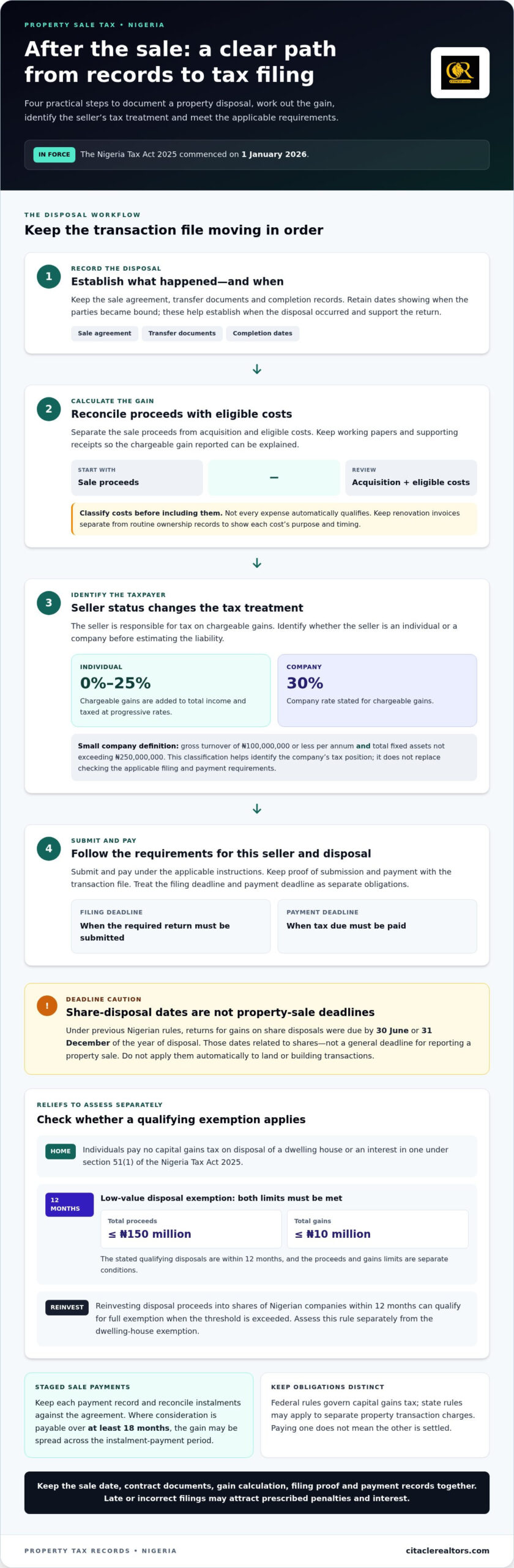
A filing deadline is the date by which a taxpayer must submit a required tax return. A payment deadline is when tax due must be paid. Treat these as separate obligations for property sales, and keep the sale date, contract documents, gain calculation, and payment records together.
A chargeable gain is the taxable gain arising from disposing of an asset. Under the Nigeria Tax Act 2025, the treatment of that gain depends on the taxpayer and the applicable rules. The Act commenced on 1 January 2026, so a disposal falling under its framework should be reviewed using the current filing requirements, rather than assuming an older process still applies.
Use this practical sequence after a property disposal:
- Record the disposal details. Keep the sale agreement, transfer documents, completion records, and dates showing when the parties became bound. These help establish when the disposal occurred and support the return.
- Calculate the gain. Reconcile sale proceeds with acquisition and eligible costs, then retain the working papers and supporting receipts. A clear calculation helps explain the amount reported as chargeable.
- Identify the taxpayer. Record whether the seller is an individual or a company. The distinction matters because the tax treatment and applicable rates differ.
- Submit and pay under the applicable requirements. Follow the filing and payment instructions that apply to the taxpayer and disposal, and keep proof of submission and payment with the transaction file.
Do not mistake dates associated with share disposals for property-sale deadlines. Under previous Nigerian rules, returns for gains on share disposals were due by 30 June or 31 December of the year of disposal. Those dates related to shares, not a general deadline for reporting a property sale. Applying them automatically to a land or building transaction could lead to a missed obligation.
The Nigeria Tax Act 2025 updates filing and withholding obligations and expands revenue authority enforcement powers. A small company is defined under the Act as having gross turnover of ₦100,000,000 or less per annum and total fixed assets not exceeding ₦250,000,000. That classification is relevant when identifying the company’s tax position; it does not replace the need to establish the correct return and payment requirements for its property disposal.
Late or incorrect filings may attract the penalty and interest prescribed for the specific default under the Nigeria Tax Act. The Act also strengthens revenue authorities’ enforcement powers, so an inaccurate gain calculation or unpaid balance can have compliance consequences.
For a sale completed in stages, retain each payment record and reconcile instalments against the agreement. Where consideration is payable over at least eighteen months, the gain may be spread across the instalment-payment period. Matching each receipt to the transaction file makes the reported figures easier to substantiate.
Capital gains tax on property sales
A property disposal is a transfer that may create a capital gain or loss. The Nigeria Tax Act determines whether the gain is taxable and how specific reliefs apply.
Deductible Property Sale Costs
Deductible property sale costs are allowable expenses that reduce the gain used for tax purposes. Keep documents relating to the property’s purchase, sale, and any work or charges connected with the transaction. They help substantiate the figures in your calculation.
Separate sale proceeds from expenses, then retain invoices, receipts, agreements, and proof of payment. Not every expense automatically qualifies, so classify each item under the Act before including it in your calculation. For example, keep renovation invoices separate from routine ownership records to show each cost’s purpose and timing.
Exemptions and Tax Reliefs
An exemption or tax relief removes or reduces tax on a qualifying disposal. Under section 51(1) of the Nigeria Tax Act 2025, individuals pay no capital gains tax when disposing of a dwelling house or an interest in one.
The framework also exempts qualifying disposals within 12 months when total proceeds do not exceed ₦150 million and total gains do not exceed ₦10 million. These are separate limits, and both conditions apply to the stated exemption. Reinvesting disposal proceeds into shares of Nigerian companies within 12 months can qualify for full exemption when the threshold is exceeded. For a property transaction, distinguish these provisions from the dwelling-house exemption and assess each rule on its own terms.
State and Federal Tax Rules
Federal tax rules govern capital gains tax, while state rules may apply to separate property transaction charges. The federal revenue authority collects capital gains tax under the national framework; state authorities administer applicable state-level property charges.
Do not confuse a state transaction charge with capital gains tax or assume that paying one settles the other. The property’s location can affect state charges, while the seller’s tax status and the nature of the disposal shape the federal calculation. Keep separate records for each liability and note the authority responsible for payment. A land transfer may involve obligations distinct from reporting a taxable gain.
Sales of Inherited or Gifted Property
An inherited or gifted property is received without an ordinary purchase by the recipient. A later sale is a disposal, and any resulting gain must be assessed under the rules applicable to that seller and transaction.
For inherited property, retain documents showing the ownership transfer and the deceased person’s estate arrangements. Under the Act, a family arrangement that varies a deceased person’s property dispositions within two years after death is treated as if the deceased made those variations. For a gift, preserve transfer records and evidence of the asset’s value and ownership history to explain the figures used for a later sale.
If you’re preparing an income-producing property for sale, property management support can help with its ongoing oversight while you organise transaction records.
Changes to capital gains tax rates
A capital gains tax rate is the percentage or tax band used to calculate tax on a chargeable gain. Nigeria introduced capital gains tax in 1967 at 20%, then reduced it to 10% under the Investments and Securities Decree before consolidation into the Capital Gains Tax Act.
The Nigeria Tax Act 2025 changed the rate framework and commenced on 1 January 2026. Property gains are no longer charged at a flat 10% rate under the new framework. Instead, the applicable treatment depends on whether the seller is an individual or a corporate taxpayer, and on the relevant income or profit level.
For individuals, chargeable gains are added to total income and taxed at progressive personal income tax rates from 0% to 25%. A progressive rate means the applicable tax band depends on the taxpayer’s income position, rather than applying one flat percentage to every gain. This makes the seller’s broader income relevant to the calculation.
For companies, the capital gains tax rate increased from 10% to 30%. A corporate seller should therefore avoid using the former 10% rate when estimating a property disposal under the new framework. The broader rate structure is described as progressive from 0% to 30%, depending on an investor’s overall income or profit level; the company rate is 30% under the Act.
These changes make the disposal date and seller classification important. For a transaction completed under the framework commencing on 1 January 2026, identify the seller first, then apply the relevant rate treatment to the calculated chargeable gain. Keep the sale agreement, ownership records, cost evidence, and valuation documents together. Those records support both the reported gain and the reason for applying a particular tax treatment.
For an individual seller, a practical review should separate the gain from other income before applying the progressive bands. For a company, the calculation should reflect corporate profits and the 30% rate. Asset valuation can help establish a defensible figure where the transaction documents or property history require careful reconciliation. It does not, by itself, determine the tax rate.
Broader corporate tax reform included an anticipated reduction of the 30% top rate for large corporate investors to 25%. Treat that figure as a reform expectation, not as the company capital gains tax rate stated under the Nigeria Tax Act. For a property sale, the stated company rate remains 30% under the current framework.
- Individual seller: add chargeable gains to total income and apply personal rates from 0% to 25%.
- Company seller: use the 30% capital gains tax rate, not the former flat 10% rate.
- Transaction review: establish the disposal date and seller type before estimating tax.
- Supporting records: retain valuation and cost documents that substantiate the reported gain.
Before relying on an earlier estimate, compare its assumptions with the current framework. A calculation using 10% may not reflect the rules that commenced on 1 January 2026.
Which costs and expenses can be deducted from property sale proceeds in Nigeria?
A deductible cost is an expense the applicable tax rules allow when calculating a chargeable gain. The starting point is not simply the money received at sale; it is the gain calculated under the Nigeria Tax Act 2025, using the transaction’s records and eligible costs.
Keep expenses in separate categories rather than subtracting every payment connected with owning the property. A purchase document, renovation invoice, valuation report, and sale-related receipt each describe a different activity. For each item, record the date, purpose, property, amount in naira, and supporting evidence. This helps assess whether it is relevant to the disposal.
Review documented costs connected with acquiring the property, improving it, and completing its sale. These are categories to assess carefully, not a guarantee that every charge qualifies. A renovation invoice, for example, should describe the work and link it to the property. Do not treat a general household expense or routine ownership bill as deductible simply because the owner paid it.
- Acquisition records: retain the purchase agreement, payment evidence, and documents for transaction-related charges.
- Improvement records: keep contractor invoices and descriptions distinguishing property work from ordinary upkeep.
- Disposal records: file sale agreements, receipts, and evidence for costs incurred to complete the transfer.
- Valuation records: preserve reports supporting property values used in the transaction calculation.
Reconcile each record against the sale agreement and payment history. Exclude expenses that cannot be linked to the property or substantiated with evidence. Separate costs reimbursed by a buyer from amounts borne by the seller to avoid using the same outlay to reduce the gain more than once. Keep the original records alongside a summary explaining how you treated each figure.
The Nigeria Tax Act expressly allows individuals to deduct capital losses when determining total taxable income. A loss on another asset is different from an expense paid to acquire, improve, or sell a particular property. Record the asset, disposal documents, and loss calculation separately, then apply the relevant provisions instead of combining unrelated amounts.
For a practical review, prepare a schedule showing the sale proceeds, each proposed cost, its purpose, and its supporting document. Mark whether each item relates to acquisition, improvement, disposal, or another activity. Assess every cost under the applicable tax provisions before using it to reduce the gain. This helps distinguish a substantiated property cost from a payment that does not qualify.
Do not rely on a bank statement alone to explain an expense. Pair it with an invoice, contract, or receipt identifying the work and property. A file that documents the transaction and its purpose gives a clearer basis for reporting the chargeable gain.
Are there exemptions or reliefs from capital gains tax on Nigerian property sales?
An exemption removes tax on a qualifying disposal, while relief reduces or defers tax under specific conditions. The Nigeria Tax Act 2025 provides several routes, but each depends on the asset, seller, transaction, and relevant time period.
Dwelling-house exemption
A dwelling-house exemption means an individual pays no capital gains tax when disposing of a dwelling house or an interest in one. Section 51(1) of the Nigeria Tax Act 2025 provides this treatment. Identify the property and the seller’s interest, then retain ownership and sale documents supporting the claim. The exemption concerns a dwelling house, so don’t assume it covers every land or investment property disposal.
Low-value disposal threshold
A low-value disposal exemption applies when qualifying sales remain within the Act’s proceeds and gain limits. The framework exempts qualifying disposals within 12 months when total sales proceeds do not exceed ₦150 million and total gains do not exceed ₦10 million. Both limits matter: meeting one does not satisfy the other.
To assess this route, total the relevant proceeds and gains across the stated 12-month period. Keep the sale agreements and gain calculations together, rather than assessing each transaction in isolation. For example, a seller considering multiple disposals should compare the combined figures with both thresholds before treating any sale as exempt.
Reinvestment and replacement-asset relief
Reinvestment relief changes the tax treatment when disposal proceeds are applied to a qualifying investment. If the low-value thresholds are exceeded, reinvesting proceeds into shares of Nigerian companies within 12 months qualifies for full exemption under the new framework. Keep evidence of the disposal, reinvestment, amounts, and dates to show how the transaction meets the conditions.
Replacement-asset treatment may also apply to compensation for a lost or destroyed asset. In Nigeria, the compensation may qualify if applied to acquire another asset within three years of receipt. This rule concerns qualifying compensation and replacement, not an automatic exemption for every property sale.
Reliefs are not interchangeable
Each exemption has its own qualifying conditions, and one route should not be substituted for another. The Nigeria Tax Act 2025 also provides relief for certain corporate reorganisations and reinvestments, subject to applicable conditions. Separately, businesses can no longer defer capital gains tax merely by reinvesting proceeds from disposing of a business asset into a replacement asset of the same class.
Before relying on a relief, identify the seller, property or asset, disposal date, proceeds, gain, and any reinvestment or compensation timeline. Keep supporting documents with the tax calculation. This record clarifies which provision applies and why the disposal meets its requirements.
Citacle Realtors: Property Management
Citacle Realtors provides Property Management for owners who need support overseeing a property after a sale or while preparing for a future transaction. This can be a practical next step when ongoing property responsibilities compete with organising ownership records and sale documents.
For properties requiring upkeep, Facilities Management supports the day-to-day environment, while Property Renovations can address improvement needs. If you’re considering a new property, Citacle Realtors also offers Residential Land Sales and Duplex Rentals. These services support property decisions and management, while tax calculations and filing remain separate matters.
To discuss property management or another real estate need, please contact Citacle Realtors or visit citaclerealtors.com.
Plan Your Next Property Move With Confidence
A property decision does not end when the sale documents are signed. Organise your records, clarify your plans for the asset, and decide how you want to manage or reinvest in property. A well-organised transaction file can also make future ownership decisions easier.
For capital gains tax on property sales in Nigeria, tax planning and real estate support serve different purposes. Citacle Realtors can assist with Property Management and Facilities Management for ongoing property needs, as well as Residential Land Sales if you’re considering another land purchase. These services complement your property plans; they don’t replace tax filing or professional tax advice.
Whether you’re preparing a property for sale, overseeing an existing asset, or exploring a new purchase, choose a next step that fits your goals and documentation. Contact Citacle Realtors about property sales to discuss your real estate needs. With clear records and a considered plan, you can move forward with greater confidence.
Frequently Asked Questions
What is Nigeria’s capital gains tax rate on property sales?
For capital gains tax on property sales in Nigeria, the rate depends on whether the seller is an individual or a company. Under the Nigeria Tax Act 2025, individuals’ chargeable gains join their total income and face progressive personal income tax rates from 0% to 25%; companies are taxed at 30%. An individual disposing of a dwelling house or an interest in one has a separate exemption under section 51(1).
How is chargeable capital gain calculated when selling property in Nigeria?
Chargeable gain is the amount remaining after the disposal proceeds and permitted tax adjustments are accounted for. Begin with the sale consideration, then support the acquisition figure and any claimed adjustments with transaction documents. The disposal date matters: under section 23(4), an asset is generally treated as disposed of when there is a binding duty to dispose of it. Keep the signed agreement and payment records together to substantiate your calculation.
How does capital gains tax apply to residential property, land, and commercial property in Nigeria?
Property type affects which relief may apply, but the seller and disposal also matter. An individual disposing of a dwelling house or an interest in one is exempt under section 51(1) of the Nigeria Tax Act 2025. That specific exemption does not automatically cover land held separately or commercial property. Assess those disposals under the general rules, then consider whether another qualifying exemption or relief fits the transaction.
What is the deadline and process for filing and paying capital gains tax in Nigeria?
Use the filing and payment deadline that applies to the seller’s property disposal under the Nigeria Tax Act framework; dates for share disposals are not property deadlines. First establish when the disposal occurred, including when a binding duty arose under section 23(4). Then calculate the chargeable gain, prepare the relevant return, pay the amount due, and keep submission and payment evidence with the sale agreement and calculation records.