

What if the tenancy agreement you copied leaves out a responsibility that you and your landlord understood differently? Creating a tenancy agreement in Nigeria takes more than filling in names and rent. The terms should reflect the property, the rental arrangement, and the rules that apply where the property is located.
A clear written record helps prevent confusion, but a generic template may leave out important details such as payment dates, repairs, deposits, permitted use, and how the tenancy can end. Requirements and procedures can vary by state, so an agreement that works for one property may not suit another.
This practical 2026 guide explains how to gather the key details, draft and review the agreed terms, and document the arrangement before signing. It also covers why execution and record-keeping matter, which state-specific rules to verify, and when legal guidance may be useful. Clear documentation gives both parties a shared understanding and supports a more orderly rental relationship from the outset.
Key Takeaways
- Creating a tenancy agreement in Nigeria starts with recording the terms both parties have actually agreed to, not relying on a generic template alone.
- Identify the essential clauses, from the parties and property to rent, deposits, utilities, occupants, and shared responsibilities.
- Separate practical contract details from legal requirements, which may vary by state and need current local verification.
- Review the agreement carefully before signing to catch errors in names, dates, property details, payment terms, and responsibilities.
- After signing, keep accessible copies and record the property’s condition, inventory, keys, and meter readings.
Why create a written tenancy agreement in Nigeria?
A written tenancy agreement records the terms a landlord and tenant have agreed to for occupying a property. It gives both parties a shared reference for practical details, including when the tenancy begins, how rent is paid, how the property may be used, and who is responsible for particular tasks.
Clarity matters because a conversation can leave room for different interpretations. For example, “rent is paid monthly” doesn’t specify the payment date or method. A written clause can state both, so neither party has to guess later. The same applies to repairs: recording how maintenance concerns should be reported and which responsibilities belong to each party can reduce uncertainty when an issue arises.
Messages and emails may show how discussions developed, but they can be spread across conversations or fail to capture the final arrangement. An unsigned draft may also contain proposed terms the parties haven’t accepted. Before relying on a document, confirm that it reflects the final agreement and has been completed by the relevant parties. A written agreement supports clarity, but it doesn’t replace applicable legal requirements.
A tenancy agreement is the shared written record of the terms the landlord and tenant have agreed to follow.
Creating a tenancy agreement in Nigeria also means considering the property’s location and the circumstances of the tenancy. Relevant laws and procedures may differ between states, and the requirements can depend on the arrangement. Treat practical clarity and legal compliance as connected but separate tasks: write the terms precisely, then verify the current requirements for the state where the property is located.
Who should be named in the tenancy agreement?
Use each landlord’s and tenant’s correct legal name and reliable contact details. If someone signs on another person’s behalf, identify who they represent and their capacity to sign. Name every co-tenant who will share responsibility under the agreement. If other people may live at the property, distinguish permitted occupants from tenants so the document accurately describes each person’s role.
What does a written agreement help prevent?
A clearly recorded rent amount and payment schedule can prevent disagreement about what is owed and when. The agreement can also explain the parties’ approach to property care, maintenance requests, utilities, and shared spaces. These details are useful when memories differ or a question comes up months after move-in. Avoid broad phrases such as “tenant handles repairs” without defining what the parties mean. Instead, describe the responsibilities they have actually agreed on. This gives both parties a clearer basis for communication and day-to-day property management.
Which clauses should a Nigerian tenancy agreement include?
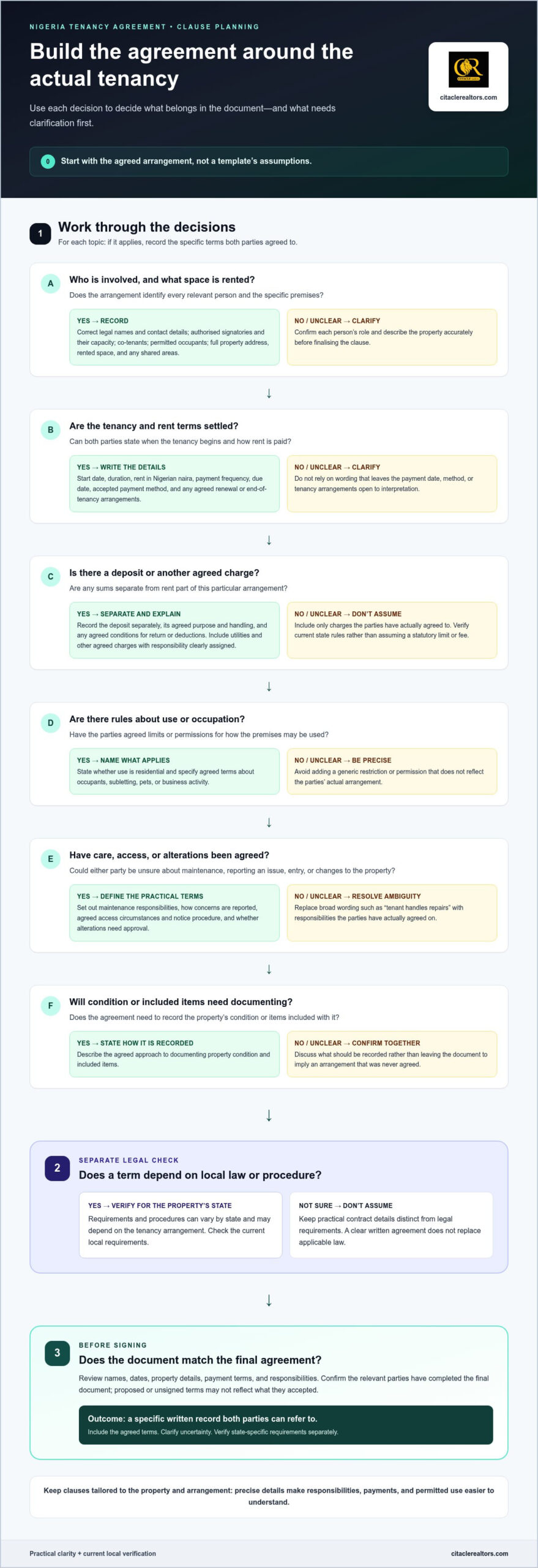
A useful agreement answers practical questions about the specific property and tenancy. Start with the landlord’s and tenant’s legal names, the property’s full address, and a clear description of the rented space. If the tenancy covers a flat within a larger building, identify the flat and any shared areas the tenant may use.
Record the start date, duration, rent, payment frequency, due dates, and agreed payment method. State any renewal or end-of-tenancy arrangements clearly, rather than assuming a template’s wording suits the circumstances. The agreement should also say whether the premises are for residential use and identify any agreed limits or permissions that apply to the property.
Use this checklist to organise the discussion. Include only terms that reflect the parties’ actual arrangement, and tailor each clause to the property:
- People and premises: Landlord, tenant, authorised signatories, permitted occupants, and an accurate property description.
- Tenancy and rent: Start date, duration, rent amount, payment schedule, due date, and accepted payment method.
- Deposits and utilities: Any deposit, its purpose and handling terms, plus responsibility for utilities and other agreed charges.
- Use and occupation: Permitted use and specific agreements about occupants, subletting, pets, or business activity.
- Care and access: Maintenance responsibilities, how issues are reported, access arrangements, and any agreed notice procedure.
- Changes and condition: Whether alterations need approval and how the property’s condition or included items will be recorded.
How should rent, deposits, and payment terms be recorded?
State the rent in Nigerian naira and specify whether it is paid monthly, yearly, or on another agreed schedule. Include the due date and payment method so neither party has to infer them later. Record any deposit separately from rent. Explain its agreed purpose and how it will be handled, including any agreed conditions for its return or deductions. Don’t assume a statutory limit or fee applies without checking the current rules for the property’s state and tenancy.
How can responsibilities and property use be made clear?
Describe each party’s maintenance responsibilities in practical terms. For example, state how the tenant should report a leak and clarify which responsibilities the landlord has agreed to handle. Set out any agreed rules about occupants, subletting, pets, or business use. For access, specify the circumstances, communication method, and notice procedure agreed by both parties. Avoid vague wording that leaves either person unsure about what will happen.
Before using a template, compare every clause with the actual property and arrangement. A clause about shared facilities may matter in a multi-unit building but not in a standalone home. State-specific review matters too, because legal requirements may vary. Clear documentation supports orderly property management, while legal questions about a clause should be checked against guidance for the relevant jurisdiction.
Which Nigerian legal and state-specific requirements should you check?
Nigeria doesn’t have one tenancy rulebook that can safely be applied to every property. Laws and procedures may differ by state, and the relevant position can also depend on the tenancy and the terms involved. Start by identifying the state where the property is located. Don’t assume that a rule or practice discussed for one state applies nationwide.
Keep two checks distinct. First, make sure the agreement is clear: the parties, property, payment terms, responsibilities, and other agreed conditions should be recorded accurately. Then verify the legal and administrative requirements that may apply locally. These can include rules affecting notices or recovery of premises, as well as whether stamping or registration is required and which process applies. A template’s wording alone doesn’t establish compliance.
Use this comparison to organise the review:
General drafting checks: Confirm that the agreement accurately describes the parties, premises, tenancy dates, rent, payment arrangements, responsibilities, and all other agreed terms. Check that the clauses suit the property and don’t contradict one another.
State-specific checks to verify: Confirm which local tenancy laws and procedures apply. Review current, authoritative guidance for the property’s state and the circumstances of the agreement, including any requirements affecting tenancy duration, notices, recovery procedures, stamping, or registration.
Stamp-duty and registration questions deserve particular care. Don’t assume every agreement follows the same process or that a figure or procedure in a general online template is current. Verify the applicable rules for the document and tenancy before signing or completing any required administrative step. This keeps a general drafting checklist from being mistaken for a legal conclusion.
How do state-level differences affect a tenancy agreement?
Start with the property’s location, not the landlord’s address or where the parties happen to sign. Then check the current state-level rules relevant to the tenancy. Duration, notice procedures, recovery of premises, and administrative steps may need local review. If a property or arrangement involves more than one jurisdiction, get guidance on which rules apply instead of borrowing a clause from another state’s template.
When should the agreement receive legal review?
Seek review from a qualified legal professional if the terms are unusual, the parties already disagree, ownership or signing authority is complex, or you’re unsure how a legal requirement applies. A generic online template can help organise information, but it may not fit the property, transaction, or current local rules. A drafting checklist helps organise agreed terms; it isn’t legal advice on whether those terms comply with the law.
Creating a tenancy agreement in Nigeria is both a practical record-keeping task and a jurisdiction-specific process. Use the draft to record what the parties have agreed, then verify legal and administrative questions against current, authoritative guidance for the state where the property is located. Keeping those tasks distinct helps produce clear documentation without treating general guidance as a substitute for local legal review.
How do you create, review, and sign the agreement?
A reliable process gives both parties time to confirm the details before the tenancy begins. Gather the information, prepare a complete draft, then review and sign only after questions or changes have been resolved. When creating a tenancy agreement in Nigeria, include state-specific legal and execution checks in the process rather than leaving them until the end.
What information should you gather before drafting?
Collect each party’s correct legal name and contact details, and clarify who has authority to sign for a landlord or tenant. Confirm the property’s full description, the agreed tenancy dates, rent and payment arrangements, and each party’s responsibilities. Gather any inventory, condition notes, or property rules that will accompany the agreement so the draft reflects the complete arrangement.
Once the information is ready, work through these steps in order:
- Confirm the parties and property. Check names and contact details against reliable records, identify any authorised representative, and ensure the property description identifies the premises being rented.
- Agree the practical terms. Settle the start date, duration, rent, payment schedule, deposit terms, permitted use, occupants, utilities, and responsibilities. Resolve differences before putting the terms in the draft.
- Prepare and share a complete draft. Include every agreed term and any intended attachments, such as an inventory or property condition record. Give both parties the complete version to review before signing, not selected pages or an incomplete draft.
- Review it together. Check names, dates, property details, payment terms, and responsibilities line by line. Look for inconsistencies, missing attachments, or wording that could mean different things to each party.
- Resolve changes and verify formalities. Make amendments clearly in the document and ensure all relevant parties acknowledge the final wording. Before execution, verify any signing, witness, stamping, or registration requirements that apply to the property’s state and circumstances.
- Sign, exchange, and retain records. Follow the applicable execution process and ensure each party receives a complete signed copy. Keep related payment records and property documents with the agreement in an accessible, secure place.
What should both parties review before signing?
Read the final version, not an earlier draft, and confirm that it contains every agreed term without conflicting clauses. Check that names, dates, rent details, the property description, and responsibilities are accurate. Make sure every amendment appears in the copy everyone will sign. Signing and witnessing formalities can depend on applicable law and the circumstances, so verify them through current local guidance or qualified legal advice.
Good record-keeping continues after execution. Store the signed agreement alongside receipts or other evidence of payments, the inventory, condition notes, and relevant property communications. Together, these documents provide a fuller reference if questions arise during the tenancy and support orderly property management.
For support with the wider rental and property-management process, explore property management support.
What should landlords and tenants do after signing?
Signing starts the tenancy record; it doesn’t finish the paperwork. The landlord and tenant should each receive a complete copy of the signed agreement, including any schedules or attachments. Save a digital copy in a secure, accessible place and keep a printed copy if useful. Both parties should be able to retrieve the same final version if a question arises during the tenancy.
As part of creating a tenancy agreement in Nigeria, document the handover and keep a clear record of what happens afterward. The agreement records the terms; dated property records, payment evidence, and written communications help show how those terms are being carried out.
How should the property handover be documented?
Prepare a dated condition record at handover and keep it with the signed agreement. Describe fixtures and included items, note existing damage or defects, and record how many keys were provided. Where relevant, capture utility meter readings and identify which meter each reading relates to. Both parties should retain the same inventory and condition record as a shared reference if the property’s state is discussed later.
- Record the condition of rooms, fittings, and included appliances, and describe visible issues clearly.
- List keys and access items handed over, and record relevant utility readings with the date.
- Keep copies of the inventory and condition notes with the agreement for both parties.
A structured walk-through can help tenants make consistent observations. The Duplex Inspection Checklist for Tenants is a related resource to use when organising an inspection.
How can professional management support clear tenancy records?
Keep later records in date order. Save payment confirmations and receipts, copies of notices, written approval for agreed changes, and messages about maintenance issues. If a repair is reported, note when it was raised, what was communicated, and any agreed next steps. Record changes to the arrangement in writing and keep them with the original agreement. Don’t rely on a verbal understanding as the only record of an important change.
Organised records can make communication and property oversight easier for landlords and tenants. A consistent approach to documents, handover notes, and maintenance correspondence is part of responsible property management. For more on the ongoing oversight of a rental home, consult the Residential Property Management Guide.
Citacle Realtors provides property and facilities management to support orderly property oversight and rental relationships. If you’re looking for help managing a property, explore Citacle’s property-management services.
Build a More Confident Rental Relationship
Use your agreement as the starting point for a well-organised tenancy, not a document to file away and forget. Keep communication open, preserve a clear record of decisions, and revisit the agreed process whenever the tenancy changes. If a clause raises a legal question, seek guidance that reflects the property’s location and circumstances.
Creating a tenancy agreement in Nigeria is one part of building a rental relationship with shared expectations. The next step is to support those expectations with thoughtful property oversight. Citacle Realtors facilitates rental opportunities and provides property and facilities management to help landlords manage their assets and rental arrangements with care.
Explore Citacle Realtors’ property management support and take a confident next step toward a more orderly rental experience.
Frequently Asked Questions
Is a written tenancy agreement mandatory in Nigeria?
A written agreement may not be a universal precondition for every tenancy in Nigeria, but the rules and consequences can depend on the property’s state and the arrangement. A tenancy without a signed document may still involve rights and obligations under applicable law. In practice, a written record helps establish what the parties agreed, especially if memories or messages conflict. Check local requirements rather than assuming that an oral arrangement has no legal effect.
Can a tenancy agreement be handwritten in Nigeria?
A tenancy agreement can generally be handwritten if its terms are legible, complete, and accepted by the parties, but handwriting alone doesn’t establish that every legal or administrative requirement has been met. Unclear corrections or missing pages, for example, can create uncertainty about the final wording. Ensure all parties sign the same complete version, retain matching copies, and verify any applicable execution formalities for the property’s state.
What should a tenancy agreement include in Nigeria?
Include enough detail to identify the arrangement without relying on assumptions. Alongside the parties, premises, rent, and dates, clarify whether parking, a store, or shared facilities are included, and record any agreed restrictions on their use. State how the parties will communicate about urgent property issues and which contact details to use. Tailor the wording to the actual tenancy, since a clause suited to one property may not fit another.
Does a tenancy agreement need to be stamped or registered in Nigeria?
Stamping or registration requirements depend on the applicable rules and the document’s circumstances, so there isn’t one safe assumption for every tenancy nationwide. Before signing or completing administrative steps, verify whether they apply to the property and agreement in question, and confirm the current procedure with authoritative guidance for that state. Don’t rely only on an online template or advice written for a different tenancy type.
Can a landlord change the terms after both parties sign?
A landlord generally shouldn’t treat signed terms as changeable unilaterally. If the parties want to alter a rent arrangement, permitted use, or another condition, record the proposed change and obtain the relevant parties’ agreement in writing. Keep the signed amendment with the original document. If the agreement provides a process for a particular change, review that wording and seek local legal guidance if its effect is unclear.
What happens if a tenant or landlord breaches the agreement?
A breach may lead to a request to correct the issue, a dispute, or legal action, depending on the term, circumstances, and applicable state rules. Keep relevant evidence, such as payment records, dated messages, notices, and photographs, and communicate the concern clearly in writing. Don’t assume that a contract clause authorises immediate eviction, withholding payment, or another remedy. Get jurisdiction-specific legal advice before taking consequential action.
How should a tenancy agreement be changed or renewed?
Document a change in a written amendment that identifies the original agreement, states exactly what is changing, and records when the change takes effect. Have all relevant parties approve and sign it, then attach it to their copies. For renewal, confirm the new term and any revised conditions before the existing arrangement ends. Check current local requirements, especially if the renewal changes the tenancy duration or other significant terms.