

A dependable rental decision comes from consistent evidence, not a convincing first impression. If you’re learning how to screen tenants for a rental property, it’s natural to worry about missed rent, property damage, or making a decision that feels unfair. A clear process can help you assess applicants with confidence while keeping the experience professional for everyone.
The aim isn’t to find a flawless applicant. It’s to review relevant information consistently, verify details responsibly, and base your decision on evidence rather than assumptions. You’ll learn what information and references may be useful, how to compare applications against the same criteria, and why keeping clear records matters. Because applications contain personal information, request only what’s relevant and handle it with care.
This guide walks through a practical screening process for Nigerian property owners, from setting criteria before applications arrive to documenting your final decision. Thoughtful tenant selection supports the wider goal of protecting your property and creating a dependable rental experience. Owners who want support with rental oversight can also consider professional property management to help organise the responsibilities involved.
Key Takeaways
- Learn how to screen tenants for a rental property with a consistent process based on relevant information, not first impressions.
- Use a clear workflow to collect applications and verify identity, income, rental history, and references responsibly.
- Compare applicants against the same criteria, separating verified evidence from details that still need clarification.
- Set your screening criteria and record-keeping steps before reviewing applications to support fair, well-documented decisions.
- See how professional property management can support rental oversight alongside the goal of protecting property condition.
What tenant screening means, and what it can realistically tell you
Tenant screening is the process of gathering and assessing relevant information about a prospective tenant before agreeing to a tenancy.
Its purpose is to help you make an informed decision, set clear expectations, and reduce avoidable misunderstandings. A structured review can bring useful details together, but it cannot predict everything that may happen during a tenancy. As this overview of the tenant screening process and purpose explains, screening can involve different kinds of checks. The value lies in considering relevant information carefully, not collecting documents without a clear reason.
Which rental risks can screening help you assess?
Each check can help you understand a different part of an applicant’s circumstances. Identity information helps confirm who is applying. Income details may help you assess whether the proposed rent appears manageable based on the information provided. Rental history can offer context about previous tenancies, while references may provide another perspective on reliability or communication.
These are useful indicators, not a score of someone’s character. A verifiable gap or inconsistency in an application is a reasonable point to clarify. An assumption based on a person’s appearance, background, family situation, or another irrelevant trait is not evidence of tenancy suitability. Keep questions connected to the tenancy and apply the same standards to each applicant.
A completed application makes the review more orderly. It gives you a consistent record of the information requested, the applicant’s responses, and any details that still need clarification. Before requesting a document or reference, consider what it will help you assess and explain that purpose to the applicant. This keeps the process focused and respectful.
What tenant screening cannot prove
Past conduct does not guarantee future conduct. A positive reference from a previous landlord cannot promise that rent will always be paid on time or that a property will be cared for perfectly. Likewise, a previous difficulty does not automatically establish that an applicant will repeat it. Screening provides context for a decision, not certainty about what comes next.
Records may be incomplete, difficult to verify, or unavailable for reasons that have little to do with suitability. Treat missing information as a prompt for careful follow-up: ask a relevant question, allow the applicant to explain, and note what remains unresolved. Don’t turn silence or an incomplete record into a conclusion without considering the circumstances and the standard you would use for other applicants.
Understanding how to screen tenants for a rental property also means recognising that screening is only one part of responsible property management. Clear tenancy expectations, ongoing communication, and attention to property condition still matter after an agreement begins. A careful review can support a sound decision, while dependable oversight helps you manage responsibilities throughout the tenancy.
How to screen tenants: verify identity, income, rental history, and references
A repeatable workflow helps you gather useful information without making an application unnecessarily intrusive. Before requesting documents, explain what you need, how it relates to the tenancy, and how you’ll use the information. Apply the same steps to each applicant, and tell them before contacting a reference or employer. Obtain permission before making those contacts.
What information should a rental application request?
Keep the application focused on details that help assess the proposed tenancy: identity and contact information, intended occupants, relevant rental history, and, where appropriate, information about income or employment. Ask for evidence only when it serves a clear purpose. Request reference contact details from the applicant and explain whom you plan to contact and what you hope to verify.
How to verify applicant information responsibly
Compare supporting documents with the application, note material inconsistencies, and give the applicant a reasonable opportunity to explain them. Use the same approach when contacting listed employers or previous landlords, and record the date, contact method, and relevant response. Limit access to applicant records, store them securely, and avoid retaining information you no longer need.
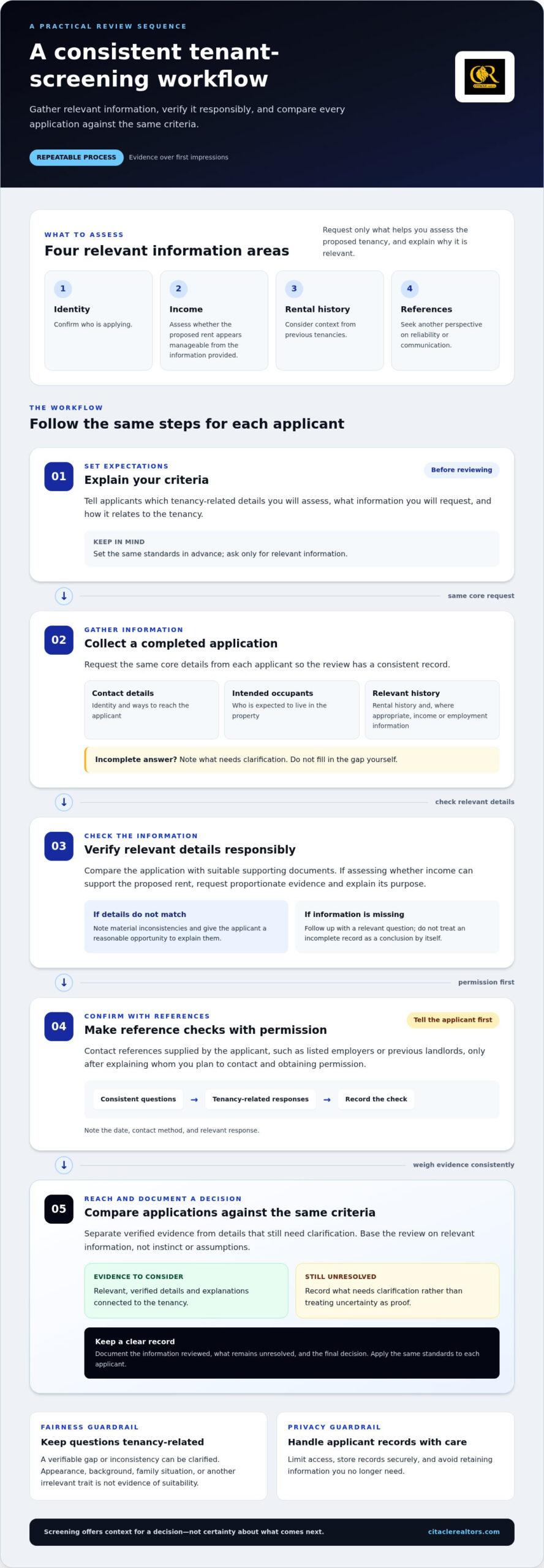
Use this ordered process to keep your review clear and consistent:
- Explain your criteria. Tell applicants which tenancy-related details you’ll assess and what information you’ll request. Clear expectations help people provide relevant details from the outset.
- Collect a completed application. Gather the same core information from each applicant, including contact details, intended occupants, and relevant rental history. If an answer is incomplete, note what needs clarification rather than filling in the gap yourself.
- Verify relevant details. Compare the information provided with suitable supporting documents. For example, if you’re assessing whether income can support the proposed rent, request proportionate evidence and explain why it’s relevant.
- Make reference checks with permission. Contact references supplied by the applicant, using a consistent set of tenancy-related questions. Record what the reference confirms and distinguish it from information that remains unverified.
- Assess and document. Consider the evidence against your stated criteria, note any follow-up, and record the reasons for your decision. Keep observations factual and avoid treating personal impressions as verified information.
Screening methods should account for the limits and potential biases of available records. The Urban Institute’s discussion of inclusive tenant screening practices highlights why fair decisions require care in how screening information is interpreted, not simply collected.
Privacy and tenancy requirements can depend on applicable Nigerian rules. Have a qualified Nigerian legal reviewer assess your application, consent, and record-handling practices before using them. Screening is also one part of wider rental oversight. Owners can explore professional property management for support with property responsibilities.
How to compare rental applicants using evidence, not instinct
Once you’ve gathered the relevant information, review applicants side by side against the same criteria for the same property. A simple comparison helps you see what is supported by documents, what an applicant has reported, and what still needs clarification. It also makes it easier to explain how you reached a decision without relying on memory or a first impression.
Consistent criteria make decisions fairer because each applicant is assessed against the same tenancy-related evidence.
Which criteria belong in a fair comparison?
Focus on factors that relate directly to the tenancy, such as documented income, relevant rental history, references, and whether the application is complete. Decide what each criterion means before reviewing applications, then apply it equally. Avoid irrelevant personal characteristics, assumptions, and informal hearsay. For more background on screening reports and common checks, consult the American Apartment Owners Association’s tenant screening overview.
Use a comparison grid like this, changing the criteria only when they are not relevant to the property or tenancy:
Criterion: Income evidence
Applicant A: Document provided and details align with application
Applicant B: Applicant-provided information; supporting document not yet received
Criterion: Rental history and references
Applicant A: Reference response recorded
Applicant B: Reference contact details supplied; response pending
Criterion: Application completeness
Applicant A: Required relevant sections completed
Applicant B: One relevant detail needs clarification
The grid is a record, not an automatic ranking. Consider affordability evidence in relation to the rent and the information available, rather than applying an arbitrary standard without context. A reference can add useful perspective, but weigh what it specifically confirms. Application completeness can identify follow-up needs, but it is not proof of reliability. Keep confirmed facts separate from statements supplied by the applicant.
How to interpret gaps and conflicting information
A missing document and a proven inaccurate statement are different findings. If details conflict, identify the specific discrepancy and give the applicant a reasonable opportunity to explain or provide relevant clarification. Record the response, the evidence reviewed, and anything that remains unverified. This creates a transparent basis for your assessment while avoiding conclusions based only on incomplete records.
For example, if an income document does not cover the period described in the application, note the gap and request relevant clarification rather than immediately treating the account as false. If a reference cannot be reached, record that it remains unverified. Don’t treat an unanswered call as a negative reference. Use the same follow-up approach for each applicant.
Learning how to screen tenants for a rental property includes deciding how evidence will be weighed, not simply collecting it. Clear comparisons support accountable rental oversight and help owners keep property decisions organised. For owners managing several rental responsibilities, professional property management can support the broader work of overseeing a rental property.
Create a consistent tenant-screening policy before reviewing applications
Set your screening policy before applications arrive. Deciding what matters after meeting applicants can lead to shifting standards, uneven requests, and decisions that are difficult to explain. A written process gives you a steady reference point: it clarifies what information you’ll request, how you’ll assess it, and what you’ll record. It also helps applicants understand what to expect.
Keep each criterion relevant to the tenancy and apply it consistently to everyone applying for the same property. A policy should describe the evidence you’ll consider, not promise a particular outcome. Review it when your application process changes, and have a qualified Nigerian legal reviewer assess it against current privacy and tenancy requirements before use.
What to include in a screening checklist
A useful checklist connects each request to a clear purpose. Identity details help establish who is applying, income evidence may inform an affordability assessment, and rental references can provide context about previous tenancies. Request only relevant information, explain why you need it, and use the same verification sequence and response expectations for each applicant.
- Requirements: List the tenancy-related details, documents, and references you request, with a brief reason for each.
- Verification steps: Set out how you’ll review documents and contact references, including how applicants can clarify missing or inconsistent information.
- Decision records: Note the evidence considered, follow-up questions, unresolved points, and reasons for the final decision.
- Information handling: Decide who can access application records, where they’ll be kept, and when information is no longer needed.
- Applicant updates: Specify how you’ll acknowledge applications, request clarification, and communicate decisions professionally.
This structure makes the process easier to repeat without turning it into a rigid formula. If an unusual situation arises, document the relevant facts and explain how you applied the policy rather than quietly changing the criteria for one applicant. Looking at how established real estate agencies like Elite Agents & Partners operate can also help owners see how structured tenant screening connects with professional property management and ongoing oversight.
How to communicate a decision respectfully
Keep messages concise, factual, and consistent with the process you explained. Tell each applicant about their own application only. Don’t disclose another person’s documents, circumstances, or decision. If you request further information, identify what is missing and allow a clear opportunity to respond. Before using any formal notice or stating a legal reason for a decision, have a qualified reviewer check the applicable requirements.
A well-documented policy turns how to screen tenants for a rental property into a repeatable owner practice, rather than an improvised judgment call. Owners can learn more about Citacle’s property management support as part of planning their wider rental oversight.
When professional property management can support tenant screening
Screening is one important decision in a rental relationship, but it sits alongside property readiness, communication, and ongoing oversight. Owners with limited time, multiple rental responsibilities, or a property they manage from a distance may value professional support to keep these responsibilities organised. That support can bring structure to rental oversight, though no screening process can guarantee a particular tenant outcome.
How screening fits into the wider rental-management picture
Tenant selection connects to the practical work that happens before and during a tenancy. A property needs to be ready for occupation, expectations should be communicated clearly, and responsibilities for ongoing care need attention. Clear records and communication can help establish an orderly relationship, while consistent oversight helps owners stay engaged with the condition and management of the property.
Careful screening alone can’t prevent late payment, disagreements, or damage. A tenancy unfolds over time, so owners still need to manage communication and property matters after an applicant has been selected. Property and facilities management can provide broader support with rental responsibilities, helping owners consider tenant selection as one part of protecting property condition and maintaining a dependable rental experience.
Citacle Realtors is a Nigerian real estate firm providing property and facilities management and supporting residential rentals nationally. For owners, this property-management perspective is relevant when rental oversight involves more than reviewing applications. It helps place tenant selection within the wider responsibilities of managing a residential property, without treating screening as a guarantee of future conduct.
Owners can also look to residential estate and lettings specialists such as winfieldsproperty.co.uk as a point of reference when considering how applicant review fits alongside property oversight and the rental experience they want to maintain.
A practical next step for rental property owners
Start by reviewing your current application and record-keeping process. Ask yourself whether your criteria are written down, whether you request only relevant information, and whether you can follow the reasons behind a past decision. Then identify which responsibilities take the most time or are hardest to manage consistently, such as property readiness, applicant communication, or ongoing oversight.
This reflection can clarify whether you need to refine your own process or would value professional support with broader rental management. As you put into practice how to screen tenants for a rental property, keep your approach fair, documented, and connected to the wider care of the asset.
For support with rental oversight, explore Citacle’s property management services.
Make your next rental decision with confidence
Your next step is to turn your screening approach into a practical routine you can use each time a property becomes available. Review your application before sharing it, consider whether each request serves a clear purpose, and identify which parts of rental oversight you want to handle yourself. A process that works for one property may need adjusting as your responsibilities change, so keep it clear and adaptable.
If you’re considering how to screen tenants for a rental property alongside the wider demands of rental ownership, professional guidance can help you approach the work with greater structure. Citacle supports property owners across Nigeria through property and facilities management, as well as residential rentals.
Take the next step at a pace that suits your goals. Explore Citacle’s property management services for support managing your rental property with care and professionalism.
Frequently Asked Questions
Is tenant screening legal in Nigeria?
Tenant screening may be part of a landlord’s rental decision, but the checks you use and how you handle applicants’ personal information must comply with applicable Nigerian requirements. Don’t assume a process used in another country automatically applies here. Before collecting identity documents, contacting references, or retaining application records, have a qualified Nigerian legal reviewer assess your approach, especially if you plan to use a standard form or screening report.
What documents should a landlord request from a prospective tenant?
Request documents that help clarify tenancy-related details, such as identity and contact information, intended occupants, relevant rental history, and, where appropriate, evidence of income. For example, an applicant might provide a suitable income document to support information about their ability to meet rent. Explain the reason for each request, and avoid gathering sensitive material that has no clear bearing on the tenancy. A focused request is easier for applicants to understand and respond to.
Can a landlord contact an applicant’s employer or previous landlord?
A landlord can seek relevant information from an employer or previous landlord, but should tell the applicant and obtain their permission before making contact. Ask only questions connected to the tenancy, such as confirming the applicant’s stated employment or clarifying a previous rental arrangement. Use the same approach for each applicant, and keep a factual note of what was confirmed. Have a qualified Nigerian legal reviewer assess your consent and information-handling practices.
How do you verify a tenant’s income and rental history?
To assess how to screen tenants for a rental property, compare income evidence with the details the applicant supplied, and check whether the information relates to the proposed tenancy. For rental history, contact the reference named by the applicant and ask focused questions about the period and arrangement they described. Record what the document or reference actually supports. If a source cannot be reached, mark the detail as unverified rather than treating it as negative evidence.
What should a landlord do if an applicant’s information does not match?
Pause and identify the exact discrepancy before making a decision. A difference in a date or an income period, for instance, may reflect an error, a change in circumstances, or a misunderstanding. Ask the applicant to clarify and, if relevant, provide supporting information. Keep a record of the question, response, and any evidence reviewed. Distinguish an unresolved detail from information you have verified as inaccurate; they are not the same finding.
Can a landlord reject a rental application after screening?
A landlord may decide not to proceed after reviewing an application, but the decision should follow relevant criteria applied consistently and should not rely on discriminatory assumptions. Record the tenancy-related reasons behind the decision, and communicate it professionally without disclosing another applicant’s information. Before sending a formal notice or relying on a specific legal ground, have a qualified Nigerian legal reviewer check the applicable requirements. Screening evidence can inform a decision, but it doesn’t remove the need for care.