

The lowest quoted fee can become the costliest arrangement if essential work sits outside the agreement. When reviewing a property management fee structure in Nigeria, it’s understandable to focus on the headline percentage, but that figure alone won’t show what you’ll receive or what may be charged separately.
A fair arrangement is defined by its scope, calculation basis and accountability. This guide explains common ways management fees may be calculated, how to distinguish ongoing oversight from additional charges, and what details to compare across proposals. You’ll also learn what to clarify about rent calculations, maintenance approvals, reporting and other responsibilities before you agree to an arrangement.
Property management is more than a deduction from rent. Professional oversight can help maintain a property’s functionality and support its value over time. With a clear understanding of the services and costs set out in an agreement, you can assess whether the arrangement suits your property and management needs.
Key Takeaways
- A property management fee structure sets out how charges are calculated, when they’re payable, and which services the agreement covers.
- Compare percentage-based and flat-fee models by looking closely at the calculation basis, not just the headline charge.
- Use a side-by-side review of duties, exclusions, additional charges, and reporting to assess whether a proposal offers clear value.
- Before agreeing, define your needs and check the rental-income basis and payment timing for each charge.
- Professional property and facilities management can support the functionality and ongoing value of residential and commercial assets.
What does a property management fee structure mean in Nigeria?
A property management fee structure is the agreed framework for what an owner pays, how charges are calculated, when they fall due and which management duties they cover. It is more than a percentage or fixed amount: the basis of the fee and the responsibilities attached to it matter just as much. For example, an agreement should make clear whether a recurring charge is calculated against rent collected or another defined basis, rather than leaving the calculation open to assumption.
That distinction is useful in Nigeria, where owners may receive proposals with different calculation methods and descriptions of service. A headline charge alone doesn’t show whether routine oversight, reporting or handling a particular task is included. The signed agreement sets the actual arrangement; general market expectations don’t replace its terms. For a wider view of the responsibilities involved, see What is property management?
Separate recurring management charges from one-off or task-triggered fees. Regular oversight may be billed on an agreed schedule, while a specific project, such as renovations, may be separately scoped and charged. The important point is not to assume that every service is included in the recurring fee. Owners can also explore the broader responsibilities involved in residential property management when deciding what support their property needs.
What can a property management agreement describe?
An agreement can record the manager’s duties, the owner’s responsibilities, the payment basis and timing, and how management activity will be reported. It can also explain how decisions and costs are handled, including whether a task requires prior approval. Recurring oversight should be distinguishable from separately agreed work, such as renovations or another defined project. The specific inclusions depend on the signed arrangement, so read the service description alongside the fee terms.
Why does the fee structure matter to Nigerian property owners?
Clear terms help owners plan cash flow and understand why a charge appears, reducing the scope for avoidable disagreements. They also make proposals easier to compare: match the calculation basis with the duties, exclusions, additional charges and reporting commitments, rather than comparing figures in isolation. A locally relevant agreement should reflect the property and arrangement at hand, not assumptions imported from another market.
In plain English, a property management fee structure is the written plan showing what management costs, how the charge is worked out, when it is due and what service the owner receives. Before agreeing, identify the exact rental-income basis, if rent is used, and when each charge becomes payable. Then consider accountability: what information will you receive, how will work be documented, and which costs need separate agreement? Professional oversight can help maintain a property’s functionality and support value retention, but the agreement should spell out the responsibilities rather than leave them to inference.
Which property management fee models and charges should you compare?
Once you know what an agreement covers, compare how it turns those responsibilities into charges. A property management fee structure may use a percentage of rental income or a fixed fee, but the label alone doesn’t tell you the total cost. Check the income basis, billing schedule, vacancy treatment and any fees triggered by a specific task. These details help you compare arrangements on a like-for-like basis without relying on assumptions from another market.
Percentage-based or flat fee: what changes for the owner?
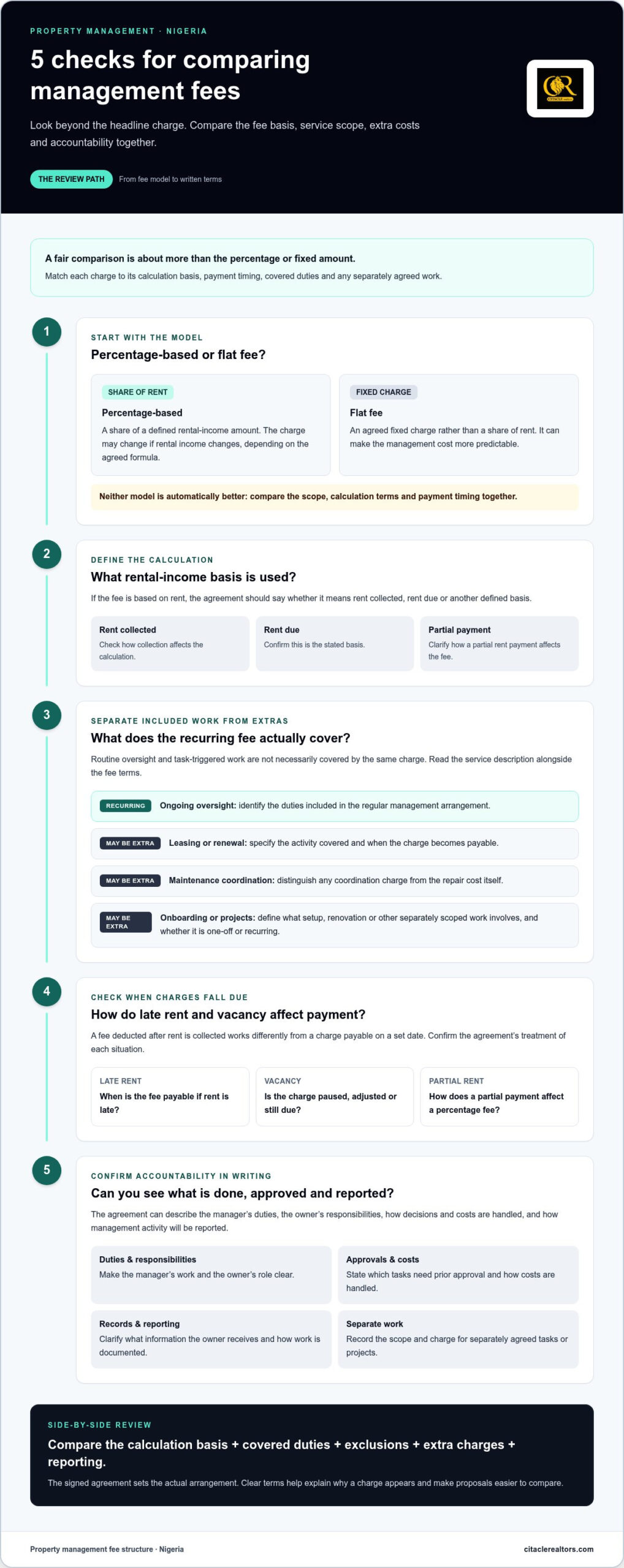
A percentage-based fee is calculated as a share of a defined rental-income amount. The agreement should state whether that means rent collected, rent due or another basis, and how the calculation works if only part of the rent is received. If rental income changes, the management charge may change too, depending on the agreed formula.
A flat fee is a fixed agreed charge, rather than a share of rent. It can make the management cost more predictable, but the owner should still understand what services it pays for and whether the charge applies during a vacant period. Neither model is automatically better. Compare the scope, calculation terms and payment timing together.
Which additional charges need their own explanation?
Some agreements may set out separate charges for leasing a property, renewing a tenancy, coordinating maintenance or onboarding a property. These are not automatically part of a recurring management fee; their application depends on the arrangement. For each item, look for the service provided, the event that triggers the charge, how costs are approved and what reporting the owner receives.
- Leasing or renewal: Identify the activity covered and when the charge becomes payable.
- Maintenance coordination: Separate the coordination charge, if any, from the cost of the repair itself, and note how approvals and records are handled.
- Onboarding: Establish what initial setup work the charge relates to and whether it is one-off or recurring.
Payment timing can change the practical cost. A fee deducted from rent after collection works differently from one payable on a set date, particularly if rent is late or the property is empty. Clarify whether a charge is paused, adjusted or still due during vacancy, and how any partial payment affects a percentage calculation. Put these terms beside the service scope when comparing proposals.
Property management and facilities management can overlap, but they may address different needs. Property management focuses on overseeing the asset and its owner-tenant arrangements, while facilities oversight concerns the functionality and operation of the property’s facilities. Explore the facility management services guide to understand that distinction. For wider local context on professional facilities practice, see the IFMA Nigeria Chapter.
For a clear comparison, place the fee basis, services, exclusions, separate charges, vacancy terms and reporting in one view. Citacle Realtors provides property and facilities management for residential and commercial assets, with an approach centred on professional oversight and maintaining property functionality and value. Owners can discuss a property management arrangement suited to their property and service needs.
How can you tell whether a management fee offers fair value?
A low headline charge isn’t automatically the best fit, just as a higher one doesn’t guarantee stronger oversight. To assess a proposal fairly, compare the work, exclusions, approval process and reporting alongside the fee basis. For Nigerian property owners, practical details matter: what happens if rent is unpaid, the property is vacant, or a repair requires a decision? Clear terms make it easier to see what you’re paying for and where your responsibilities begin.
What should the fee comparison table include?
Use one row for each proposal and the same columns for each provider. Record what the fee is based on, when it’s due, which duties are included, and what is excluded. Add separate charges, vacancy terms, approval thresholds and reporting commitments. If a proposal leaves an item vague, mark it for discussion before accepting the agreement rather than treating silence as inclusion.
| Comparison point | Proposal A | Proposal B |
|---|---|---|
| Fee basis and payment timing | Record the calculation basis and due date | Record the calculation basis and due date |
| Included duties | List the stated management tasks | List the stated management tasks |
| Exclusions and additional charges | Note what costs extra or sits outside scope | Note what costs extra or sits outside scope |
| Unpaid rent and vacancy | Record how the fee is treated | Record how the fee is treated |
| Approvals and reporting | Note spending approval and update arrangements | Note spending approval and update arrangements |
Keep descriptions specific. “Maintenance support,” for example, could mean coordinating a repair, seeking approval, arranging access or simply notifying the owner. The proposal should describe the actual responsibilities and how work is reported. Compare like with like, not one detailed offer against another that leaves key points unstated.
How do you weigh the fee against property oversight?
Consider how much time you can give the property and the demands of its day-to-day operation. A distant owner or a property with frequent maintenance needs may value documented coordination differently from an owner who handles tasks personally. Tenant-facing duties, repair approvals and reporting should match the service scope in writing. Assess the fit, not a promised saving or return.
Look closely at response processes without assuming a particular speed or availability. Does the agreement explain how an issue is raised, who decides whether work proceeds, and how the owner learns what was done? Also check how unpaid rent and vacant periods affect charges, so the fee’s operation remains clear when circumstances change. These provisions help distinguish active, accountable oversight from a charge with an unclear service behind it.
Fee value depends on the scope of work and the accountability attached to it, not on the lowest figure alone. A well-matched arrangement can support consistent property care and functionality, while leaving the owner with a clear record of duties, decisions and charges. For residential developments and communal estates seeking examples of comprehensive estate oversight and structured fees, winfieldsblockmanagement.co.uk illustrates standard service models and professional reporting.
How should you review a property management fee agreement?
Review the agreement as a working plan for managing your property, not just a page that records a charge. A careful read helps you see how the fee is calculated, what the manager is responsible for and where your own decisions are required. Pay particular attention to unclear wording: if duties overlap or a charge has no stated trigger, its meaning may be difficult to establish later.
Use this sequence to work through the document:
- Define your needs. Note the tasks you want handled, your preferred level of involvement and any property-specific demands.
- Map the services. Match each need to a written duty, such as tenant-facing administration or maintenance coordination.
- Inspect the calculations. Identify the exact rental-income basis, fee frequency, payment date and treatment of vacant periods.
- Check exclusions. Find separate charges, the services or events that trigger them, and any approval steps.
- Confirm reporting. Look for what updates or records you’ll receive and how completed work and costs will be documented.
Which fee terms deserve careful attention?
Read the payment clauses closely. If a fee is tied to rent, establish whether the calculation uses rent collected or another defined amount, and what happens when rent is late or only partly paid. Check when each recurring and one-off charge becomes payable, and how vacancy affects it. Review notice periods, changes to the arrangement and termination conditions; don’t assume these follow a standard form.
Maintenance terms deserve equal care. The agreement should make clear how work is proposed, who approves it, how that decision is recorded and what follow-up reporting is provided. If the document uses broad wording such as “maintenance handled,” ask for the specific responsibilities to be set out in the agreement. This helps distinguish coordination from the cost of the work itself.
How can owners compare proposals consistently?
Apply the same checklist to every proposal, using one row per provider and the same property needs for each. Compare the duties and exclusions alongside the fee basis, payment timing, vacancy terms and reporting. Note overlapping responsibilities, unclear charges and any missing termination details for discussion before signing. This gives you a like-for-like view rather than a ranking based on headline figures alone.
A clear property management fee structure should connect charges to defined duties and explain how decisions are handled. If you’re considering professional oversight for your property, you can discuss a property management arrangement suited to your property and service needs.
How does Citacle Realtors approach property management in Nigeria?
Citacle Realtors provides property and facilities management for residential and commercial assets in Nigeria. The focus is professional oversight: helping owners organise the responsibilities involved in running a property and keeping its facilities functional. This work is not simply a fee deducted from rent. The value of an arrangement depends on the agreed scope, the property’s needs and the clarity of how responsibilities and charges are set out.
Every property presents a different combination of priorities. An owner may be focused on the condition of the building, the smooth operation of its facilities or having a clear process for decisions about property care. The property management fee structure should be considered alongside these priorities, so the owner understands what the agreed management arrangement is intended to address. No particular outcome should be assumed; the services and responsibilities should be clear in the agreement.
What role can professional property oversight play?
Professional oversight can help bring consistency to property operations by giving attention to ongoing functionality and the responsibilities agreed with the owner. Where maintenance coordination or renovation work is relevant, its scope, approvals and costs should be addressed as part of the arrangement rather than presumed to be included in a management charge. Citacle’s related renovation and facilities management services can be considered in line with the property’s needs and agreed responsibilities.
Before discussing an arrangement, it can help to prepare a short property brief. Include:
- The property type and whether it is residential or commercial.
- Current priorities, such as facility functionality, maintenance concerns or planned renovation work.
- The level of involvement you want in decisions and approvals.
- Questions about service scope, charges, payment timing and reporting.
This preparation gives the discussion a practical starting point. It also helps distinguish day-to-day oversight from a separate project or task, so expectations can be aligned before responsibilities are agreed.
What is the next step for a property owner?
Bring your property details and priorities to the conversation, including any existing management concerns and the questions you want answered about fees. Discussing these points together can help clarify the service scope, the owner’s role and how the arrangement should reflect the property’s operational needs. Clear expectations support a more considered decision about professional oversight.
Citacle Realtors welcomes property owners seeking a management arrangement suited to their asset and service needs. If you’re considering professional property or facilities management, contact Citacle to discuss your property management needs and the responsibilities you would like addressed.
Make your next property decision with confidence
Your management arrangement should be able to evolve with the way you own and care for your property. Treat the property management fee structure as the foundation of an ongoing working relationship, not a document to file away after signing. As your priorities change, clear written expectations can help keep decisions and responsibilities aligned.
Before moving forward, consider what you want to make easier: coordinating property matters, staying informed about decisions, or planning for the asset’s ongoing needs. Those priorities can guide a practical conversation and help shape an arrangement around what matters to you, rather than a generic template. Take the time to discuss the details and make a considered choice.
Discuss your property management needs with Citacle Realtors and take a confident next step toward professional oversight. A thoughtful arrangement can bring greater clarity to the way you care for your property.
Frequently Asked Questions
How are property management fees usually structured in Nigeria?
In Nigeria, management arrangements commonly use either a percentage linked to rental income or a fixed agreed charge. The agreement should explain the calculation basis, payment schedule and whether task-based charges sit outside the regular fee. For example, a landlord could compare a rent-linked charge with a fixed fee by applying each proposal’s terms to the same expected rent and duties. This makes the property management fee structure easier to assess without relying on assumptions.
Is a percentage-based fee better than a flat property management fee?
Neither model is automatically better; the right fit depends on the property, expected income and service scope. A percentage-based charge may rise or fall with the rental income defined in the agreement, while a flat fee offers a set charge for the stated period or service. Compare how each model works if rent changes, arrives late or is only partly collected. Also consider whether the included duties remain comparable under both proposals.
What services should a property management fee cover?
There’s no universal service list that applies to every agreement. Depending on the arrangement, management duties may involve tenant communication, rent administration, property oversight or coordinating maintenance. Check that each duty is described clearly, including what records or updates the owner receives. For instance, “maintenance support” should specify whether it means reporting an issue, coordinating a repair or another task. Don’t assume a service is included unless the agreement says so.
Can a property manager charge separate fees for maintenance or lease renewal?
Yes, an agreement may set separate charges for specific tasks such as coordinating maintenance or handling a lease renewal. The terms should identify what service the charge pays for and the event that triggers it. For maintenance, distinguish the manager’s coordination charge, if any, from the repair cost itself. Clarify how work is approved and documented, and whether the owner receives supporting records before or after the task is completed.
How much does property management cost in Nigeria?
There isn’t one fixed amount that applies to every property management arrangement in Nigeria. The total depends on the property, the agreed calculation method, the duties covered and any separate charges. Ask for a written proposal that states each charge in Nigerian naira, its calculation basis and when it becomes payable. Then compare the proposals using the same property needs and expected rental-income assumptions, rather than treating a headline figure as the full cost.
Do owners pay management fees when a property is vacant?
It depends on the agreement. A fee linked to rent collected may be treated differently from a fixed charge that applies on a schedule, so vacancy terms need to be explicit. Check whether the regular management fee continues while the property is empty and whether separate leasing or tenant-placement charges can apply when a new tenant is secured. Confirm when any such charge becomes payable and what activity it covers.
What should I check before agreeing to a property management fee?
Check the fee calculation, payment timing, included duties, exclusions and any separate task charges. Read how the agreement handles vacancies, unpaid rent, maintenance approvals and reporting. Also review its duration, how changes are recorded and what notice is needed to end the arrangement. If a phrase could be interpreted in more than one way, request clear wording in the agreement before signing. Keep a copy of the final terms and related schedules for your records.