

A rental property can become costly before the first rent payment if tenant screening is rushed. Key mistakes to avoid when managing rental property include approving an applicant without checking their background, verifying employment and income, and contacting references. These steps help you make a more informed decision before signing a lease.
It’s understandable to want to fill a vacancy promptly, but a careful process can help protect your property and set clear expectations from the start. This guide covers how to assess applicants, set rent with the local market in mind, budget for repairs, keep up with maintenance, prepare for emergencies, and create a clear lease agreement. Each step can make day-to-day oversight more organised and help you identify avoidable costs early.
Key Takeaways
- Use a consistent process to record tenant repair requests, assess urgency and follow up until each issue is resolved.
- Set rent by comparing similar properties in the local market, then review it as conditions and property features change.
- Plan for routine upkeep as well as unexpected repairs, and keep property income and expenses clearly recorded.
- Put rent terms, payment dates, deposit details and property rules in a written lease suited to the tenancy.
- Prepare for urgent problems in advance by documenting response steps and organising access to suitable repair professionals.
1. What happens when landlords neglect regular maintenance?
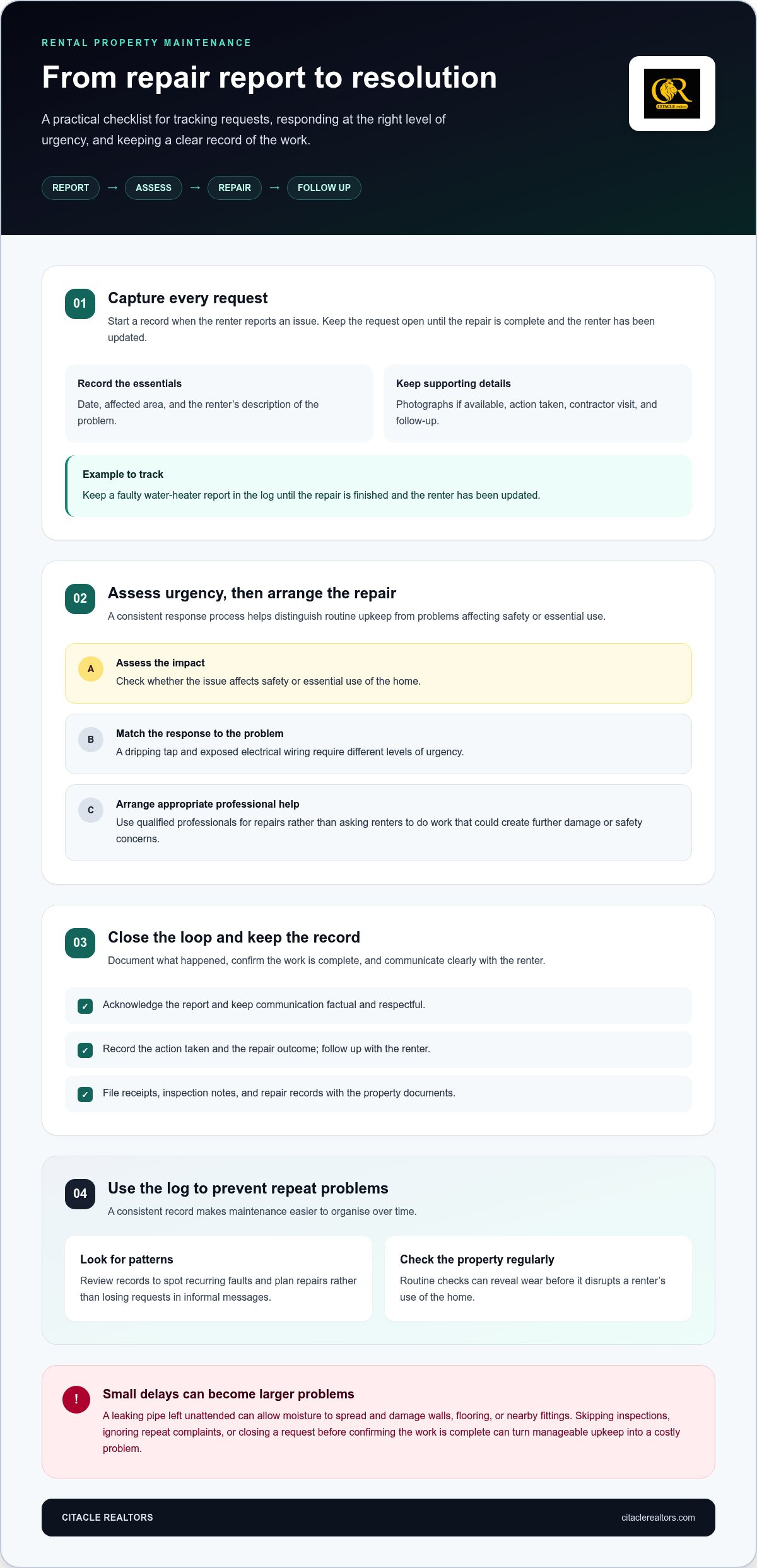
When a landlord delays a small repair, such as a leaking pipe, moisture can spread and damage walls, flooring, or nearby fittings. Prompt attention limits how far the problem develops and helps preserve the property’s condition and rental appeal. Routine maintenance is not just cosmetic: it can reveal wear before it disrupts a renter’s use of the home.
Track every maintenance request from the first report to completion. Record the date, affected area, tenant’s description, photographs if available, action taken, contractor visit, and follow-up. For example, keep a report about a faulty water heater open in the log until the repair is complete and the renter has been updated. A consistent record helps property owners spot recurring faults and plan repairs instead of losing requests in informal messages.
Use a clear response process: acknowledge the report, assess whether it affects safety or essential use, arrange the appropriate repair, and document the outcome. A dripping tap and exposed electrical wiring require different levels of urgency. Keep communication factual and respectful, and file receipts, inspection notes, and repair records with the property’s documents. These records help landlords understand repair patterns and distinguish routine upkeep from damage that needs further attention.
Is self-managing a rental property better than hiring a property manager? Self-management can suit a landlord with time to track requests, coordinate professional repairs, and communicate consistently with renters. A property manager can help when these ongoing tasks are difficult to handle personally; in the vacation rental sector, for instance, professional operators like Northern Michigan Escapes demonstrate how dedicated management streamlines maintenance, inquiries, and day-to-day oversight across diverse property portfolios.
What are landlords’ responsibilities for repairs, safety, and habitability in Nigeria? Landlords should address property problems promptly, maintain safe and usable premises, and follow the tenancy agreement and applicable Nigerian requirements. Keep written records of reported hazards, repair decisions, and completed work.
How should landlords handle rent arrears, late payments, and tenant disputes? Record missed payments and relevant communications, apply the lease terms consistently, and address disputes promptly through calm, documented discussion. Any action relating to arrears should follow the agreement and applicable requirements.
What insurance coverage should rental property owners have? Consider property and liability insurance with coverage suited to the building and its rental use. Keep policy details with maintenance records so relevant information is organised if a repair incident or claim arises.
Use qualified professionals for repairs instead of asking renters to do work that could cause further damage or safety concerns. Pair this approach with regular property checks and a maintenance log. Skipping inspections, ignoring repeat complaints, or closing a request before confirming the work is complete can turn manageable upkeep into a costly problem and undermine long-term property value.
2. Setting an appropriate rental price
Set rent by comparing your property with similar homes in the same local market. Compare a flat in a residential estate with similar nearby flats, not automatically with a detached home elsewhere. Location, property type, condition, access, and included features all influence what tenants may consider reasonable. Local comparisons provide a more accurate starting point than choosing a figure based only on expected income.
Build a useful comparison by reviewing current rental listings and checking what each property actually offers. Compare like with like: a furnished apartment is not identical to an unfurnished one; serviced accommodation providers such as flexiestays.com show how tailored furnishings and amenities create distinct expectations and value. Consider the number of bedrooms, parking, security arrangements, water access, maintenance condition, and distance to everyday services. If a listing has features your property lacks, adjust the comparison instead of assuming both homes can command the same rent.
Asking rent and achieved rent are not always the same. A property advertised above comparable homes may attract fewer enquiries and remain vacant for an extra month or two. The lost rental income can outweigh the higher asking figure. For example, if prospective tenants repeatedly view a home but choose similar, lower-priced homes, review the price alongside the property’s presentation and features.
Avoid setting rent by copying one expensive listing or relying on what you paid for the property. Neither approach shows what tenants currently have available in that neighbourhood. Instead, gather several relevant comparisons, note their condition and included amenities, then choose a competitive rent that reflects your property’s strengths and limitations. Revisit the comparison when demand or nearby rental options change.
Fair pricing also supports clearer tenant relationships. Explain what the rent covers, including any services or facilities provided, and keep those terms consistent in the advertising and lease. If a tenant asks why the rent differs from another property, point to specific distinctions such as furnishings, room layout, upkeep, or location. Clear explanations reduce confusion and help prevent disagreements caused by unclear expectations.
Monitor the response after advertising. Track enquiries, viewing attendance, applications, and feedback about the asking rent. Few enquiries may signal a mismatch between the price and comparable homes, while strong interest followed by repeated withdrawals may point to other concerns. Treat each response as information, not proof on its own, and review the full picture before changing the rent.
One mistake to avoid when managing rental property is leaving the price unchanged while the local market shifts. Make a fresh comparison before advertising a vacancy or reviewing rent for a new tenancy. This disciplined approach helps you set a fair, competitive rate without undervaluing the property or pricing it beyond what comparable real estate can support.
3. Budgeting for refurbishment and unexpected repairs
Separate routine upkeep, planned refurbishment, and unexpected repairs in your property budget. Routine costs might include servicing a water pump or fixing a loose door handle. Refurbishment could involve repainting between tenancies, while a burst pipe calls for an unplanned response. Recording these categories separately shows where rental income goes and helps you prepare for costs beyond regular bills.
One budgeting approach is to reserve 1% of the property’s total value for maintenance expenses. Treat this as a planning guide, then adjust your reserve to reflect the building’s age, condition, fittings, and repair history. A property with recurring plumbing issues may need a larger practical buffer than one with recently maintained systems. Review the estimate as inspection records reveal new needs.
Keep a clear expense record for each property. Include the date, fault, contractor’s work, invoice, payment status, and whether the repair was planned or unexpected. If a water tank needs replacing, record it separately from routine servicing. Keep rent payments and operating expenses organised, and avoid mixing personal spending with property funds. Clear records help you see whether repairs are consuming more income than expected.
What rental property expenses and taxes should landlords budget for in Nigeria? Allow for repairs, routine maintenance, insurance, property management company fees, and applicable property taxes. Plan for taxes throughout the year, and retain receipts and payment records for each property.
Use qualified professionals for technical or safety-related repairs rather than asking tenants to do the work. A tenant might report a faulty electrical fitting, but a qualified electrician should assess and repair it. Professional work can also provide an invoice and a clear record of what was addressed. For refurbishment, request a written scope that separates essential work from improvements that can wait.
Keep an emergency reserve separate from money set aside for scheduled refurbishment. A vacancy or missed rent payments can coincide with a repair, so avoid treating expected income as money already available. Review the reserve after each major repair and replenish it as funds allow. Document and handle a tenant’s deposit according to the tenancy agreement and applicable requirements, rather than treating it casually as the landlord’s repair fund.
If a management company oversees the property, record its fees alongside maintenance and insurance expenses. Include itemised reports of repairs, contractor invoices, and outstanding work in the management records. Whether you manage the property yourself or use professional oversight, compare actual spending with your budget regularly. This review helps identify recurring faults early and supports better decisions about repairs, refurbishment, and ongoing maintenance.
4. Clear, legally reviewed lease agreements
A written lease creates a shared record of the landlord and tenant’s expectations. Identify the parties, rental property, tenancy start date, rent amount, payment due date, and payment method. For example, state whether rent is payable by bank transfer and how the tenant will receive confirmation. Clear details give owners and renters the same agreement to refer to if a disagreement arises.
Describe the tenancy period and what happens when it ends. Explain any renewal process, notice method, and steps for discussing a change to the arrangement. Avoid relying on informal messages to settle important terms. If both parties agree to a change, record it in writing and keep the updated document with the original lease.
State the deposit amount, how the landlord will record its receipt, and the conditions for any deductions. Include a move-in condition report noting existing damage, such as a cracked tile or stained wall. Dated photographs can support the inventory. At move-out, compare the property’s condition with the original record before discussing deductions, and document the outcome.
What are the legal requirements for rental property management in Nigeria? Owners should use a written agreement that reflects applicable tenancy requirements and the rules relevant to the property’s location. Have a qualified Nigerian legal professional review the lease, especially its rent, notice, deposit, termination, and dispute terms.
Make responsibilities specific. The agreement can explain how tenants report problems, which party handles particular upkeep, and how access for inspections or repairs will be arranged. For example, set out a written process for notifying the landlord about a leaking tap. Avoid vague language such as “the tenant handles all repairs,” which can leave both parties unsure of their responsibilities.
Include property-specific rules that renters can follow. Clarify whether the home is for residential use, how shared areas should be used, and how occupants should handle waste or parking. If the property includes a generator or water system, describe appropriate use and reporting of faults. Rules should be clear, practical, and applied consistently to tenants.
Before signing, check that names, dates, rent figures, deposit details, and property descriptions match across the agreement and supporting records. Ask the legal reviewer to explain unclear clauses in plain English. Unresolved ambiguity can lead to disputes, delayed payments, or unexpected expenses. Give each party a complete signed copy, and store it securely with payment records and the condition report.
A lease should also explain how the parties will raise and document concerns. Set out a communication method, such as written notice by email or letter, and retain copies of important messages. If a rent payment is late, refer to the agreed due date and process rather than relying on memory. A consistent paper trail helps owners respond calmly and address disagreements with the relevant terms in view.
5. Emergency planning and contractor networks
A burst pipe, power fault, or storm-damaged roof can quickly disrupt tenants and rental income. Write an emergency plan before a problem occurs, and keep it with the property records. Include the property address, access arrangements, utility shut-off points, and the person responsible for coordinating repairs. A clear plan helps everyone know what to do when an urgent report comes in.
Give tenants a simple way to report urgent problems and explain what details to include. Ask for the affected room, a short description, and photographs when safe. For example, a report of water entering near a ceiling should identify whether the leak is spreading. Owners managing rentals themselves may receive tenant calls as late as 10 p.m., so decide how urgent messages will be handled.
Prepare a network of contractors before you need one. Keep contact details for suitable plumbing, electrical, roofing, and general repair professionals, with notes on the work each handles. A contractor who can address a leaking pipe may not be suited to inspect damaged wiring. Match the reported fault to the right trade, then record the agreed scope, access arrangements, and completion details.
Before urgent work begins, establish how the contractor will access the property and who will update the tenant. If a tenant is away, use only access arrangements already agreed under the tenancy terms. For example, share details of the reported fault and affected area with the contractor, then confirm when the visit is complete. A brief written update prevents confusion about unfinished work or follow-up visits.
Maintain a good relationship with tenants through calm, practical communication. Acknowledge the report, explain the next step, and provide an update if a repair needs further assessment. Keep messages and invoices with the property’s maintenance record. If a water leak affects a neighbouring unit, document the timeline and actions taken. These details help owners understand the incident and its effect on expenses.
Review the plan after each repair or emergency. Note what worked, which contact was unavailable, and whether the contractor needed better access information. Update contact numbers and property instructions when circumstances change. A property management company can coordinate tenant reports, repair communications, and contractor arrangements for owners who need help overseeing these tasks. Define responsibilities clearly so urgent decisions don’t stall while tenants wait for a response.
Keep the plan practical rather than complicated. Store one accessible copy of essential contacts and instructions, and retain a fuller incident record with invoices and repair notes. Ensure tenants know how to report a serious issue, while contractors receive only the information needed for their work. This preparation helps property owners respond methodically, limit disruption, and make informed decisions about repairs affecting safety or the home’s continued use.
Citacle Realtors: Property Management
Citacle Realtors offers Property Management for owners seeking professional support with rental oversight and day-to-day responsibilities. Consider this service when coordinating tenant matters, property upkeep, and rental records alongside other commitments becomes difficult to manage consistently.
For buildings where shared spaces and essential systems need attention, Citacle Realtors’ Facilities Management can support the property’s wider upkeep. The right focus depends on your needs: Property Management for tenancy-related responsibilities, or Facilities Management for the building’s ongoing operation. Clear records and defined responsibilities matter whichever service you choose.
To discuss rental property oversight, contact Citacle Realtors or visit citaclerealtors.com.
Build a More Confident Property Plan
Rental costs are easier to manage when decisions follow a consistent operating plan instead of reacting to each new invoice. Set a regular review routine: compare spending with your plans, note recurring issues, and use those patterns to guide future priorities. Mistakes to avoid when managing rental property are easier to address when each expense informs a considered decision about the property’s ongoing needs.
As your property goals evolve, match your support to your next step. Citacle Realtors offers Property Management and Facilities Management for owners overseeing rental properties, alongside Residential Land Sales for those considering land ownership. Each service addresses a different property need, so consider which fits your current plans.
A clear direction can help you move from managing costs reactively to making deliberate choices for your property. Contact Citacle Realtors today to discuss the support that fits your plans. With a thoughtful approach and the right next step, you can manage your property with greater confidence.
Frequently Asked Questions
How can landlords avoid neglecting proper tenant screening?
Use the same screening steps for every applicant, even when a vacancy needs filling quickly. Request information that lets you verify employment and income, then contact listed references with consistent questions about reliability and tenancy history. Keep a dated record of what you checked and the decision made. For example, if two applicants have similar incomes, documented references can help you assess their applications more fairly.
What’s the most common mistake landlords make?
A common mistake is making important decisions informally, then relying on memory when a problem arises. A landlord might agree by phone to change a payment date, then later disagree about what was settled. Follow up on significant conversations in writing and retain the reply. A clear record supports consistent decisions about rent, access, repairs, and other tenancy matters without relying on conflicting recollections.
How can landlords avoid mismanaging their rental finances?
Use a dedicated account and ledger for rental activity, then reconcile each rent receipt with the tenancy record. Record expenses by property and category, such as insurance, cleaning, or a contractor invoice. If one owner manages several homes, separate property records make it easier to see which asset incurred each expense. Store receipts and payment confirmations together so transactions can be traced later.
How should landlords prepare for emergencies at a rental property?
Prepare a simple action sheet for incidents such as a power fault, water leak, or storm damage. Include the property address, utility shut-off locations, access instructions, and the person authorised to coordinate work. Give tenants a clear reporting method and ask them to describe the affected area. After an incident, record when it began, who was notified, and what actions followed.
What Are the Biggest Financial Pitfalls of Being a Landlord?
Cash-flow pressure can build when rent is delayed, a property sits vacant, or essential work is postponed until damage spreads. Another pitfall is counting all rent received as available income before accounting for regular operating expenses. Keep expected income separate from committed costs, and review upcoming bills before discretionary spending. This gives you a clearer view of what the property can support.
What happens when landlords neglect regular maintenance?
Small defects can affect other parts of a home if left unaddressed. For example, water entering around a window can damage surrounding finishes, while a blocked drain can interfere with normal bathroom use. Recurring problems may also make the property harder to present well to prospective renters. Keep inspection notes and compare them over time to identify deterioration that a single visit might miss.
Why should landlords never skip a written lease agreement?
A written agreement gives both parties a reference if their memories differ about what they accepted. For example, a tenant may believe parking was included, while the owner remembers a different arrangement. Recording property-specific terms, shared facilities, and agreed responsibilities helps prevent that misunderstanding. A signed document also gives owners a reliable record to consult before discussing a concern or considering a change to the tenancy.
What are the most common mistakes landlords make when managing rental property?
Common errors include choosing tenants without consistent checks, setting rent without relevant comparisons, overlooking cash-flow records, and treating verbal promises as settled terms. Another is leaving small property issues unresolved because they seem inconvenient. Use a repeatable process for applicant decisions, financial records, and tenant communications. Reviewing that process after a vacancy or dispute can reveal gaps before they affect another tenancy.