

An asking price may sound convincing, but it isn’t proof of a property’s worth. A reliable real estate appraisal explains how its value was assessed and what evidence supports the conclusion. If you’re unsure what the appraisal covers, or whether its comparisons are relevant to your property, ask questions before relying on the result.
This guide explains what a property valuation covers, how factors such as location, condition, access and title documents may affect the assessment, and why an appraised value can differ from an asking price or eventual sale price. You’ll also learn what information to prepare, how to review comparable properties and what to ask about the appraiser’s professional standing and approach.
From sales comparisons to income and replacement-cost assessments, we’ll look at the main methods and their limitations in the Nigerian market. The aim is to help you judge whether a valuation is clear, relevant and well supported before using it to inform a property decision.
Key Takeaways
- A real estate appraisal estimates a property’s value for a stated purpose and date. Check which decision the valuation is intended to support.
- Prepare accurate details about ownership, size, condition, use and improvements so the appraiser can assess the property with relevant information.
- Market, income and cost approaches assess value in different ways. The appropriate method depends on the property and the evidence available.
- Before relying on a valuation, review its assumptions, property description and valuation date. Check that comparable evidence is relevant and clearly explained.
- Citacle Realtors offers real estate asset valuation in Nigeria to help property owners understand their asset’s value.
What Does a Real Estate Appraisal Tell You About a Property’s Value?
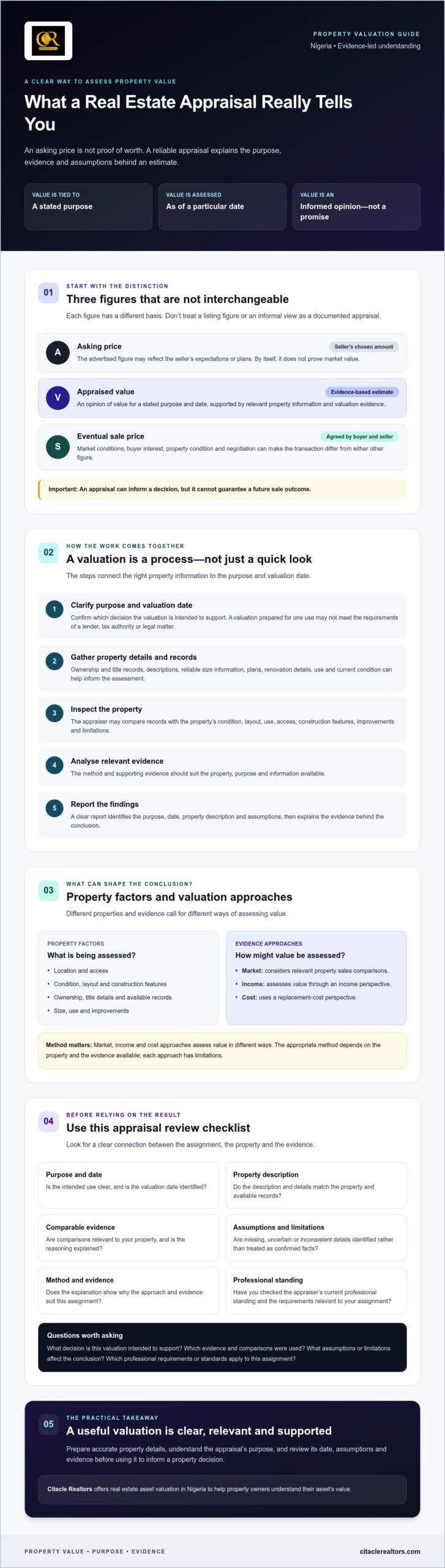
A real estate appraisal is an evidence-based estimate of a property’s value for a stated purpose and as of a particular date. It gives owners, buyers, investors and other property stakeholders a considered basis for decisions, rather than simply repeating a seller’s expectations or an informal opinion. The real estate appraisal overview also explains key valuation concepts and types of value.
An appraisal is an informed opinion, not a promise that the property will sell for that amount. Market conditions, buyer interest, property condition and negotiation can affect the eventual transaction. The report can help you understand the evidence behind an estimate, but it cannot guarantee a future sale outcome.
What is the difference between appraised value and asking price?
An asking price is the amount a seller chooses to advertise. It may reflect the seller’s expectations, plans or view of the property, but it isn’t proof of market value. An appraisal considers evidence relevant to the property and the valuation’s purpose, rather than relying only on the listing figure.
The eventual sale price is the amount agreed between buyer and seller. It can differ from both the appraised value and asking price as market conditions and negotiations change. An informal agent estimate may offer a useful initial perspective, but it shouldn’t automatically be treated as a documented appraisal. Ask what evidence supports it and what it was prepared to establish.
When might a property owner need an appraisal?
You might seek a valuation while planning a sale, considering a purchase, reviewing your assets or making property-management decisions. For example, an owner reviewing a rental property may want to understand its value as part of a wider assessment, while a prospective buyer may want an independent basis for evaluating a property.
The intended use matters because it can affect the scope of the work, the information required and the evidence considered. A valuation prepared for one decision may not automatically meet the requirements of a lender, tax authority or legal matter. Before commissioning or relying on one, clarify its purpose and confirm that the recipient or decision-maker will accept the type of appraisal provided.
How Is a Real Estate Appraisal Carried Out in Nigeria?
A real estate appraisal involves a series of decisions and checks, not just a quick look at a property. The appraiser clarifies the purpose and valuation date, gathers property information, inspects the asset, analyses relevant evidence and reports the findings. These steps help ensure the conclusion relates to the right property and the decision it is meant to inform.
What information and documents may support an appraisal?
Before the work begins, gather available ownership and title records, property descriptions, building plans or other reliable records of size, and documents about renovations or improvements. Share how the property is used and describe its current condition. Check that the descriptions and measurements you provide match the available records as closely as possible.
Accurate information matters. If records are missing or inconsistent, the appraiser may need to clarify details, make assumptions or explain limitations in the assessment. Identify uncertain information instead of presenting an estimate as confirmed fact. The scope and confidence of the result can depend on the evidence available.
What happens during inspection and reporting?
An inspection helps the appraiser compare recorded information with the property itself. They may observe its condition, layout, use, access, construction features and improvements, as well as limitations that could affect the assessment. Appearance is only part of the picture. An inspection can also reveal details that documents or photographs don’t show clearly.
After the inspection, the appraiser analyses relevant evidence in light of the agreed purpose and prepares the findings. A clear report should identify the purpose, valuation date, property description and assumptions, then explain the evidence supporting the conclusion. The International Valuation Standards provide a wider reference point for valuation principles. Check which standards or professional requirements apply to the specific assignment rather than assuming they are automatically followed.
A property appraisal defines its purpose, checks property information, inspects relevant features, analyses supporting evidence and reports an opinion of value for a stated date.
In Nigeria, confirm the appraiser’s current professional standing and any reporting requirements relevant to your intended use. Requirements may depend on the purpose and recipient of the valuation, so don’t assume that one report will meet every need. If you’re preparing for a valuation, discuss your asset valuation needs with Citacle Realtors, which offers real estate asset valuation in Nigeria.
Which Factors and Valuation Methods Can Change an Appraisal?
A real estate appraisal reflects more than a property’s visible features. Its conclusion can be shaped by the valuation date, the purpose of the work, the property’s condition and use, and the quality of the evidence available. In Nigeria, access, infrastructure, title documentation and whether the property’s actual use aligns with its documented or permitted use may also be relevant. The effect of each factor depends on the property and assignment.
How do the market, income, and cost approaches differ?
Each approach answers the valuation question differently. The appropriate method depends on the property type, the evidence available and the appraisal’s purpose. An appraiser may also use more than one approach to develop and check the conclusion.
| Approach | How it estimates value | When it may be useful |
|---|---|---|
| Market | Considers relevant transactions involving comparable properties, with adjustments for meaningful differences where appropriate. | When sufficiently relevant and reliable transaction evidence is available. |
| Income | Analyses the property’s income potential using assumptions relevant to its use and expected income. | For income-generating properties where income evidence can support the assessment. |
| Cost | Considers the cost of replacing or reproducing improvements, with allowance for depreciation and other relevant factors. | When the property is new, unusual or lacks suitable comparable evidence. |
No approach is automatically best for every property. A property with rental income may invite income analysis, while a distinctive building with few close comparables may call for cost evidence alongside other considerations. The appraiser should explain why the chosen approach fits the assignment.
Why can two property appraisals reach different figures?
Different conclusions don’t necessarily mean one appraisal is wrong. Reports may address different purposes or valuation dates, use different scopes, or rely on different assumptions and evidence. A change in condition, an incomplete property description, uncertain documentation or a different selection of comparable transactions can also affect the analysis.
Comparables need careful review. A property that seems similar in size may differ in access, condition, use or other characteristics that matter to value. Evidence that is dated, poorly explained or not closely matched may provide less support than relevant transactions with clear adjustments. Ask how each comparable relates to the property and whether the appraiser has explained the important differences.
If two appraisals differ, examine their dates, purposes, scopes, assumptions and supporting evidence before drawing a conclusion. Don’t select the higher figure simply because it is more favourable. Assess which analysis is better supported for the decision you need to make.
How Can You Check a Real Estate Appraisal Before Relying on It?
Start by checking the report’s purpose, then see whether its property description and evidence fit the asset and the decision you need to make. You don’t need to choose a value in advance. Focus on whether the reasoning is clear, relevant and transparent about its limits.
What should a clear appraisal report explain?
Use this checklist to guide your review:
- Purpose: Does the report state what the valuation is intended to support? Confirm that this matches your planned decision and any requirements set by the intended recipient.
- Valuation date: Is the date clear? The conclusion relates to the circumstances and evidence considered for that date, so check that it fits your needs.
- Property identification and scope: Does the report accurately describe the property and explain what was included in the assessment? Compare its recorded size, use, condition and relevant features with the information you supplied.
- Assumptions and limitations: Are important assumptions stated? Look for disclosures about missing records, access restrictions or other factors that may have limited the work.
- Evidence and reasoning: Does the report explain how the supporting evidence relates to the property? If it uses comparable properties, check whether it discusses their similarities and differences instead of simply listing them.
An unclear explanation or unsupported conclusion is a reason to ask for clarification, not automatic proof that the appraisal is wrong. The report should give you enough context to understand how the analysis led to its conclusion.
What questions should you ask about an appraisal?
Ask the appraiser or report provider questions that connect the analysis to your specific concern:
- Does this report suit the decision I intend to make, and will the relevant recipient accept it?
- How did the property’s condition, use and available ownership or building records affect the assessment?
- Why were these comparable properties selected, and how were important differences considered?
- What assumptions or limitations could materially affect the conclusion?
- Would a change in the property or circumstances since the valuation date call for an updated assessment?
If you’re preparing to sell and want to use the valuation to shape a sale strategy, rather than simply review an asset, see this property valuation guide for sellers. If material questions remain after you seek clarification, consider whether an independent review is appropriate. To discuss your valuation needs, contact Citacle Realtors about asset valuation.
How Can Citacle Realtors Help With a Real Estate Appraisal?
Once you know what to check in a valuation, choose a service that fits your property decision. Citacle Realtors offers real estate asset valuation in Nigeria. To make an initial discussion more focused, prepare a clear description of the property and explain what you want the valuation to help you assess.
What should you share when requesting a valuation discussion?
Start with the basics: the type of property, how it is used and the decision you are considering. A valuation for sale planning may need a different scope from one intended for an asset review, so be specific about your purpose. You can also gather available supporting records, such as ownership documents, building information and details of renovations or other improvements.
Share what you know about the property’s condition, including any repairs or limitations that may be relevant. Describe improvements factually, without assuming they increase value by a particular amount. If measurements, records or ownership details are incomplete or uncertain, mention that early so the scope can be discussed clearly.
Useful questions to raise include:
- What scope of valuation may suit the decision I’m making?
- What property information and supporting evidence should I provide?
- What deliverables should I expect, and what will they explain?
- Are there professional or reporting requirements I should confirm for my intended use?
These questions help you understand what is being considered before proceeding. Don’t assume that a particular method, report format or professional requirement applies to every assignment. Confirm the details that matter for your purpose.
What happens after you receive an appraisal?
Review the report against the decision it was prepared to support. Check that its purpose, valuation date and property details still fit your needs, then review the assumptions and evidence behind its conclusion. If a feature, record or comparable property is unclear, ask for an explanation. If important concerns remain after clarification, consider whether an independent review is appropriate.
Property owners seeking additional guidance can read the asset valuation guide for real estate owners. For a discussion about your property, discuss your property valuation needs with Citacle Realtors. Sharing your intended use and available information can help frame a considered conversation without assuming a particular valuation outcome or turnaround.
Make Your Next Property Decision With Greater Clarity
A reliable real estate appraisal is an evidence-based opinion for a stated purpose and date, not a guaranteed sale price or a seller’s asking figure. Its value depends on accurate property details, an appropriate valuation approach and the quality of the supporting evidence. Before relying on a report, check that its purpose, date, assumptions and comparable evidence fit the decision you need to make.
Preparing ownership records, measurements, condition details and information about improvements can make a valuation discussion more focused. If any report details or assumptions are unclear, ask for an explanation before acting on the figure. A difference between valuations is a reason to examine their evidence and scope, not simply select the higher estimate.
Citacle Realtors offers asset valuation as part of its real estate services to clients across Nigeria. If you’re considering a valuation for your property, discuss your property valuation needs with the team. Share your intended use and the information you have available to start a focused conversation about your property.
Frequently Asked Questions
What is a real estate appraisal?
A real estate appraisal is an evidence-based opinion of a property’s value for a stated purpose and as of a particular date. It considers relevant property details and supporting information to reach a reasoned conclusion. The figure isn’t a guaranteed sale price or a prediction of what a future buyer will pay. Its usefulness depends on whether the purpose, scope and valuation date fit the decision you need to make.
How is a property appraisal calculated in Nigeria?
A property appraisal in Nigeria is developed by defining its purpose, gathering property information, inspecting where appropriate, analysing evidence and reporting the findings. Depending on the property and assignment, the analysis may use comparable transactions, income potential, replacement or reproduction cost, or more than one approach. Accurate information about ownership, size, condition, use and improvements helps inform the assessment. Ask the appraiser to explain the method and evidence relevant to your case.
What factors affect a real estate appraisal?
Value may be influenced by the property’s location context, condition, construction quality, access, infrastructure, use and title documentation. The quality and relevance of comparable evidence also matter, as does the valuation date. For a property with rental income, its income potential and the assumptions used to assess it may be relevant. No single factor determines the conclusion on its own. The appraiser considers the characteristics and evidence that fit the assignment.
Is an appraisal the same as a market price or asking price?
No. An appraisal is an evidence-based opinion for a stated purpose and date. An asking price is the seller’s chosen listing figure, while a market price may refer to an amount agreed in an actual transaction. The eventual sale price can differ from an appraisal or asking price as buyer interest, market conditions and negotiation affect the deal. Check what the report measures before using its figure to guide a decision.
How long does a real estate appraisal take?
The time required varies with the property, the assignment’s scope, access for inspection and the availability of accurate supporting information. A straightforward property with complete records may involve fewer information-gathering steps than one with unclear details or limited comparable evidence. Ask the appraiser what stages are involved, what documents are needed and what timing applies to your assignment. Don’t assume a standard turnaround without confirming it with the service provider.
Can two appraisers value the same property differently?
Yes. Differences can arise because appraisals use different purposes, valuation dates, scopes, assumptions or evidence. Appraisers may also select different comparable properties or interpret differences in condition and documentation differently. A gap between figures doesn’t automatically show that either appraisal is wrong. Compare the reports’ reasoning, dates and evidence, then ask about any material differences. Don’t choose the higher figure without first assessing how well it is supported.
What should I check in a property appraisal report?
Check that the report identifies its purpose, valuation date, property and scope, and clearly states its assumptions and limitations. Confirm that the description reflects the property’s size, use and condition as you understand them. Review how the evidence supports the conclusion, including whether comparable properties are relevant and their differences are explained. If anything is missing or unclear, ask the report provider for clarification before relying on it for a decision.