

What if the valuation you rely on doesn’t reflect your property’s condition or the reason you need it? For Nigerian owners, asset valuation for real estate is most useful when it connects the property’s documented features, its market context and the purpose of the assessment.
Before arranging a valuation, it’s reasonable to ask what the valuer will consider, which records may be needed and how to interpret the final figure. A valuation is an informed professional opinion based on relevant evidence, not a promise of the price a property will achieve in a future sale. Understanding its purpose and limitations can help you use the result with confidence.
This 2026 guide explains the factors that can shape a property valuation, how to prepare records and arrange access, and what to consider when choosing a valuation service. It also covers how valuation findings may inform ownership and asset-management decisions, including whether to explore property management or renovation. Citacle Realtors offers asset valuation in Nigeria, and this guide can help you approach the process with clearer expectations.
Key Takeaways
- Clarify why you need a valuation. Its purpose helps guide the assessment and the evidence considered.
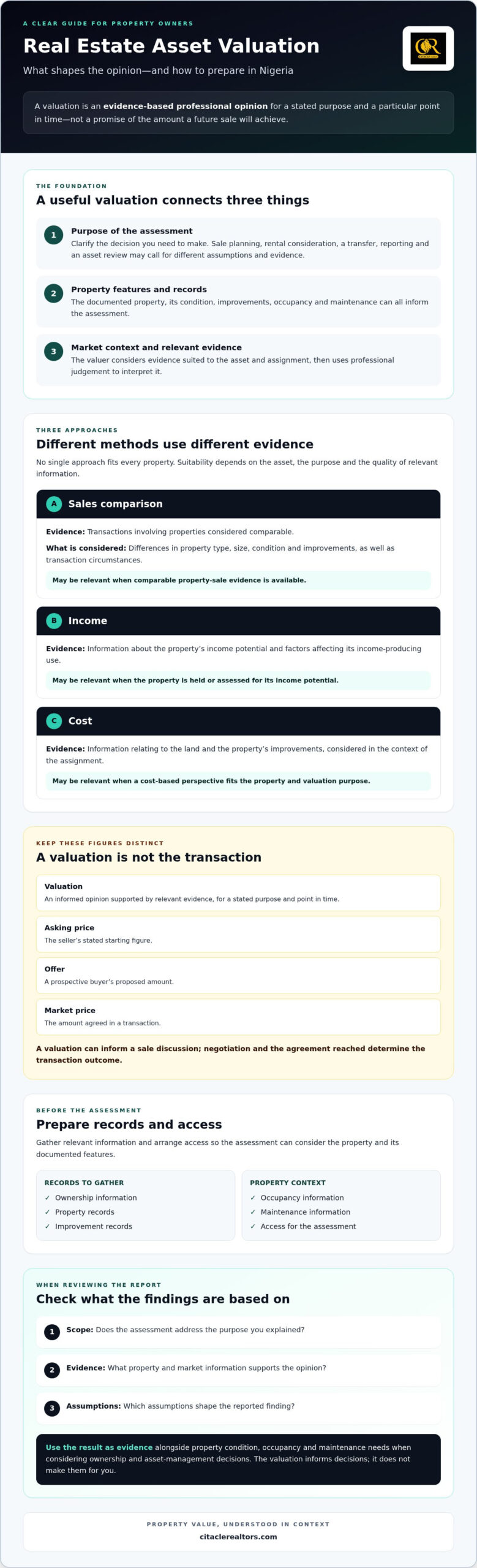
- Sales comparison, income and cost approaches use different kinds of property evidence. The suitable approach depends on the asset and the information available.
- For asset valuation for real estate, distinguish an evidence-based opinion from an asking price, an offer or a guaranteed sale amount.
- Gather relevant ownership, property, improvement, occupancy and maintenance records, and arrange access for the assessment.
- Review the report’s scope, evidence and assumptions so you can use its findings to inform ownership and asset-management decisions.
What Asset Valuation for Real Estate Tells Property Owners
Property owners need more than a number. They need an informed estimate connected to a clear purpose and supported by relevant evidence about the property and its market context. That’s the role of asset valuation for real estate: it helps you assess an asset in relation to an ownership decision, rather than simply settle on a figure that feels right.
In brief: A real estate valuation is an evidence-based opinion of a property’s value for a stated purpose and at a particular point in time. It does not establish a guaranteed sale price, a buyer’s offer or the amount a completed transaction will produce.
The purpose matters because different questions may call for different assumptions and evidence. A valuation prepared to support sale planning, for example, may not answer the same question as one requested for a transfer, rental consideration, reporting or a wider review of an owner’s assets. Clarify the decision you need to make before the assessment begins so the scope and findings can address it.
When might a property owner need an asset valuation?
You might seek a valuation when planning a sale, considering rental income, transferring an interest, preparing information for reporting or reviewing your property holdings. These purposes aren’t interchangeable, so explain your intended use before the assessment starts. If you’re preparing to sell, read our property valuation guide for sellers in Nigeria for guidance focused on that decision.
For ongoing asset management, a valuation can provide evidence to consider alongside the property’s condition, occupancy and maintenance needs. It can inform your decisions, but it doesn’t make them for you.
Valuation, appraisal and market price: what is the difference?
“Valuation” and “appraisal” are often used to describe an opinion of property value, although terminology can vary by professional context and assignment purpose. A market price, by contrast, is the amount agreed in a transaction. An asking price is the seller’s stated starting figure, while an offer is a prospective buyer’s proposed amount. For a foundational overview of real estate appraisal methods and terminology, see this general reference.
Imagine an owner receives a valuation while preparing to sell. They set an asking price, a buyer makes a different offer, and both parties negotiate. The valuation can help inform that discussion, but the final outcome depends on the agreement reached. Treat the report as evidence for a defined decision, not a promise of what the market will pay.
How Real Estate Asset Valuation Methods Use Property Evidence
Valuers may use different approaches to understand a property’s worth. The suitable approach depends on the asset, the available evidence and the purpose of the assessment. In asset valuation for real estate, the aim isn’t to force every property into the same calculation. It’s to select an approach that fits the question and use professional judgement to interpret the evidence.
No single valuation approach fits every property. The most suitable method depends on the asset, the assessment’s purpose and the quality of relevant evidence.
| Approach | Evidence considered | May be relevant when |
|---|---|---|
| Sales comparison | Transactions involving properties considered comparable, with differences in features and circumstances taken into account. | Relevant evidence of comparable property sales is available. |
| Income | Information about the property’s income potential and factors that affect its income-producing use. | The property is held or assessed for its income potential. |
| Cost | Evidence relating to the land and the property’s improvements, considered in the context of the assignment. | A cost-based perspective is useful for the property and valuation purpose. |
What evidence supports the sales comparison approach?
Comparable transactions can indicate how buyers have valued properties with similar features. A comparison is useful only when the transactions are sufficiently relevant. A valuer may consider differences in property type, size, condition and improvements, as well as the circumstances of each transaction. A nearby sale, for example, may be a poor comparison if the property differs substantially or the transaction took place under different circumstances.
The approach depends on the evidence that can be identified and assessed for the particular assignment. It shouldn’t rely on a simple match or assume every recorded sale represents the same market conditions.
When might income or cost approaches be considered?
For an income-producing property, income potential may be relevant to the valuation question. The valuer considers suitable evidence in context; rental income alone doesn’t automatically determine value. Broadly, the cost approach considers the land and improvements, with the property’s characteristics informing the assessment. Neither approach is a universal formula. The appropriate analysis depends on the property, the available information and the stated purpose.
For general background on professional valuation standards, consult the International Valuation Standards. Owners considering a professional assessment can also explore Citacle Realtors’ asset valuation service and clarify the assignment’s scope and purpose before proceeding.
What Can Change a Real Estate Asset Valuation?
A valuation is not a guaranteed sale price. It’s an evidence-based opinion prepared for a particular purpose and point in time. A buyer’s offer or the amount ultimately agreed may be different. For owners, understanding what informed the opinion is more useful than expecting one figure to predict every possible transaction.
Several factors can influence asset valuation for real estate, including the assessment’s purpose, the property’s characteristics and condition, and the evidence available. Use, size, layout, visible features, completed improvements and maintenance issues may all be relevant. The weight given to each factor depends on the property and the scope of the assignment.
A valuation reflects evidence and stated assumptions at a defined date. It does not guarantee the price a buyer will offer or a transaction will achieve.
How do property condition and documentation affect the assessment?
The valuer may consider the building’s observable condition, its use, its features and any improvements. Be ready to explain relevant work and provide records that clarify the property’s history or current arrangements. Depending on the assignment, useful documents may include ownership records, plans, improvement details, occupancy information or maintenance records.
Incomplete or inconsistent information can limit what the valuer can confirm. Don’t assume any single document proves ownership or determines value on its own. If something is missing or differs across records, explain that rather than leaving the valuer to make an unsupported assumption.
Why can valuation opinions differ?
Two opinions may differ for reasonable reasons. They may relate to different valuation dates or purposes, use different assumptions, consider different inspection information or apply different approaches to the available evidence. The property’s condition or circumstances may also have changed between assessments. A difference alone doesn’t establish that either opinion is improper.
Ask the valuer to explain the report’s purpose, scope, date, key assumptions and evidence considered. If information about the property appears to be missing or misunderstood, raise it and ask how that affects the assessment. For context on the profession in Nigeria, consult the Nigerian Institution of Estate Surveyors and Valuers, and verify any professional details relevant to your assignment.
How to Prepare for a Real Estate Asset Valuation
Preparing in advance can help the valuer understand your property and the reason for the assessment. Requirements vary by property and engagement, so confirm what’s needed rather than assuming every document applies. Use this sequence to get ready for asset valuation for real estate:
- Define your purpose. Explain whether the assessment is for sale planning, rental consideration, transfer, reporting or an asset review. The intended use helps clarify the scope.
- Agree on the engagement. Ask what the assessment covers, what inspection and research are included, and what assumptions may apply.
- Gather available records. Collect relevant ownership and title documents, plans, improvement details, occupancy information and maintenance records. Ask the valuer which items are needed for your property.
- Arrange property access. Discuss access to the areas the valuer needs to inspect, including occupied spaces or parts of the property that may be difficult to reach.
- Share relevant information honestly. Point out known defects, repairs, alterations or changes in use. This helps the valuer distinguish what is observable from information provided by the owner.
- Review the completed report. Check that its stated purpose, valuation date, scope and assumptions match what you agreed. Ask for clarification if anything is unclear.
Which records and property details should owners gather?
Start with records you already have. Don’t delay asking a valuer for guidance because one item is unavailable. Depending on the property and assignment, useful information may include title or ownership records, a site or building plan, details of additions or renovations, occupancy or tenancy information, and maintenance or repair history. Note known defects or changes that could affect inspection, and explain them clearly. The valuer can confirm which records are relevant and what can be verified from them.
What should owners ask before appointing a valuation provider?
Discuss the provider’s relevant experience and qualifications, the valuation purpose and the assignment’s scope. Confirm whether the work includes a property inspection, what research will be considered, how assumptions will be handled and what form the report or other deliverable will take. Ask for an expected timeline and what could affect it. Clear answers help you compare providers on fit and transparency, not just the headline figure.
For property owners also managing assets abroad or seeking insights into regional markets like Southern California, visit County Properties for tailored guidance on local real estate assessments and listings.
If the valuation is part of wider ownership planning, consider how its findings relate to ongoing oversight. Citacle Realtors’ professional residential property management services guide may help you explore that separate aspect of managing a property.
Citacle Realtors lists asset valuation as a service. To discuss your valuation needs and clarify the engagement’s scope, contact Citacle Realtors about asset valuation.
Choosing an Asset Valuation Service and Acting on the Findings
A suitable valuation service should fit your property and the decision you need to make. Before appointing a provider, compare the proposed scope and how clearly they explain their approach, rather than choosing based on a figure you hope to receive. A well-defined engagement gives you a clearer basis for understanding and using the findings.
How can owners assess whether a valuation service fits their needs?
Ask whether the provider has relevant experience with your type of property and the purpose of your assessment. Then clarify what the engagement includes. Use this checklist to guide the conversation:
- Fit: Does the provider understand the property type and the question you need answered?
- Scope: What inspection, research and assessment work is included, and what falls outside the engagement?
- Evidence: What property information and market evidence will be considered?
- Assumptions and limitations: How will these be explained, and what information could affect the opinion?
- Communication and deliverables: What will the report cover, how will the findings be explained, and what is the expected timeline?
Ask about relevant qualifications and how the provider’s experience relates to your assignment. Clear responses help you assess whether the service is appropriate without relying on unsupported claims of a guaranteed result or a particular valuation outcome. Citacle Realtors lists asset valuation among its services in Nigeria; confirm the precise scope, process and deliverables directly before proceeding.
What should owners do after receiving a valuation?
Read the report in light of the decision you’re making. Check its purpose, valuation date, scope, assumptions and explanation of the evidence. If a term is unclear or an assumption doesn’t match information you provided, ask the provider to explain it before relying on the findings.
Use the opinion as one input, not as an instruction or a guaranteed transaction result. For example, if you’re considering improvements to a rental property, weigh the valuation findings alongside the property’s condition, likely costs and your ownership plans. Our guide to increasing rental property value in Nigeria offers further context for that decision.
A clear purpose, a suitable service and a careful review can make valuation findings more useful for ownership decisions. To discuss your property’s needs and clarify the service scope, discuss your property valuation needs with Citacle Realtors.
Make Your Next Property Decision with Greater Clarity
A useful valuation starts with a clear purpose and considers evidence relevant to the property, its condition and the question being assessed. Remember that asset valuation for real estate provides an informed opinion, not a guaranteed sale price. Preparing relevant records and understanding the report’s assumptions can help you use its findings with greater confidence.
Citacle Realtors lists asset valuation among its professional real estate services. Its property management and renovation services may also support related ownership decisions, depending on your needs. Before proceeding, discuss the purpose of your assessment and confirm the valuation service’s scope, process and deliverables.
For a considered conversation about your property, discuss your property valuation needs with Citacle Realtors. With the right questions and clear evidence, you can take your next ownership step with greater confidence.
Frequently Asked Questions
What is asset valuation for real estate?
Asset valuation for real estate is an evidence-based professional opinion of a property’s value for a clearly stated purpose and at a particular date. It may help an owner consider a sale, rental, transfer or wider asset review. The opinion isn’t the same as an asking price, a buyer’s offer or a completed transaction, and it doesn’t guarantee the amount a property will eventually sell for.
How is real estate asset valuation calculated?
A valuer considers the assignment’s purpose, the property’s characteristics and condition, and relevant evidence. Depending on the property and information available, the assessment may use comparable sales, income potential or cost-related evidence. These approaches aren’t interchangeable formulas, and no one method automatically suits every property. Ask the provider to explain which approach fits, what evidence supports the opinion and what assumptions or limitations apply.
Who can provide a professional property valuation in Nigeria?
Seek a valuation provider with relevant property experience, appropriate qualifications and a clear explanation of the service’s scope. Ask who will carry out the work, what their professional background is and whether it fits your property and intended use. You can also check relevant professional information with Nigerian valuation bodies, including NIESV and ESVARBON. Citacle Realtors lists asset valuation among its professional real estate services; confirm the specific engagement details directly.
What documents are needed for a real estate valuation?
Requirements depend on the property and valuation purpose, so ask the provider for a tailored document list. Potentially useful records include available title or ownership documents, property plans, details of improvements, occupancy or tenancy information, and maintenance or repair records. Share known defects, alterations or changes in use as well. These records provide context, but no single document automatically establishes ownership or determines the valuation opinion.
Can a property valuation differ from its eventual selling price?
Yes. A valuation is an evidence-based opinion for a stated purpose and date, while a selling price is the amount agreed in a completed transaction. The final price may differ because the parties negotiate, circumstances change or new information becomes available. For example, an owner may receive a valuation, set an asking price and later accept a different offer. Treat the report as decision-support evidence, not a guaranteed sale result.
How often should a property owner obtain a valuation?
There isn’t one interval that suits every owner or property. Consider a new valuation when you need evidence for a different purpose, when substantial changes have been made to the property, or when you believe relevant market conditions may have shifted since the previous assessment. Before arranging one, explain the decision you’re considering and ask whether the earlier valuation remains suitable or a fresh assessment would better address your needs.
How much does a real estate asset valuation service cost?
There’s no single fee that applies to every valuation engagement, and Citacle Realtors’ service pricing should be confirmed directly. Ask the provider for a written fee proposal based on your property and the agreed scope. Confirm what the fee covers, including any inspection, research, reporting and other deliverables, and ask whether additional work could affect the quoted amount before appointing a provider.