

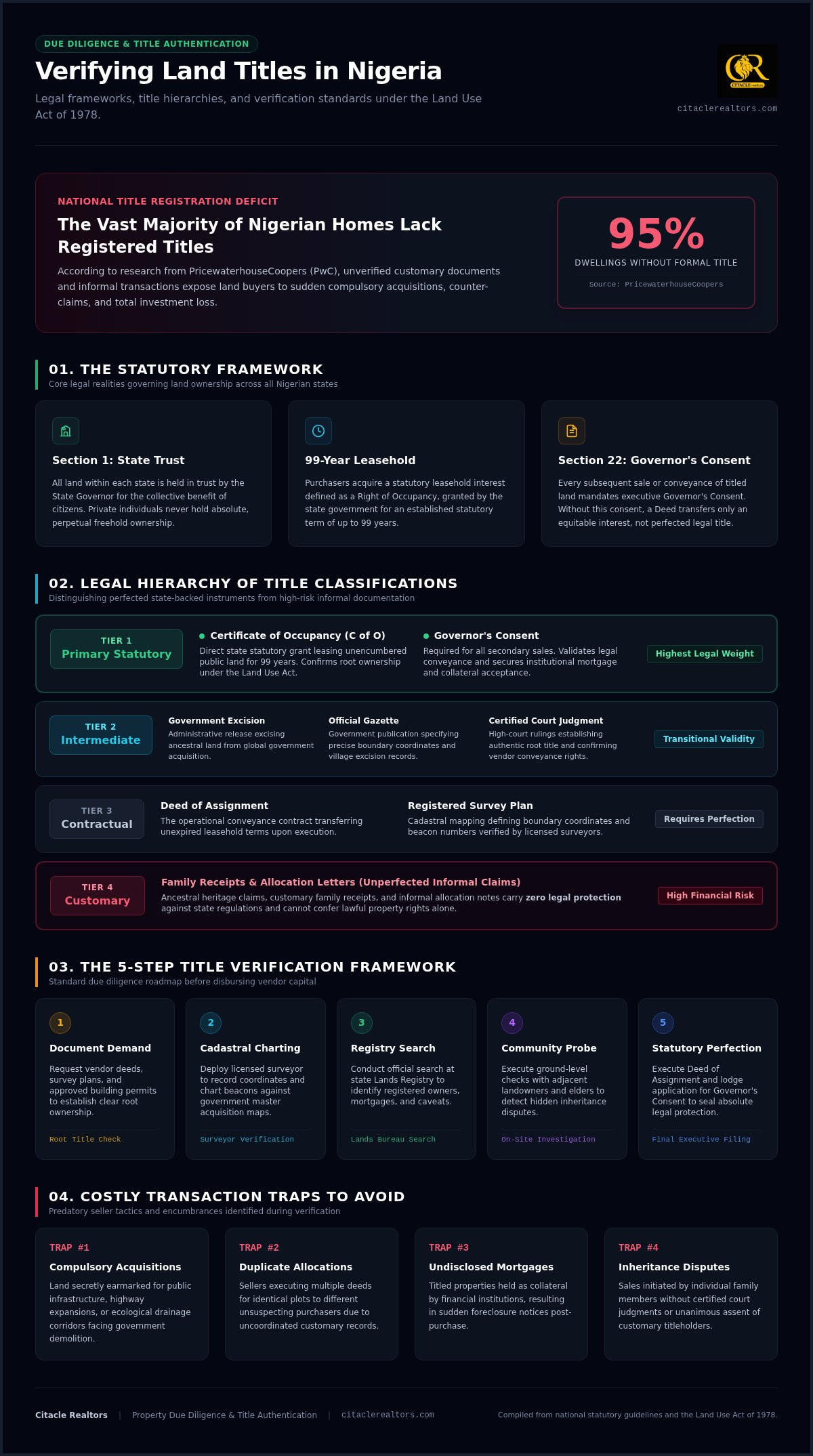
According to research from PricewaterhouseCoopers, an estimated 95% of household dwellings across Nigeria lack registered formal titles. If you feel anxious about risking your hard-earned capital on counterfeit deeds, compulsory acquisitions, or duplicate sales allocations, your caution is entirely justified. Untangling complex documents like a Certificate of Occupancy, Gazette, or Governor’s Consent can feel daunting, but learning how to verify land titles Nigeria demands far more than accepting a seller’s stamped papers at face value.
You deserve absolute peace of mind when undertaking such a significant property journey. In this 2026 due diligence guide, you’ll master the essential legal and survey standards required to authenticate titles and eliminate costly transaction traps before paying a vendor. We’ll walk you through official land registry searches, cadastral charting with licensed surveyors, and community background checks, giving you the clarity to secure unencumbered, litigation-free ownership with complete confidence.
Key Takeaways
- Understand statutory rights of occupancy under national property laws to confirm genuine root ownership before negotiating terms.
- Discover the essential five-step framework for how to verify land titles Nigeria, linking official registry searches with surveyor coordinate charting.
- Learn the legal hierarchy of title classifications to distinguish between perfected instruments and risky, pending application claims.
- Spot predatory seller red flags, hidden encumbrances, and civil disputes early to avoid the threat of duplicate allocations.
- Gain actionable confidence on collaborating with seasoned property advisory specialists to secure unencumbered residential land assets.
Understanding Nigerian Land Ownership and Title Legalities
A genuine land title serves as the ultimate legal instrument confirming proprietary rights, ownership history, and lawful possession over real property. Under Section 1 of the Land Use Act of 1978, all land within each state is held in trust by the State Governor for the collective benefit of citizens. Because of this legal structure, private individuals never hold absolute, perpetual freehold ownership. Instead, buyers acquire a statutory leasehold interest known as a Right of Occupancy, typically granted for an established term of 99 years.
This statutory framework creates a sharp distinction between lawful state-recognized titles and traditional customary land rights. Indigenous landowning families frequently sell parcels based on ancestral heritage, communal memory, or informal family receipts. While customary claims feel culturally persuasive, they carry zero legal protection against state regulations without formal statutory perfection. Relying on unverified paper documents leaves unsuspecting purchasers exposed to sudden government forfeiture, demolitions, and permanent eviction. Understanding how to verify land titles Nigeria begins with recognizing that authentic ownership exists solely within documented administrative registers, not mere verbal agreements.
The Legal Framework of Land Ownership in Nigeria
Under national property statutes, private rights exist strictly as leasehold interests sanctioned by state authority. Physical occupation, clearing vegetation, or erecting perimeter fences does not establish lawful ownership. Without formal instruments documented at the relevant lands bureau, your claim remains merely equitable rather than legal, leaving the door wide open for rival claimants to challenge your interest.
Why Due Diligence Is Essential for Every Land Buyer
Implementing a comprehensive verification process shields your capital against catastrophic losses caused by undisclosed bank mortgages, unresolved inheritance disputes, or duplicate sales allocations. Crucially, systematic checks prevent you from acquiring acreage earmarked for public infrastructure projects, highway expansions, or ecological drainage corridors. Thorough due diligence secures lawful development approvals and protects your long-term residential equity, ensuring your property remains a source of enduring peace and lasting value.
Key Nigerian Land Title Classifications and Documents
Evaluating real estate instruments requires appreciating their legal hierarchy. Every land classification carries specific statutory weight, procedural requirements, and varying risks for prospective purchasers. When exploring how to verify land titles Nigeria, recognizing whether an instrument confers direct legal ownership or merely an equitable interest ensures you budget accurately for perfection. You can review the overall financial implications by exploring the cost of buying land in Nigeria alongside state perfection levies.
Primary Statutory Titles: C of O and Governor’s Consent
A Certificate of Occupancy (C of O) represents the state’s initial statutory grant, leasing unencumbered public land to an individual or corporate body for 99 years. Under Section 22 of the Land Use Act, any secondary sale or transfer of titled land mandates formal Governor’s Consent. Without this executive approval, a Deed of Assignment transfers only equitable rights rather than perfected legal title, directly influencing long-term security and collateral acceptance.
Intermediate Titles: Excision, Gazette, and Court Judgments
Intermediate documentation bridges the divide between customary ancestral holdings and formal state recognition through specific administrative processes:
- Government Excision: The official administrative release of ancestral land back to indigenous communities, excising it from global acquisition.
- Official Gazette: An authenticated government publication detailing the precise coordinates, boundaries, and village names tied to an approved excision.
- Certified Court Judgments: Higher-court rulings that conclusively establish root ownership between disputing families, validating the seller’s lawful right to convey the acreage.
Contractual Documents: Deed of Assignment and Survey Plans
A Deed of Assignment acts as the operational conveyance contract, transferring the seller’s unexpired leasehold term to the buyer once duly executed. In parallel, a registered survey plan delineates precise boundary coordinates and beacon numbers verified against national cadastral mapping. Family purchase receipts and allocation letters never confer lawful property rights on their own. To avoid purchasing encumbered assets or non-excised plots, partnering with professional advisors for vetted residential land sales gives you structured, verified protection throughout your acquisition.
The 5-Step Process to Verify Land Titles in Nigeria
Conducting meticulous due diligence eliminates transaction ambiguity. When learning how to verify land titles Nigeria, you need an independent legal and surveying team working methodically on your behalf. Rushing through due diligence to meet artificial seller deadlines often leads to costly missteps. Follow this structured five-step framework to authenticate root records and protect your investment capital.
Step 1: Document Collection and Preliminary Review
Begin by demanding certified true copies of the vendor’s title documents, survey plan, and valid government identification. Scrutinize the paperwork carefully. Ensure the vendor’s legal names correspond identically across all deeds, identity cards, and historical records. Confirm that the survey plan carries the legible seal and mandatory registration details of a licensed, registered surveyor.
Step 2: Cadastral Charting at the Surveyor General’s Office
Never rely on coordinates printed on an existing survey plan. Retain an independent surveyor to pick fresh geographic coordinates directly from the site beacons. Your surveyor then submits these coordinates to the relevant Surveyor General’s office for cadastral charting. This vital test reveals whether the coordinates sit within committed government acquisitions or unencumbered free zones.
Step 3: Conducting Searches at the State Lands Registry
Submit a formal search application alongside property particulars to the state lands bureau. This investigative step inspects official registry folios to verify registered proprietors, mortgage liabilities, caveats, or court attachments. It confirms an unbroken, authentic chain of title tracing directly back to the original statutory root grant.
Step 4: Court Registry and Corporate Affairs Commission Inquiries
Title searches must extend beyond land registries. Conduct searches at jurisdictional court registries to ensure the asset isn’t entangled in contentious inheritance or boundary litigation. If the vendor is an incorporated entity, search the Corporate Affairs Commission database to confirm legal incorporation, active directors, and valid board resolutions authorizing the disposition.
Step 5: On-Site Ground-Truthing and Community Inquiries
Physical ground-truthing uncovers hidden risks no registry file reveals. Visit the site personally to inspect beacon pins, terrain, and adjoining boundary developments alongside your surveyor. Engage traditional community leaders, youth representatives, and neighboring property owners. Confirming family consensus and peaceful historical occupation ensures your title verification process concludes with unassailable security.
Common Red Flags and Pitfalls in Land Title Due Diligence
Fraudulent syndicates exploit buyer enthusiasm with calculated urgency and deceptive claims. A polished perimeter wall, installed security gate, or active farming activity does not validate root ownership. If formal registration records do not exist at the state lands bureau, those visible physical structures mean nothing in law. Navigating how to verify land titles Nigeria requires staying vigilant against subtle irregularities before parting with your funds.
One major threat involves parcels advertised under “excision in process” or “gazette pending.” In statutory terms, pending excisions remain unexcised land under committed government acquisition. Buyers hold zero legal claim and risk complete forfeiture without state compensation until an excision is officially signed, gazetted, and documented. Similar hazards surround land tied to unresolved probate processes, where competing heirs execute unauthorized deeds without universally signed Letters of Administration.
Documentary and Registry Red Flags
Paperwork issues often signal deliberate deception or fractured ownership roots:
- Missing Conveyance Links: Gaps between the primary grantee named on a Certificate of Occupancy and the current seller.
- Dubious Documentation Details: Mismatched survey plan coordinates, altered folio numbers, or missing practitioner seals on historical deeds.
- Restricted Registry Access: Vendors who delay providing certified copies or insist on closing deals without independent bureau verification.
Physical and Community Warnings on the Ground
Ground-truthing frequently exposes disputes that clean paperwork attempts to conceal. Look out for red spray-painted notices bearing statutory warnings or court litigation markers such as “Buyer Beware” or “Under Dispute.” Discovering competing beacon numbers near existing perimeter points suggests conflicting private surveys and overlapping boundary allocations. Pay close attention to objections voiced by community elders or neighboring property owners regarding unresolved family partitions.
Protecting your property portfolio requires proactive risk management at every stage. Explore how our structured property management services safeguard verified holdings from fraudulent intrusions, boundary encroachments, and title risks nationwide.
Securing Your Property Acquisition with Citacle Realtors
Partnering with a seasoned advisory firm provides your strongest safeguard against transaction risks. While understanding how to verify land titles Nigeria gives you theoretical clarity, executing full investigations across busy bureaucratic registries requires dedicated professional coordination. Citacle Realtors bridges this divide, applying rigorous multi-point verification across our vetted residential land sales so you acquire litigation-free property with complete confidence.
Safeguarding capital extends far past closing a deal. Combining acquisition due diligence with proven operational principles from our professional property management guide ensures your real estate equity remains thoroughly protected against physical encroachment, boundary shifting, and administrative disputes over time.
Comprehensive Land Due Diligence and Title Perfection Support
Citacle Realtors coordinates independent coordinate charting and comprehensive lands bureau investigations before committing client capital to an acquisition. Our advisory team facilitates clean title handovers, tracking every documentation step from original deeds of transfer through formal Governor’s Consent perfection. You benefit from seasoned professionals dedicated to protecting your investment journey at every turn.
Sustaining Long-Term Value Through Professional Management
Vacant land demands proactive care to preserve market value and keep boundaries intact. Citacle Realtors offers structured operational oversight designed to build lasting generational security:
- Encroachment Prevention: Active property management keeps vacant parcels secured against unauthorized physical squatting and illicit boundary shifts.
- Integrated Asset Valuation: Connecting land investors with professional asset valuation specialists helps you track true market appreciation accurately.
- Post-Acquisition Guidance: Thoughtful facilities management and property oversight provide structured support whether preparing plots for immediate residential building or long-term portfolio growth.
Before signing binding purchase contracts or advancing earnest deposits, engage our dedicated advisory team to help you navigate your real estate transactions with complete peace of mind.
Take the Next Confident Step Toward Secure Land Ownership
Acquiring real estate should be an inspiring milestone rather than a source of persistent anxiety. When you understand how to verify land titles Nigeria, you replace uncertainty with decisive action. Cross-referencing certified registry folios with independent surveyor charting and thorough community vetting ensures your capital stays protected against duplicate claims, sudden state acquisitions, and encumbrances.
You don’t have to navigate this complex investigation alone. Citacle Realtors serves as your trusted advisory partner, bringing together rigorous transaction diligence, professional asset valuation, and active property management under one roof. We deliver exclusively pre-vetted residential land opportunities backed by authentic, unencumbered title documentation nationwide. Explore verified residential land opportunities with Citacle Realtors today, and take the next confident step toward building your real estate legacy with complete peace of mind.
Frequently Asked Questions
Can an individual legally sell land in Nigeria without a Certificate of Occupancy?
Yes, an individual can legally sell land without a Certificate of Occupancy if they hold another recognized statutory or customary root of title. Valid alternatives include an official government gazette, an approved court judgment, or an existing registered deed of assignment backed by executive consent. However, the purchaser must investigate the underlying root to confirm that the vendor possesses transferable rights under national laws rather than an unperfected customary claim.
What is the difference between excised land and committed government acquisition land?
Excised land has been formally released from compulsory state acquisition, while committed government acquisition land is strictly reserved by authorities for public infrastructure or ecological use. Buying property in a committed acquisition zone leads to inevitable forfeiture without state compensation. Excised land, conversely, grants legitimate proprietary autonomy back to indigenous communities or private holders once published in an official government gazette and entered into administrative survey records.
How long does a formal land title search take at the state lands registry?
A formal land title search generally takes between three business days and three weeks depending on registry administrative speed and file digitization. Modernized digital portals allow legal representatives to access property records swiftly, whereas manual archive retrieval requires extra time. When learning how to verify land titles Nigeria thoroughly, buyers should budget adequate time for legal counsel to cross-examine registry files, survey charts, and encumbrance ledgers without rushing.
Can a registered survey plan replace a statutory land title document?
No, a registered survey plan can never substitute for a lawful land title document. A survey plan simply functions as a technical cadastral blueprint that delineates precise physical boundaries, parcel dimensions, and beacon coordinates. It provides no legal proof of ownership. Legitimate proprietary rights require formal documentation like a Certificate of Occupancy or a stamped Deed of Assignment. A survey merely helps verify where the land sits, not who owns the underlying title.
What should a buyer do if the seller only provides an ancestral land receipt?
You should halt payment immediately and demand verifiable statutory documentation before proceeding. Family receipts and purchase agreements convey zero legal title against government acquisition or rival claims. If a seller only holds an informal receipt, commission an independent surveyor to chart site coordinates at the surveyor general’s office. You must also trace family authority, ensuring all principal family heads and accredited representatives give unanimous consent to execute a valid deed.
How do buyers verify that a real estate company actually owns the estate land they sell?
Buyers must conduct an independent corporate search alongside full land registry and cadastral investigations. Understanding how to verify land titles Nigeria sold by developers requires reviewing their registered Deed of Assignment or root grant. Check the Corporate Affairs Commission database to confirm the company is active, inspect board resolutions authorizing property sales, and confirm the land isn’t pledged as collateral against commercial debentures. Professional real estate advisors simplify this entire process.
Is a Governor’s Consent required if the land already possesses a valid C of O?
Yes, a Governor’s Consent is legally mandatory for any subsequent transaction involving land that already carries a Certificate of Occupancy. A Certificate of Occupancy is only granted once to the original applicant. Under national land regulations, every subsequent transfer, whether through a sale, gift, or mortgage, requires formal executive consent. Without this approval, your Deed of Assignment merely grants an equitable interest, leaving you without a perfected legal title enforceable against third parties.