

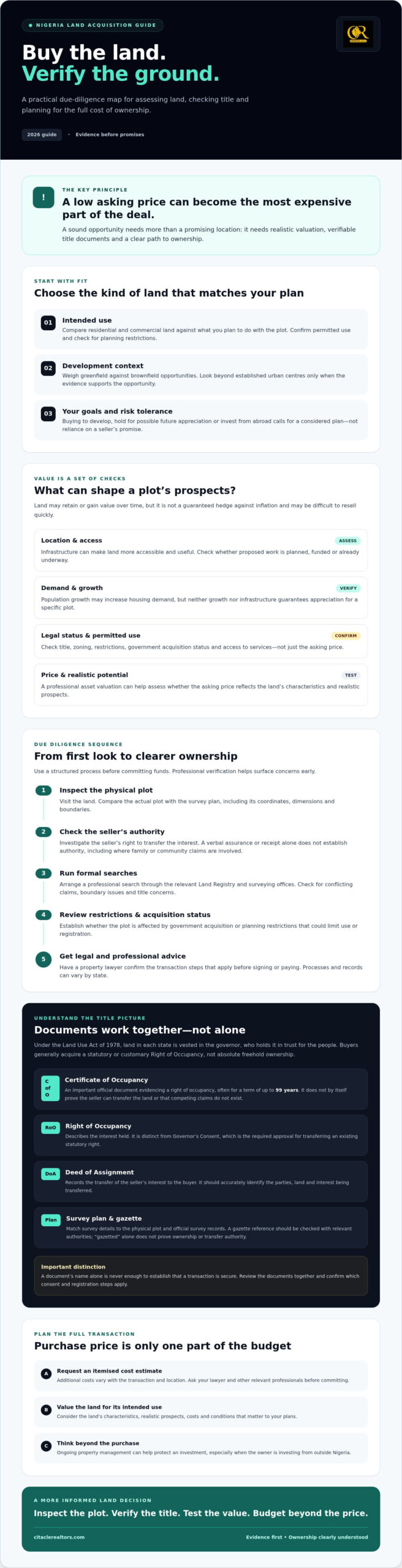
A low asking price can become the most expensive part of a land deal. The best land acquisition opportunities Nigeria has to offer aren’t simply plots in promising locations; they’re opportunities backed by sound valuation, verifiable title documents and a clear path to ownership.
If you’re concerned about land-grabbers, fraudulent papers or unclear costs, your caution is well placed. Buying land also means understanding the legal requirements, including title searches and the relevant consent and registration steps. With careful checks, you can reduce avoidable risks and make a more confident investment.
This 2026 guide shows you how to assess land, review its value and carry out essential due diligence before committing funds. You’ll also learn what to check in ownership documents, how to approach government regularisation requirements and why the purchase price is only one part of your budget. Whether you’re buying to develop, hold for possible future appreciation or invest from abroad, a considered plan can help you make a more informed decision.
Key Takeaways
- Compare residential and commercial land, and weigh greenfield against brownfield opportunities to match a purchase with your goals and risk tolerance.
- Assess a plot’s current characteristics and future potential before committing, rather than relying on the asking price or promises of appreciation.
- Explore land acquisition opportunities Nigeria with a structured process, from physical inspection and preliminary checks to a formal Land Registry search.
- Understand how land titles and the Land Use Act shape ownership, and identify the legal steps that may apply to your transaction.
- Plan beyond the purchase: consider ongoing property management to help protect your investment, especially if you’re investing from outside Nigeria.
The Landscape of Land Acquisition Opportunities in Nigeria
Nigeria’s property market may attract investors, but demand alone doesn’t make every plot a sound investment. Land may retain or gain value over time, but it isn’t a guaranteed hedge against inflation. It can be difficult to resell quickly, and its value depends on factors such as location, legal status, permitted use and access to services.
The strongest land acquisition opportunities Nigeria offers require more than spotting a low price. Investors may look beyond established urban centres to developing corridors and satellite communities, where entry costs could be lower. Any future growth potential depends on evidence, not promises. Check whether infrastructure is planned, funded or already underway, and assess whether present-day demand supports the seller’s projections.
Budget for the full transaction, not just the advertised price. Additional costs can vary with the transaction and location, so ask your lawyer and other relevant professionals for an itemised estimate before committing. A professional asset valuation can help you judge whether the asking price reflects the land’s characteristics and realistic prospects. Make sure the estimate accounts for the costs and conditions that matter to your intended use.
Drivers of Land Value Appreciation
Infrastructure can make land more accessible and useful, while population growth may increase demand for housing. Neither factor guarantees that a particular plot will appreciate. Zoning matters too: confirm the land’s permitted use and check for planning restrictions. Treat proposed infrastructure and possible future rezoning as uncertain until you have verified their status with the relevant authorities.
Common Risks in the Nigerian Land Market
Traditional land claims can be complex. A person described as an “Omonile” may claim family or community rights, but a verbal assurance or receipt alone doesn’t establish that the seller has authority to transfer the interest. Nigeria’s legal framework draws on multiple traditions; this overview of Nigerian legal systems offers context, but isn’t a substitute for transaction-specific legal advice.
Also establish whether the plot falls under government acquisition or is affected by planning restrictions. Buying without checking can leave you unable to use or register the land as intended. Arrange a physical inspection, verify the survey and seller’s authority, and obtain a professional search through the relevant Land Registry and surveying offices. These checks can help identify conflicting claims, boundary issues and title concerns before money changes hands. Professional verification is a core part of protecting your investment.
Understanding Nigerian Land Titles and Legal Frameworks
Before pursuing land acquisition opportunities Nigeria offers, understand what the documents actually give you. Under the Land Use Act of 1978, land in each state is vested in the governor, who holds it in trust for the people. Buyers generally acquire a statutory or customary Right of Occupancy, not absolute freehold ownership. The applicable process and records can vary by state, so a document’s name alone is never enough to establish that a transaction is secure.
A Certificate of Occupancy (C of O) is an important official document evidencing a right of occupancy, often for a term of up to 99 years. It isn’t a guarantee that a seller has authority to transfer the land or that no competing claims exist. A Right of Occupancy describes the interest held, while Governor’s Consent is the required approval for transferring an existing statutory right. Treat these as related but distinct parts of the title picture.
A Deed of Assignment records the transfer of the seller’s interest to the buyer. It should accurately identify the parties, land and interest being transferred. The transfer process may also require Governor’s Consent and registration under the relevant state procedures. Have a property lawyer confirm which steps apply before signing or paying.
Key Title Documents You Must Know
Review documents together, not in isolation. Check that the C of O or other root of title matches the seller and the land described in the transaction. Compare the survey plan’s coordinates, dimensions and boundaries with the physical plot and official survey records. A gazette may record government decisions or land allocations, but the word “gazetted” by itself doesn’t prove that a seller owns or can transfer a specific parcel. Confirm the gazette reference and its effect with the relevant authorities and a qualified legal professional.
The Role of Asset Valuation in Title Verification
Valuation helps test whether the asking price is consistent with the land’s characteristics and available market evidence, and whether the investment appears proportionate to the costs you expect to incur. It isn’t a substitute for a title search: a valuer cannot establish legal ownership or clear an encumbrance. Pair valuation with searches and document review to investigate restrictions, competing interests or other issues that could affect value. For a closer look at asset valuation for real estate, consider how an independent assessment can inform your decision before purchase.
The World Bank’s review of land sector governance in Nigeria provides broader context for why careful records and verification matter. If you’d value guidance on assessing a property’s worth, explore professional asset valuation services as one part of a thorough acquisition process.
Evaluating High-Potential Investment Opportunities
There’s no single “best” type of land. The right choice depends on your intended use, investment horizon, budget and ability to manage risk. Compare each plot against those criteria before weighing its growth potential. Residential land may suit buyers planning a home or future housing development; commercial land depends on demand from businesses and whether zoning permits the intended activity. Neither category is automatically more profitable.
Greenfield land, which is largely undeveloped, may offer room for future growth but can involve uncertain infrastructure, access and development timelines. Brownfield land has previously been developed or used, so existing access and services may be an advantage, but investigate past use, site condition and any restrictions. Likewise, established urban nodes can offer existing demand at a higher entry price, while fringe areas may cost less but rely more heavily on future infrastructure and population growth.
Serviced estates can provide prepared infrastructure and a more organised development setting, often at a premium over less-developed land. Confirm exactly which services are installed, who maintains them, and whether the estate’s title, planning status and access arrangements have been independently checked. Don’t treat a brochure’s future-development promises as completed improvements.
Strategic Selection Criteria
Use a consistent checklist to compare plots. Inspect the topography, drainage, soil and access conditions, since difficult site characteristics may add to future construction costs. If you plan to develop or improve a rental property, this guide to building renovation specialists offers related considerations for protecting property value. Check the status, funding and likely relevance of planned transport or industrial projects rather than assuming they will proceed. Finally, assess present-day security and year-round accessibility, not just the site’s projected potential.
- Use: Does zoning align with your intended residential or commercial purpose?
- Readiness: Are access, utilities and essential services available, or merely proposed?
- Risk: Can you verify the title, boundaries, site conditions and development plans?
- Costs: Can your budget cover the purchase, ongoing holding costs and any preparation needed?
Land Banking: The Long-Term Wealth Strategy
Land banking means purchasing land to hold for possible future use or appreciation rather than developing it immediately. A “path of progress” is a location where credible, observable expansion may create future demand, such as infrastructure that is funded and underway. It isn’t a promise of returns. Before buying, decide how long you can hold the plot, account for applicable expenses, and arrange regular checks to deter encroachment. For non-resident investors, professional property management can help maintain oversight during the fallow period.
The Step-by-Step Land Purchase Process in 2026
A disciplined process turns promising land acquisition opportunities Nigeria into a more informed purchase. Procedures and document requirements vary by state, so have a Nigerian property lawyer confirm the steps for the specific plot. Don’t pay in haste because a seller claims another buyer is waiting.
- Inspect the plot and make preliminary checks. Visit the site, confirm its boundaries against the survey plan, assess access and look for signs of occupation or disputes. Speak with nearby residents where appropriate, but treat informal assurances as leads to verify, not proof of ownership.
- Search official records. Ask a property lawyer to conduct a search at the relevant Land Registry and have the survey plan checked with the Surveyor-General’s office. Confirm the registered interest, ownership history, boundaries and any recorded interests that could affect the transaction.
- Agree terms and prepare the purchase agreement. Before signing, clarify the parties, property description, purchase price, payment schedule, documents to be supplied and conditions for completion. Have your lawyer draft or review the agreement so it reflects the verified title and agreed terms.
- Pay securely and execute the Deed of Assignment. Use a traceable payment method and transfer funds only to an account verified as belonging to the seller or an authorised recipient. Keep payment evidence. Execute the deed only after your lawyer confirms the seller’s authority and the documents match the agreed transaction.
- Complete the title-perfection steps. The transfer may require Governor’s Consent, stamp duty and registration at the relevant state offices. Confirm the applicable process, fees and timing with your lawyer and the relevant authorities.
Due Diligence: The Investor’s Shield
Ask the Surveyor-General’s office to check whether the land is marked as government-acquired or committed, and have the seller’s identity and authority to sell independently verified. Check that names and land descriptions align across the title documents, survey plan and agreement. A practical checklist for verifying land titles can help organise your review, but it doesn’t replace an official search or legal advice.
Closing the Deal Securely
At completion, obtain receipts and the original title documents the seller has agreed to provide, with a written record of every handover. Then take documented physical possession. Marking boundaries or installing fencing and signage may help deter disputes, but first confirm the boundaries and any applicable approvals. This is particularly valuable if you’re buying from outside Nigeria. For support with residential land sales and asset valuation, explore the relevant services offered by Citacle Realtors.
Securing Your Investment with Professional Management
Completing a land purchase is a milestone, not the end of the work. Until you develop or sell, the plot still needs oversight. Keep title and payment records safely, maintain a clear record of its boundaries, and arrange periodic inspections. If you’re investing from outside Nigeria, a trusted local contact or property manager can help you stay informed about the site and respond to concerns promptly.
Encroachment can lead to costly disputes. Compare boundary markers with the survey plan, document the plot’s condition during inspections, and keep dated records of any fencing, signage or maintenance. If someone occupies or claims part of the land, seek legal advice rather than trying to resolve the matter through confrontation. For developed sites or estates with shared infrastructure, facilities management can support the ongoing oversight of facilities and help keep the property in good order.
Before moving from owner to developer, revisit your investment goals. Confirm that the intended use aligns with zoning and title conditions, then assess access, utilities, site constraints and likely development costs. A realistic plan helps you decide whether to build now, hold the land or prepare it for a future project. Don’t rely on projected rental income or resale value without checking the assumptions behind those estimates.
Enhancing Value Through Strategic Development
If your plans include building homes, residential property management services can help prepare completed properties for future tenants and ongoing oversight. Existing structures may also benefit from carefully planned renovations that improve condition and marketability. Assess the work needed before budgeting, and keep clear records of repairs and improvements. Professional oversight can be especially helpful for non-resident owners who cannot regularly visit the property themselves.
The Citacle Advantage: Your Property Partner
Land acquisition, valuation and property management are connected parts of a long-term investment. Citacle Realtors offers residential land sales, asset valuation and property management, services that can help you consider a plot’s value alongside the responsibilities that follow purchase. A clear, well-documented process supports more informed decisions and greater peace of mind, though no provider can guarantee appreciation or eliminate every risk.
For support with residential land sales, asset valuation or property management, explore Citacle Realtors’ property services and take the next step with a clearer view of your investment’s needs.
Build Your Land Investment with Confidence
Strong land investments begin with a clear purpose and careful checks. Across land acquisition opportunities Nigeria offers, compare a plot’s potential with your goals, verify its title and boundaries, and budget for costs beyond the purchase price. Then plan for what comes next, from protecting the site to developing or managing it over time.
Citacle Realtors brings together residential land sales, asset valuation and property management to support investors beyond the initial purchase. These services can form part of your decision-making and ongoing property oversight, alongside independent legal advice and official checks.
Whether you’re investing locally or from abroad, a well-considered next step can bring greater clarity to a significant decision. Explore Citacle Realtors’ property services to discuss residential land sales, asset valuation or property management for your investment.
Frequently Asked Questions
What is the safest land title to buy in Nigeria?
No title document is automatically safe without independent verification. A Certificate of Occupancy (C of O) is an important record of a right of occupancy, but it doesn’t alone prove that the seller can transfer the land or that there are no competing claims. Ask a property lawyer to check the root of title, conduct a Land Registry search, confirm the survey and boundaries, and establish which transfer approvals and registration steps apply.
Can a foreigner or non-resident Nigerian buy land in Nigeria?
Yes. Foreigners can legally acquire land in Nigeria, but they acquire a Right of Occupancy rather than absolute freehold ownership. Non-resident Nigerians can also purchase land. In either case, don’t rely on distance-based assurances or scanned documents alone. Appoint a qualified local lawyer or representative to verify the seller’s authority, inspect the plot, check the title with the relevant authorities and guide the required transfer and registration process.
How long does it take to perfect a land title in 2026?
There isn’t a verified national average timeline for perfecting a title in 2026. The process and duration can vary by state, title history, documentation and the offices involved. Before completing a purchase, ask a property lawyer familiar with the relevant state process for a realistic, transaction-specific estimate. Confirm which approvals, payments and documents are required, and make sure the sale agreement clearly records the parties’ responsibilities and any agreed conditions.
What are the hidden costs associated with buying land in Nigeria?
Plan for more than the seller’s asking price. Depending on the transaction and state, additional expenses may include legal and agency fees, a survey, title searches, stamp duty, registration and Governor’s Consent where applicable. Site preparation or boundary marking may also add to your budget. Request an itemised, current estimate from your lawyer and relevant professionals before committing, and confirm which costs are payable by each party.
What happens if I buy land that is under government acquisition?
You may face restrictions on registering, occupying, developing or transferring the land, depending on its status and the applicable government action. Don’t assume that a seller’s receipt or promise of later regularisation resolves the issue. Before paying, have the parcel checked with the relevant state authorities and Surveyor-General’s office, and ask a property lawyer to explain the specific consequences. If acquisition or commitment is confirmed, pause the transaction until you receive professional advice.
How can I verify if a C of O is genuine without going to the Land Registry?
You can ask a Nigerian property lawyer or authorised representative to conduct the official search on your behalf. A photograph, photocopy or online image of a C of O isn’t reliable proof of authenticity. Provide the document details and survey plan for checking against official records, and confirm that the land description and holder match the proposed sale. Use a digital verification service only if the relevant authority confirms it is an official channel.
Is it better to buy land in a serviced estate or from traditional families?
Neither option is automatically safer or better. A serviced estate may offer established infrastructure, but confirm what is already provided, who maintains it and whether the seller has authority to transfer the land. For a family sale, establish who has the right to act for the owners and whether all necessary parties have consented. In both cases, verify the title, boundaries, planning status and transfer requirements independently before paying.
How do I protect my land from ‘Omonile’ after purchase?
Start with a completed, documented transfer and keep your original title documents, payment records and survey plan secure. Confirm the plot boundaries on site, record its condition and arrange regular inspections. Fencing or signage may help show possession, but check boundaries and any relevant approvals first. If someone makes a claim or enters the land, document what happened and consult a property lawyer promptly. Avoid confrontation, and don’t assume physical markers resolve a title dispute.