
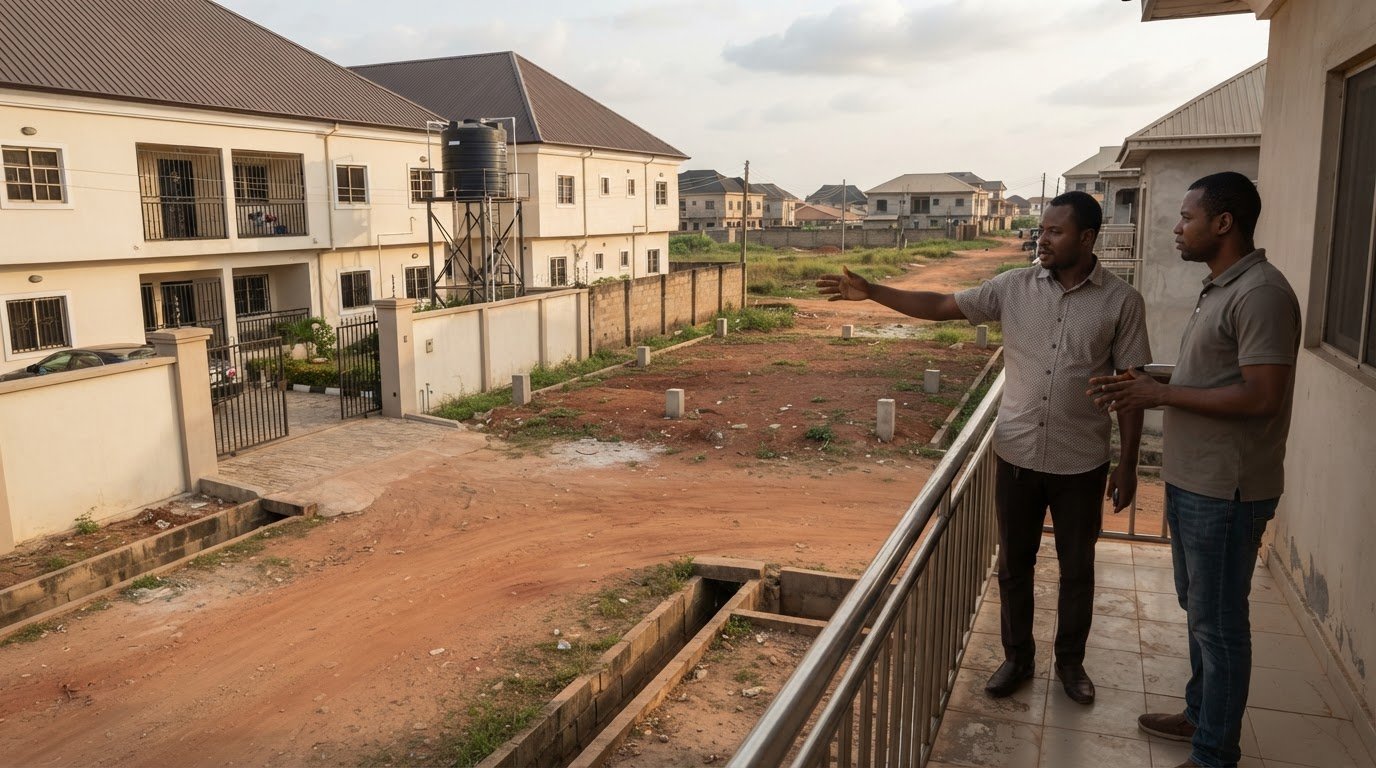
The asset that builds wealth faster may be the one you can hold comfortably, not simply the one with the greatest potential upside. When investing in land vs other assets in Nigeria, land may suit a longer holding period, while listed shares can be sold during market hours and property sales can take months. The right fit depends on your capital, timeline, access to cash and tolerance for ongoing costs.
It’s understandable to see land as a tangible investment with potential to appreciate, while also wanting an asset that can be converted into cash more readily. Neither advantage settles the choice on its own. Land requires careful attention to purchase costs and documentation, while other assets offer different routes to returns, costs and liquidity.
This comparison weighs land against apartments, shares and real estate investment schemes using the practical factors that shape the decision. Consider how entry capital, potential timelines, ease of selling and ongoing responsibilities differ, then choose an investment approach that fits your financial plans in Nigeria.
Key Takeaways
- Compare the full cost of owning land or property, including transaction expenses and the time and effort required to manage it.
- Match your investment to your available capital and timeline: lower entry costs or quicker potential access may matter more than long-term appreciation.
- Consider how soon you might need your money. Shares can generally be sold more readily, while finding a property buyer can take time.
- Factor in maintenance and oversight before choosing; property management and facilities management can help address the responsibilities of holding real estate.
Direct property investment requirements and challenges
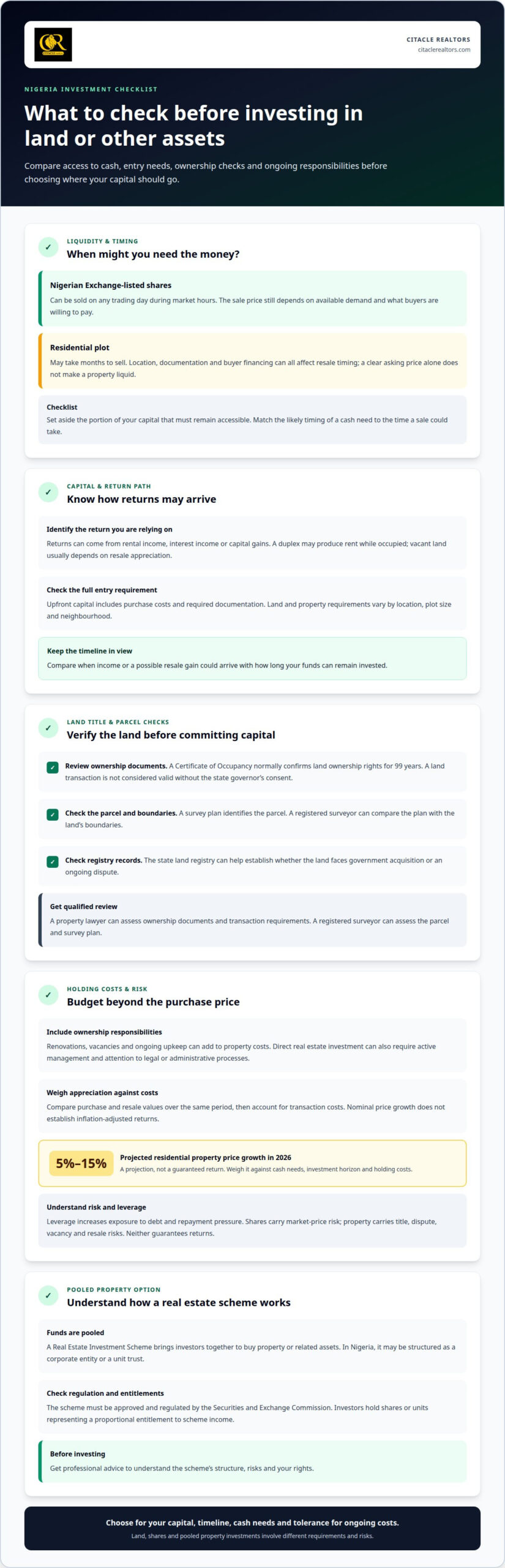
In Nigeria, a Certificate of Occupancy (C of O) normally confirms land ownership rights for 99 years. A land transaction is not considered valid without the state governor’s consent. A survey plan identifies the parcel, while the state land registry can help establish whether it faces government acquisition or an ongoing dispute.
Reviewing title is essential before committing capital. A property lawyer can assess ownership documents and transaction requirements, while a registered surveyor can compare the survey plan with the land’s boundaries. These checks matter because direct real estate investment can require substantial capital, active management and attention to complex legal or administrative processes.
Budget for more than the purchase price. Renovations, vacancies and ongoing upkeep can add to your costs, so weigh potential capital appreciation against inflation and holding costs.
Pooling funds offers another route. A Real Estate Investment Scheme brings investors together to buy property or related assets. In Nigeria, it may be structured as a corporate entity or unit trust and must be approved and regulated by the Securities and Exchange Commission. Investors hold shares or units that represent a proportional entitlement to scheme income. Professional advice can help you understand the structure, risks and rights involved.
Leverage can expand access to an investment, but it also increases exposure to debt and repayment pressure. If income or resale proceeds fall short, the investor still has financing obligations. Shares carry market-price risk; property carries title, dispute, vacancy and resale risks. Neither guarantees returns.
- Ask a property lawyer to review ownership documents and consent requirements.
- Use a surveyor to assess the parcel and its survey plan.
- Consult a qualified investment professional about scheme terms, leverage and risk.
Choosing an investment based on capital and timeline
Your choice turns on entry capital, desired cash flow, and how long funds can remain invested.
Income and Capital Gains
Investment returns can come from rental income, interest income, or capital gains. Rental income pays while a property is occupied; interest income comes from lending or interest-bearing investments, while capital gains arise when an asset sells above its purchase price. A duplex may produce rent, whereas vacant land usually depends on resale appreciation. Compare when returns arrive with your financial timeline. If rental income matters, consider duplex rental options alongside land.
Wealth Creation and Capital Preservation
Wealth creation means growing assets over time, while capital preservation focuses on limiting losses to invested funds. For larger portfolios and multi-generational strategies across the continent, institutional family offices like vieyragroup.com demonstrate how patient capital balances real assets with broader wealth-holding objectives. Real estate can contribute through rent or appreciation, but ownership also brings ongoing expenses and exposure to local conditions. Residential property prices were projected to grow between 5% and 15% in 2026. Treat that projection as a possible outcome, not a guaranteed return, and weigh it against your cash needs and investment horizon.
Upfront Capital Requirements
Upfront capital is the amount needed to enter an investment, including purchase costs and required documentation. These are location-specific benchmarks, not 2026 citywide averages; plot size and neighbourhood matter.
Capital Appreciation Potential
Capital appreciation means an increase in an asset’s value and can contribute to long-term wealth building. However, nominal price growth does not establish inflation-adjusted returns. Compare purchase and resale values over the same period, then account for transaction costs before judging real gains.
Liquidity: How Easily Can You Access Your Money?
Liquidity describes how quickly an investment can be converted into spendable cash. Nigerian Exchange-listed shares can be sold on any trading day during market hours. A residential plot, by contrast, may take months to sell. This difference matters if you need funds for a planned purchase, an emergency or another investment.
Property resale depends on several connected factors: location, documentation and buyer financing. For example, a seller in Lagos State may need to wait while a prospective buyer arranges funding and reviews the title. A clear price expectation alone doesn’t make a property liquid. The buyer must be ready, and transaction details must support progress toward completion.
Buying land also ties capital to a specific parcel and location. Demand can vary with access, nearby infrastructure and the area’s intended use. A residential plot suited to home building may attract different buyers from land intended for commercial projects. These factors shape the likely pool of buyers, but cannot guarantee a sale by a particular date.
Shares offer a different route to resale: Nigerian Exchange-listed holdings can be sold during market hours on any trading day. However, the sale price depends on available demand and what buyers are willing to pay. If you need a particular amount, remember that being able to sell and receiving that amount are separate questions.
When comparing Nigerian investments with options in other African markets, consider how quickly each asset can meet a cash need. Set the likely timing of that need beside a property’s location, documentation and buyer-financing requirements. For example, money needed soon may be a poor match for a land sale that could take months. Funds intended for a longer holding period may allow more time for resale.
Before buying, decide what portion of your capital must remain accessible. Keep that requirement separate from expectations about property demand or future infrastructure. A strong location may support buyer interest, but it does not eliminate the time needed to find a purchaser and complete a property sale.
Ongoing management and maintenance costs
Holding land or rental property affects cash flow in different ways. Before buying, include recurring upkeep and transaction expenses in your estimate of net returns.
Costs of Holding Idle Land
Idle land is property held without current use or rental income, so ownership can bring costs without generating cash flow. In Nigeria, an undeveloped plot still needs oversight: overgrowth, waste, boundary issues or unauthorised use can create practical problems. For example, a plot reserved for a future commercial project may remain unproductive while its owner pays for upkeep and monitoring. Consider whether the expected future value justifies these carrying costs.
Taxes, Fees, and Transaction Costs
Taxes, fees and transaction costs are expenses associated with acquiring or selling property. In Nigeria, property transaction costs often add 10-15% to the purchase price, while real estate agency fees are usually 5-10% of the sale price. The applicable taxes and official charges depend on the transaction and state. Include these expenses when estimating what remains from a sale, rather than treating the agreed price as your net proceeds.
A developed property brings different ongoing responsibilities from an empty plot. For a rental building, repairs, shared-area upkeep and periods without tenants can reduce rental income. A commercial property may also need regular facilities oversight to keep common areas functioning. Account for these demands when assessing whether expected returns can support the property’s operating needs.
Idle land generates no rent to offset maintenance or oversight costs. A developed property can produce income, but repairs and vacancies affect the cash available to the owner. Compare both cases in a simple record: expected income, recurring expenses, transaction costs and planned improvements. This helps you assess whether an asset can preserve wealth or become profitable over its intended holding period.
For rental buildings, professional property management can help organise ongoing oversight and maintenance.
Citacle Realtors: Residential Land Sales
Citacle Realtors offers residential land sales for investors whose plans, capital and holding timeline suit land ownership. If you’re weighing a specific property against other assets, asset valuation can help you understand its assessed value as part of your decision.
After acquisition, property management and facilities management can support the ongoing oversight of real estate. These services are useful when you hold property and need to plan for its care, rather than when you need quick access to invested funds.
Consider residential land sales when you’re ready to explore land ownership as part of your investment plans. Contact Citacle Realtors to discuss your property needs.
Make Your Next Investment Decision With Purpose
Before committing capital, write a brief for yourself: what should the investment achieve, when might you need the money, and how much ongoing responsibility suits you? Clear priorities give you a practical way to assess opportunities without letting market excitement dictate your direction.
For investing in land vs other assets in Nigeria, compare each opportunity with your brief and wider financial plans. Your choice should reflect the role you want the investment to play, not simply its potential appeal. Defining that role can help you move forward with greater clarity.
If you’re ready to discuss your property options, contact Citacle Realtors. A thoughtful decision begins with a clear sense of what matters to you, and you can take that next step at your own pace.
Frequently Asked Questions
Land vs Apartment Investment in Nigeria: Which Builds Wealth Faster?
Neither land nor an apartment reliably builds wealth faster; results depend on rent, resale value, expenses and time held. A vacant plot may gain value but usually produces no rental income. An occupied apartment can generate rent sooner, although repairs and vacant periods reduce net proceeds. Compare expected cash flow and your holding period, then consider whether you can manage a building or wait for land resale.
Which Should You Choose?
Choose an investment based on what you need it to do, not just its potential appreciation. A sound approach to investing in land versus other assets in Nigeria starts by ranking three priorities: income, access to cash or long-term ownership. For example, someone saving for a near-term expense may prioritise liquidity, while an investor with patient capital may accept a longer property holding period. Let that priority guide your comparison.
Which is a better investment, shares or property in Nigeria?
Shares may suit an investor seeking a tradable holding and exposure to companies; property may suit someone seeking direct ownership or rental use. Neither is automatically superior. A share price can fall, while a property can face vacancy, upkeep or title issues. Compare each investment’s income source, costs and exit plan, and avoid committing money needed for a fixed near-term obligation.
Which is better?
Neither is universally better. The stronger choice is the one that fits your objective without concentrating all available capital in one asset. For instance, putting all your savings into one parcel can leave little cash for urgent needs. Holding only market-linked assets may not meet a goal that requires direct property ownership. Define your time horizon, cash needs and tolerance for price changes before deciding.
What are the returns, risks, and liquidity of Nigerian land compared with stocks, bonds, treasury bills, and real estate?
Land and other property can produce gains through resale or rent, but upkeep, vacancies and slow resale affect net returns. Stocks offer market-linked returns and can be sold on trading days. Bonds and treasury bills follow stated terms and maturity dates, so review their income and exit conditions. Compare each option’s potential return with price risk, access to cash and the time you can leave funds invested.
What are the main risks of investing in Nigerian land, including fraud, land disputes, flooding, and compulsory acquisition?
Key risks include false or competing ownership claims, disputes that delay use or resale, flooding that affects access or usability, and government acquisition that disrupts plans for affected land. Before buying, compare ownership documents with survey details and state land registry records, including acquisition or dispute status. Assess site drainage and access, and have a property lawyer review the transaction documents.