

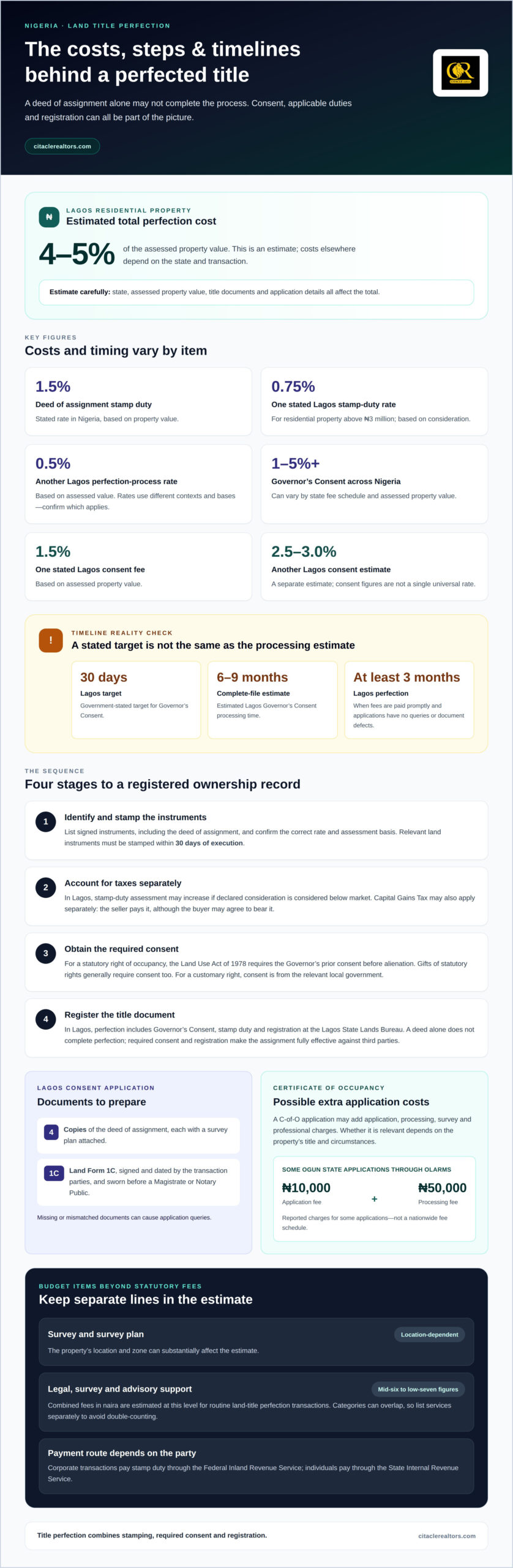
The cost of perfecting land title in Nigeria isn’t a single nationwide fee. In Lagos, total perfection costs for residential property are estimated at approximately 4-5% of the assessed property value, while the amount elsewhere depends on the state and transaction. Governor’s Consent processing in Lagos is estimated to take 6-9 months for complete files.
It’s easy to assume a deed of assignment is all you need to secure a property purchase. But perfecting title can involve obtaining Governor’s Consent, paying applicable duties and fees, and registering the title document. Depending on the property’s title and circumstances, an application for a Certificate of Occupancy may also be part of the process.
This guide explains what land title perfection means and how to estimate the costs, including fees that may apply and the roles of Governor’s Consent and Certificate of Occupancy processing. The state, assessed property value, title documents and application details all affect your estimate and planning.
Key Takeaways
- Understand how title perfection turns transaction documents into a registered ownership record, and why a deed of assignment alone may not complete the process.
- Identify the main costs to account for, including stamp duty, consent, registration, searches and professional fees.
- See how Governor’s Consent fits into a transfer and which factors can affect the application process.
- Learn when a Certificate of Occupancy application may be relevant and how its processing can add steps and fees.
What Does Perfection of Title to Land Mean?
Perfecting title involves stamping the relevant instrument, obtaining required consent, and registering the ownership document. Steps and timelines vary by state; Lagos processing takes at least three months when fees are paid promptly and applications have no queries or document defects.
-
Identify stamp duty on land instruments
Identify each signed instrument in the transaction, including the deed of assignment, because stamp duty applies to relevant land documents. Match the document to the transaction and property value before estimating payment. In Nigeria, the Stamp Duties Act, 2004 requires relevant land instruments to be stamped within 30 days of execution. Avoid treating an unstamped deed as a complete record for title administration.
-
Confirm stamp duty rates and payment
Confirm the applicable rate for the instrument, property and state before paying. Stamp duty on a deed of assignment is stated at 1.5% of property value in Nigeria. For residential property above ₦3 million, one stated Lagos rate is 0.75% of consideration; another described Lagos perfection process gives 0.5% of assessed value. These figures use different bases and contexts, so don’t assume one rate applies to every document. Corporate transactions pay through the Federal Inland Revenue Service; individuals pay through the State Internal Revenue Service.
-
Allow for assessment and other statutory taxes
Use the correct declared consideration and assessment basis when planning the tax portion. In Lagos, the Lagos State Internal Revenue Service may increase the stamp duty assessment if it considers the declared consideration below market. Capital Gains Tax may also apply to a property transaction, so account for it separately from stamp duty. The seller pays this tax, though the buyer may agree to bear it. Separate this potential amount from stamp duty in your working estimate.
-
Complete consent and land registry registration
After stamping, complete the required consent and registration steps for the title document. In Lagos, perfection includes Governor’s Consent, stamp duty payment and registration at the Lagos State Lands Bureau. Keep official payment evidence alongside the signed documents and registration records. For a commercial transaction involving a corporate party, stamp duty is paid through the federal route; an individual’s payment goes to the relevant State Internal Revenue Service. Include the state’s process when estimating the total cost.
Governor’s Consent
Governor’s Consent is a key approval for certain land transfers, but fees and processing vary by state. In Lagos, the application requires specific documents, and the estimated processing time differs from the government’s stated target.
-
Gather documents required for consent
Prepare four copies of the deed of assignment, each with a survey plan attached, for a Lagos State application. Complete Land Form 1C with the transaction parties’ signatures and date. The form must also be sworn before a Magistrate or Notary Public. Keep the deed, plans and form consistent, since missing or mismatched documents can cause application queries.
-
Submit the consent application and fees
Submit the completed application through the relevant state process and budget for the consent fee. In Lagos, one stated fee is 1.5% of assessed property value, while another estimate puts the fee at approximately 2.5-3.0%. Across Nigeria, Governor’s Consent fees can range from 1% to 5% or more, depending on the state fee schedule. These varying figures make the property’s assessment and location important to your estimate.
-
Obtain consent for a land transfer
Apply for consent when transferring a statutory right of occupancy. Section 22 of the Land Use Act of 1978 requires the Governor’s prior consent before the holder alienates that right. Gifts of statutory rights generally require consent too. For land under a customary right of occupancy, the relevant consent is from the local government where the land is situated.
-
Complete the transfer and registration
Arrange stamping before applying for Governor’s Consent, then register the title document after endorsement. A deed of assignment alone does not complete perfection; consent and registration are also needed for the assignment to be fully effective against third parties. Transfers made without required consent are legally defective. Lagos has a stated target of 30 days, while processing estimates for complete applications are 6-9 months.
Certificate of Occupancy application and processing fees
A Certificate of Occupancy (C-of-O) application may involve separate application, processing, survey and professional charges. The amounts depend on the location, land characteristics and work required to prepare the ownership documents.
- Separate application and processing charges in your estimate. Some Ogun State C-of-O applications through OLARMS have a ₦10,000 application fee and a ₦50,000 processing fee. These are reported charges for some applications, not a nationwide fee schedule. Keep each item separate in your budget, so you can distinguish the application stage from other official payments.
- Allow for a survey and survey plan suited to the property’s location. The location and zone can substantially affect this part of the estimate.
- Set aside a separate amount for professional support and related advice. Combined legal, survey and advisory fees for routine land-title perfection transactions are estimated at mid-six figures to low-seven figures in naira. These categories can overlap, so list each service separately to avoid counting the same work twice.
- Review the solicitor’s fee basis before adding it to the application budget. Solicitor fees for a property transaction in Nigeria typically range from 5% to 10% of property value. This percentage-based estimate differs from the lawyer fee range above, so don’t automatically add both as separate charges for identical work. For complex Abuja matters involving C-of-O issuance, combined official issuance and professional-processing charges may reach the mid to high seven figure naira range.
Meaning of land title perfection
Title perfection means completing the approvals and registration needed to document a land interest. It turns transaction papers into a formal ownership record, helping buyers understand what their documents establish and identify any gaps.
- Identify the land interest and transaction document before estimating the process. The Land Use Act restructured landholding in Nigeria in 1978, with land vested in state governments to hold in trust for the people. A deed of assignment records a transfer between parties, but signing it alone doesn’t complete title perfection. The required steps depend on the interest being transferred and the state’s procedures.
- Distinguish a Certificate of Occupancy from evidence of a later assignment. A C-of-O records a right of occupancy, while an assignment documents the transfer of an existing interest. They are different documents and do not necessarily serve the same role in a real estate transaction. Identify which document supports the seller’s interest and which registration steps apply to the transfer.
- Complete required registration so the instrument can serve its intended evidential purpose. Under Section 20 of the Land Instruments Registration Law, as applicable in states such as Lagos, an unregistered instrument is inadmissible in court and cannot be relied on to prove ownership. In Lagos, a perfected title serves as initial evidence of legal title. Registration therefore matters beyond keeping paperwork in order.
- Treat title perfection as a practical safeguard, not a guarantee that disputes cannot arise. Completing the applicable steps can help protect an owner against future claims and make land easier to use as collateral for bank loans. The key for buyers is to treat consent, stamping and registration as parts of one process. A deed without the required formalities may leave the ownership record incomplete.
For a clearer next step in your property plans, review available land opportunities.
Citacle Realtors: Residential Land Sales
Citacle Realtors offers residential land sales for buyers considering a land purchase in Nigeria. Understanding the approval, documentation and registration steps can help you plan for title perfection as part of your purchase.
Before choosing a residential plot, consider how its location and existing title documents may affect the steps and fees involved in perfection. A clear estimate helps you assess the overall commitment, with the purchase price kept separate from government and professional charges. Citacle Realtors can help you explore residential land opportunities as part of your property search.
Ready to discuss residential land sales? Contact Citacle Realtors.
Plan Your Next Property Step With Confidence
Use your title-cost estimate as part of a wider decision about the property’s role in your plans. Before proceeding, consider how the land fits your plans for ownership, future use and ongoing care. Clarifying these priorities can help you move from paperwork planning to a considered property decision.
The cost of perfecting land title in Nigeria is one part of the decision, not a substitute for assessing the property’s role in your plans. Citacle Realtors offers residential land sales, property management and facilities management, connecting land acquisition with property care and oversight.
If you’re ready to discuss your next property step, contact Citacle Realtors. A thoughtful plan today can help you approach your property goals with greater clarity.
Frequently Asked Questions
How long does Governor’s Consent take in Lagos?
Governor’s Consent processing in Lagos is estimated at 6-9 months for complete files. The state’s stated target for approval and title perfection is 30 days, but this is not the same as the estimated processing time. For planning, allow for the longer estimate and remember that queries or document defects can affect progress. Keep copies of filed documents and payment records together.
How much does title perfection cost in Lagos Nigeria?
For residential property in Lagos, total title-perfection costs are estimated at approximately 4-5% of assessed property value. The cost of perfecting land title in Nigeria depends on the state and transaction, so keep the assessment basis distinct from the agreed purchase price.
What does perfecting land title mean in Nigeria?
It means completing the applicable steps to formally record a land interest, rather than relying on a sale document alone. A transfer can involve stamping, obtaining required consent and registering the instrument. For example, a buyer receiving a deed of assignment should understand that the deed records the assignment, while consent and registration address further formalities relevant to the transfer.
What are the costs of registering a Certificate of Occupancy in Nigeria?
There is no single nationwide amount because fees depend on the state and application. Some Ogun State applications through OLARMS have reported a ₦10,000 application fee and a ₦50,000 processing fee. Survey and professional charges may be separate. For budgeting, distinguish official application and processing payments from survey work and legal or advisory support.
How much are stamp duty and deed registration fees for land in Nigeria?
The amounts depend on the instrument, property assessment and state process. A deed of assignment stamp-duty rate is stated as 1.5% of property value, while a described Lagos registration fee is 0.5% of assessed property value. These rates use different bases and cover separate charges. For a reliable estimate, calculate each item independently rather than combining them as one fee.
How are consent fees calculated for land transfers in Nigeria?
Consent fees are generally calculated as a percentage of the assessed property value, using the relevant state’s fee schedule. Across Nigeria, reported rates range from 1% to 5% or more. The assessment, location and type of land interest affect the amount. For land under a customary right of occupancy, consent is required from the local government where the land is situated.