
A property budget that ignores maintenance is incomplete. A practical starting point is to reserve 1% to 4% of a property’s value annually for maintenance and repairs, then adjust the figure to reflect the building’s age, condition and existing systems. Budgeting for property maintenance costs also means distinguishing repairs that restore a property from improvements that enhance it.
It’s easy to focus on the purchase price or rental income and treat upkeep as an occasional expense. However, as residential real estate resources like zakksellshomes.com highlight when discussing homeownership costs, planned maintenance helps you prepare for routine work and unexpected repairs instead of relying on guesswork.
This guide explains what property maintenance includes, how to record and categorise expenses, and how to set a workable budget for a property in Nigeria. You’ll learn how to establish a starting estimate, account for the building’s condition and set aside funds for urgent issues, so you can make informed decisions about maintaining your property.
Key Takeaways
- Use a maintenance calendar to schedule routine work and record each expense by date, property area and type of job.
- Separate repairs that restore the property from improvements that enhance it, so your records show where the money goes.
- Compare rental-income and property-value budgeting methods, then adapt your starting estimate to the building’s age, condition and floor area.
- Plan for preventive care as well as urgent repairs; a clear reserve can make unexpected maintenance easier to manage.
How to track maintenance expenses?
Use a calendar and consistent records to plan and review maintenance expenses. Separate routine operating costs from repairs and improvements so each entry contributes to a clearer budget.
-
Plan maintenance calendars and expenses
Create a calendar for recurring tasks, inspections and known repair needs. Record the property area, task, expected timing and whether work is preventive or urgent. For example, schedule checks of plumbing, roofing and electrical systems alongside routine cleaning. Review the calendar before each planning period, and avoid treating every task as an unexpected expense when it can be anticipated.
-
Keep expense records and receipts
Save each invoice, receipt and payment record in one digital or paper file, labelled by property and date. Add a short description, such as “repair leaking tap” or “replace damaged door,” and note the affected area. These details make expenses easier to compare. Keep replacement and improvement records distinct: replacing a worn item is different from upgrading a property.
-
Review past maintenance expenses
At the end of each year, group previous expenses by task, property area and urgency. Compare recurring repairs with one-off work, then use the pattern to plan annual maintenance. Check whether the same fault appears repeatedly, as this may signal a larger issue. A property past 30 years may have higher routine maintenance needs than newer construction.
-
Separate operating and maintenance expenses
Track operating costs, such as shared-area utilities or routine cleaning, separately from repairs and replacements. Classify each project by purpose: work that restores a property to its original condition is a repair, while work that improves it is an improvement. Use separate categories in your property management records to clarify totals and support future planning.
What is property maintenance?
Property maintenance covers routine care, repairs and replacements that keep a building usable. Estimate its cost by combining income, property value, floor area, condition and likely work.
- Use the 50% rule as a broad rental-property screening tool: it suggests total operating expenses should not exceed 50% of rental income. Since that total can include maintenance, repairs and property management, treat it as an initial guide, not a maintenance-only allowance or a guaranteed fit for every Nigerian property.
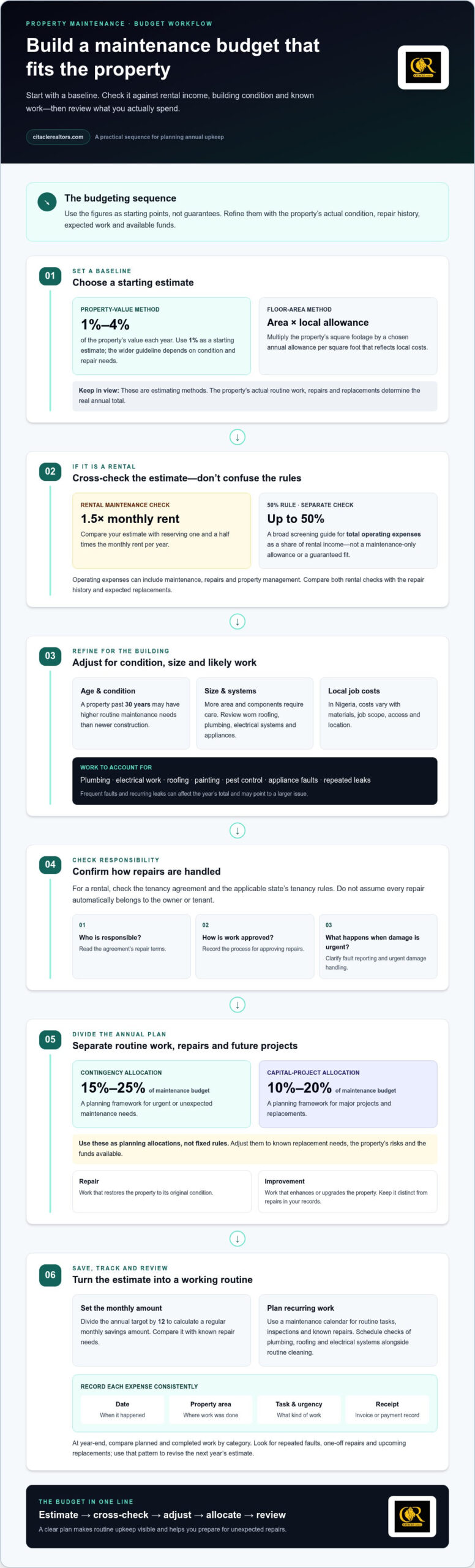
- Estimate annual savings with the property-value formula: set aside 1% of the property’s value each year as a starting point. A wider guideline ranges from 1% to 4% annually, depending on the building’s condition and repair needs. A floor-area method instead multiplies the square footage by a chosen local allowance per square foot.
- To estimate a Nigerian home’s annual maintenance cost, total its actual routine work, repairs and replacements rather than relying on a single national figure. Plumbing, electrical work, roofing, painting and pest control costs vary with materials, job scope, access and location. Frequent appliance faults or repeated leaks also affect the yearly total.
- Check the tenancy agreement to see how the owner and tenant divide repair responsibilities. The applicable state’s tenancy rules and the agreement’s wording matter, so don’t assume every repair automatically falls to one party. Record the agreed process for reporting faults, approving work and handling urgent damage.
- Build emergency and capital-replacement savings from the property’s risks and condition. One budgeting framework reserves 15% to 25% of the maintenance budget as contingency and 10% to 20% for capital projects. Treat these as planning allocations, then adjust them to known replacement needs and available funds.
- Use the property’s age, size and condition to refine your estimate. A larger property has more area and components to maintain, while worn roofing, plumbing or electrical systems may need more attention. Homes past their thirtieth year typically have higher routine maintenance needs than newer construction, so review major systems and appliances.
How to budget for maintenance issues?
Choose a starting estimate, then adjust it for the property’s condition, size and expected work. A useful budgeting for property maintenance costs plan also separates regular upkeep from major replacements.
-
Set up maintenance savings
Set aside 1% of the property’s value annually as a starting estimate; a broader guideline ranges from 1% to 4%. For a floor-area approach, multiply the property’s square footage by an annual maintenance allowance per square foot that reflects local costs. Divide your yearly target by 12 to determine a regular monthly savings amount, then compare it with known repair needs.
-
Apply rental maintenance budgeting rules
For a rental, compare your estimate with the rule of reserving one and a half times the monthly rent per year. The 50% rule is a separate check: it suggests total operating expenses should not exceed 50% of rental income, rather than treating that share as maintenance alone. When budgeting for property maintenance costs, review both rules against the property’s repair history and expected replacements.
- Build the annual budget from planned work. List plumbing, roofing, appliance and painting needs, then distinguish routine repairs from capital projects. One framework allocates 15% to 25% of a maintenance budget to contingency and 10% to 20% to capital projects. Use those shares to organise your plan, not as a substitute for assessing the property.
- Review actual spending and revise the next year’s estimate. Compare planned and completed work by category, noting repeated faults and upcoming replacements. A roof or appliance nearing the end of its useful life may need a separate savings target. This makes budgeting for property maintenance costs more responsive to the home’s condition and keeps recurring work visible in your expenses.
- For a rental property in Nigeria, record the repair responsibilities set out in the tenancy agreement. Keep the agreement with your maintenance records, and document reported faults, decisions and completed work. Clear records help owners and tenants refer to the same terms when arranging routine repairs or responding to an urgent issue.
Benefits of a property maintenance budget
A written maintenance budget helps owners plan routine care, prepare for unexpected repairs and make informed decisions about property upkeep.
- Protect routine care from being crowded out by urgent work. Set budget categories for inspections, cleaning and repairs, then compare actual spending with your plan. Tracking plumbing and electrical jobs separately, for example, can reveal repeated issues before they become larger projects. Clear records also help explain maintenance charges to anyone reviewing the property’s expenses.
- Prioritise prevention over avoidable emergencies. Preventive maintenance can pay back 3-5 times its cost through avoided emergency expenses. Use the budget to schedule checks and address small faults promptly, rather than waiting for visible damage. For owners, the practical benefit is not a promise that breakdowns disappear; it is a clearer plan for managing repairs when they arise.
- Prepare for replacements before a major system fails. Add equipment age and observed condition to a replacement schedule, then build the expected work into future planning. For example, standard tank water heaters commonly last roughly 8 to 12 years. Knowing a unit’s age gives owners time to plan, instead of facing an unplanned replacement after a sudden failure.
- Make comparisons more meaningful across different properties. Record each property’s size, completed jobs and recurring maintenance needs alongside annual spending. A larger building may have more areas and systems to maintain, while its condition affects the repairs required. Reviewing these details together helps you judge whether a budget reflects the property, rather than relying on a flat amount.
- Turn records into a useful property-management routine. Review the budget at regular intervals, note changes in repair frequency and adjust categories when needs shift. If managing maintenance decisions across a property feels difficult, explore property management support as a way to organise ongoing oversight. A budget remains useful when its records inform the next maintenance decision.
Citacle Realtors: Property Management
Citacle Realtors offers Property Management for owners who need support overseeing a property and its ongoing needs. If maintenance planning, expense records and repair priorities are becoming difficult to manage alongside other responsibilities, property management can be a practical next step.
Where shared spaces and building systems need oversight, Facilities Management may be relevant. The right focus depends on the property and work involved, whether you’re organising upkeep for a rental or managing facilities used by multiple occupants. Clear maintenance records and a planned budget can help inform your management decisions.
If you’d like to discuss your property’s management needs, please contact Citacle Realtors.
Plan Your Next Property Decision With Confidence
A maintenance plan can do more than prepare you for the next repair. It can help you decide which work needs attention, what to monitor over time and how upkeep fits your wider ownership goals. Treat budgeting for property maintenance costs as an ongoing part of responsible ownership, not a task to revisit only after a problem appears.
As your property’s use or condition changes, revisit the assumptions behind your plan. Base decisions on what you observe and record. A clear view of upkeep can help you prioritise work and make thoughtful choices about maintaining the property’s usefulness for the people who depend on it.
For support with your property needs, Contact Citacle Realtors today. Take the next step with a considered plan and move forward with confidence.
Frequently Asked Questions
What are the consequences of not prioritising maintenance?
Delaying maintenance can allow a small fault to damage other parts of a property. A minor roof leak, for example, may spread moisture into ceilings or walls if ignored. Unresolved faults can also disrupt occupants’ use of the building and make later work more extensive. Record reported problems, assess their urgency and address issues that could cause further damage first.
How much money is too much for home maintenance?
There isn’t one spending limit that suits every home; compare actual expenses with the property’s condition, work completed and original budget. Review each large repair for scope, materials and whether it fixes a fault or upgrades the home. If actual spending is 20% or more above a bottom-up budget, the estimate may be too low or spending may be inefficient.
Is preventative maintenance worth it?
Yes. Preventive work can help identify faults before they develop into larger repairs. For example, addressing a small plumbing leak promptly can limit damage to nearby finishes and fixtures. Use inspection findings to prioritise tasks, document completed work and note recurring problems. This makes it easier to distinguish necessary upkeep from repeated repairs.
What is a typical annual property maintenance budget as a percentage of property value?
A common starting range is 1% to 4% of a property’s value annually. Choose within that range by considering its age, present condition, building systems and planned replacements. A well-maintained home with recently serviced systems may need a different allocation from a property with recurring faults. Treat the percentage as a planning estimate, then compare it with actual expenses.
How much should landlords budget for repairs and maintenance per rental property?
A common rental-property rule of thumb is to reserve about one and a half times the monthly rent per year. Divide that annual amount into regular savings, then adjust your plan for the property’s repair history, appliances and upcoming replacements. Keep routine upkeep separate from major improvements so you can see which costs support ongoing operation and which need separate planning.
Which property maintenance costs should a homeowner include in a budget?
Include routine inspections, cleaning, plumbing and electrical repairs, pest control, painting, roof work, appliance servicing and replacement of worn components. Add shared-space or utility costs if you pay them, and keep a separate line for urgent repairs. For each category, note the last service date, known defects and planned work so the budget reflects the home’s actual needs.