

What if the most expensive renovation you have planned actually does nothing for your home’s market price? It is a common fear for many investors who worry that informal valuations or incomplete documentation might be quietly eroding their wealth. You likely feel that identifying the specific factors affecting property value in Nigeria is more of a guessing game than a science, especially with a national housing deficit exceeding 15 million units. We understand that uncertainty; it is difficult to feel secure when the 2026 Fair Market Value updates and shifting land use charges seem to change the rules of the market overnight.
This guide is here to provide the steady assurance and professional clarity you deserve. You will discover the essential physical, legal, and economic elements that determine your property’s true worth in the current landscape. We are going to move past the guesswork and provide a clear framework to assess your investment. By the end of this checklist, you will know exactly which management steps increase value and how to approach professional valuers with total confidence in your asset’s potential.
Key Takeaways
- Distinguish between sentimental attachment and objective market appraisal to ensure your investment decisions are grounded in professional reality.
- Identify how legal documentation and structural health act as the most decisive factors affecting property value in Nigeria today.
- Evaluate the value premium of external infrastructure and security features to better predict your property’s future resale potential.
- Learn how proactive facilities management and targeted renovations can directly counteract depreciation and enhance your annual rental yield.
Understanding the Core Drivers of Real Estate Appraisal in Nigeria
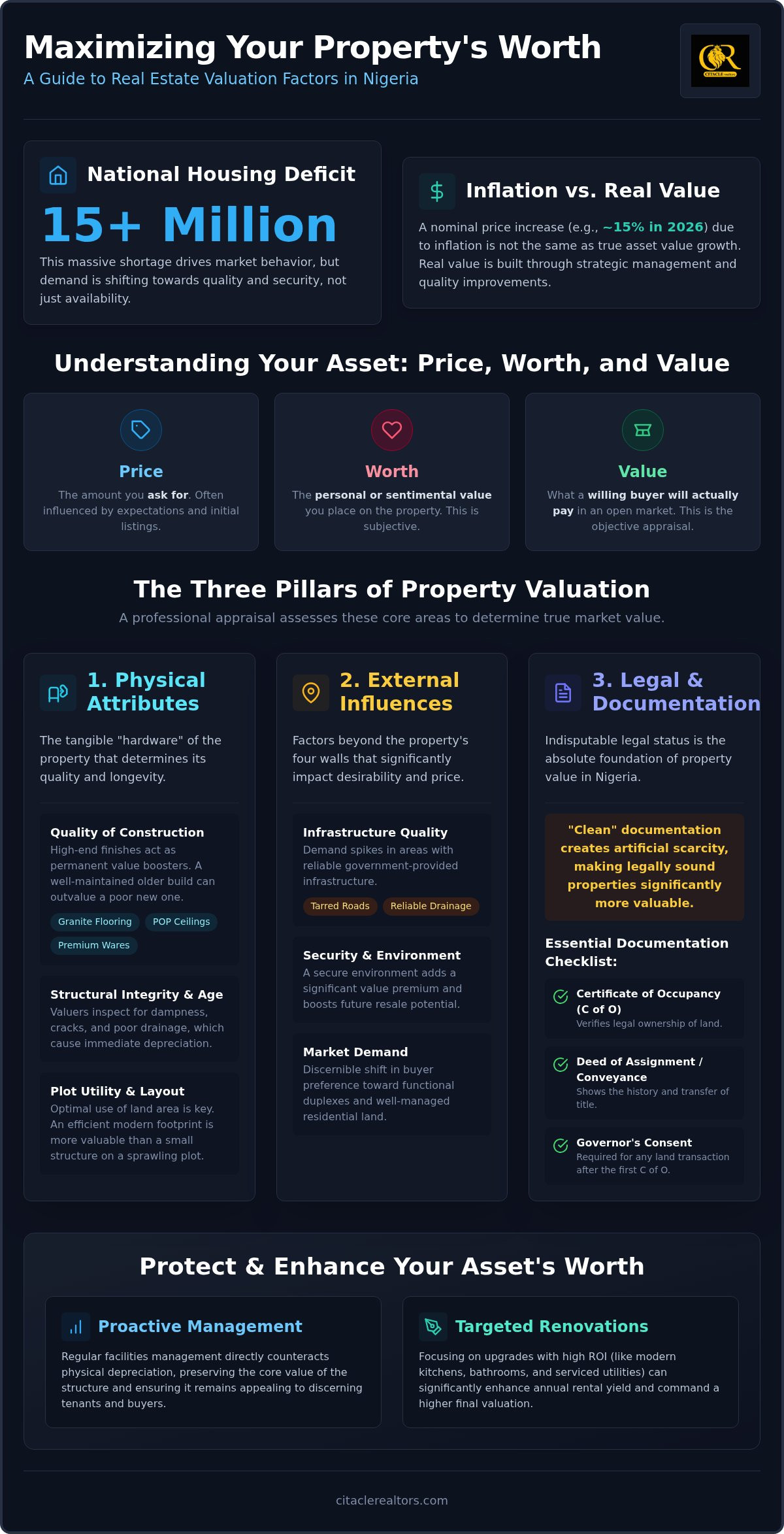
Value is not a static number written on a deed; it’s a living reflection of market forces, legal security, and structural health. Many owners fall into the trap of “neighbourhood hearsay,” assuming their home is worth a specific amount simply because a neighbor’s property sold for that price. However, professional real estate appraisal is a disciplined science that separates emotional attachment from economic reality. At Citacle Realtors, we believe that understanding the factors affecting property value in Nigeria requires looking at three distinct pillars: the physical state of the building, the environmental context of the location, and the legal indisputability of the title.
Relying on informal estimates often leads to missed opportunities or stagnant listings. A professional asset valuation provides a reliable baseline, ensuring you don’t leave money on the table or scare away serious buyers with an inflated ego-price. It’s about finding the “sweet spot” where market demand meets the unique attributes of your specific plot or duplex.
The Difference Between Price, Worth, and Value
It’s easy to confuse these terms, but they represent very different concepts in the Nigerian market. Price is what you ask for, worth is what the property represents to you personally, and value is what a willing buyer will actually pay in an open market. In 2026, we’ve seen property prices increase by approximately 15% in nominal naira terms. This increase is often driven by high inflation rather than actual improvements to the asset. If your property’s price rises only because the currency is devaluing, you aren’t necessarily gaining real wealth. True value growth comes from strategic management and maintaining high standards of construction.
Supply and Demand Dynamics in 2026
The national housing deficit remains a massive driver of market behavior. As of early 2026, Nigeria faces a shortage of approximately 14.925 million to 15.2 million housing units. While this suggests that any property should sell quickly, the reality is more nuanced. The growing middle class is becoming more discerning, shifting demand toward properties that offer modern facilities and secure environments. Key dynamics include:
- Artificial Scarcity: In developing hubs, “fixed supply” isn’t just about land; it’s about land with “clean” documentation.
- Specific Demand: There is a noticeable shift toward functional duplex rentals and well-managed residential land.
- Infrastructure Lag: Demand spikes sharply in areas where the government has successfully delivered tarred roads and reliable drainage.
By recognizing these core drivers, you can move away from the uncertainty of informal valuations. You’ll begin to see your property as a dynamic asset that requires professional oversight to truly flourish in a competitive landscape.
Physical and Structural Attributes: The Hardware of Property Value
While location often sets the price floor, the physical state of the building determines the ceiling. Among the most tangible factors affecting property value in Nigeria is the structural integrity and age of the asset. A building that shows signs of dampness, cracked walls, or poor drainage will suffer immediate depreciation, regardless of its address. Professional valuers look beyond the fresh paint; they assess the “hidden” costs of repairs that a buyer would eventually inherit. A well-maintained structure built twenty years ago can often outvalue a poorly constructed new build if the core “hardware” is superior.
Maximizing plot utility is equally vital. There’s a delicate balance between total land area and the built-up area. A massive plot with an inefficiently placed small structure often holds less value than a smaller plot used optimally with a modern footprint. This is especially true as insecurity and economic shocks force investors to prioritize functional, manageable spaces over sprawling, wasteful estates that are expensive to secure and maintain.
Quality of Construction and Finishing
The choice of materials acts as a permanent signature of quality. High-end finishes like granite flooring, POP ceilings, and premium sanitary wares aren’t just aesthetic choices; they are value boosters that command higher appraisals. In today’s market, “serviced” properties—those with pre-installed infrastructure for power and water—consistently outperform unserviced shells. If you’re considering an upgrade, it’s wise to review the cost vs value of home renovations Nigeria to ensure your investment translates into a higher market price. Quality finishing suggests a level of care that reassures buyers of the property’s long-term durability.
Property Type and Functional Design
The configuration of your home plays a massive role in its desirability. While detached duplexes remain the peak of residential luxury, well-designed terraces and flats are gaining ground due to their efficiency. Interestingly, the Nigerian market often prioritizes “room count” over raw square footage. A four-bedroom duplex with compact rooms often appraises higher than a three-bedroom house of the same total size. However, modernity is catching up. Older properties with cramped, closed-off rooms are losing value to modern open-plan designs that favor natural light and ventilation. If your current layout feels outdated, our team can assist with professional property renovations to modernize your space and reclaim its market worth.
External and Environmental Influences: Beyond the Four Walls
A property doesn’t exist in a vacuum; it is deeply tied to the earth beneath it and the community surrounding it. While structural quality is essential, the environment often dictates the ultimate price ceiling. In the Nigerian market, external factors affecting property value in Nigeria can be more volatile than the buildings themselves. A luxury duplex loses significant market appeal if the access roads are seasonal or if the area is prone to perennial flooding. Savvy investors look for “future-proof” locations where the environmental risks are low and the infrastructure is scheduled for improvement.
Proximity to economic hubs remains a dominant driver of valuation. The “commute factor” is a major consideration for the growing middle class, who prioritize time-saving locations. This reality is underscored by the impact of economic conditions on property values, where external instability and rising transport costs make centrally located assets more desirable than ever. When the cost of movement rises, the value of being “near the action” rises with it.
Infrastructure and Utility Access
Quality infrastructure acts as a force multiplier for property worth. In 2026, the presence of sophisticated drainage systems has become a top priority for buyers who want to protect their assets from water damage. A property on a tarred road with functional gutters will consistently outvalue a similar structure on a dirt track. Access to stable utility grids—whether for power or emerging gas lines—adds a significant premium. For those looking at residential land sales, “ready-to-build” plots that already feature perimeter fencing and cleared topography command much higher prices because they reduce the immediate capital burden on the buyer.
Neighbourhood Security and Desirability
Peace of mind has a clear price tag in modern real estate. Gated communities and estates with 24-hour security personnel offer a level of assurance that standalone properties often struggle to match. This “security premium” is a reflection of the collective desire for safety and orderly living. Beyond physical safety, the “character” of a neighbourhood—determined by zoning laws and the quality of neighboring developments—influences long-term appreciation. If a residential area is protected from noisy industrial encroachment by strict government planning, its value will remain stable. We often encourage clients to investigate future government development plans, as a new bypass or public utility project nearby can trigger a massive spike in local land prices.
The Legal and Documentation Checklist for Maximum Valuation
In the Nigerian real estate market, a beautiful structure is only as strong as the paper it stands on. Legal security is perhaps the most decisive of all factors affecting property value in Nigeria, acting as the ultimate shield for your investment. A property with “clean” and unencumbered papers can command a price premium of 20% to 30% over a similar asset with questionable documentation. Buyers in 2026 are increasingly risk-averse, meaning they’ll pay significantly more for the peace of mind that comes with a verified title. Without these documents, even the most luxurious duplex is essentially a high-risk liability.
The Certificate of Occupancy (C of O) remains the gold standard of value. It serves as a state-issued guarantee of ownership for a fixed term, usually 99 years. However, for secondary market transactions, the Governor’s Consent is equally vital. This document proves that the state government has officially recognized the transfer of ownership from the original holder to you. Properties with an active Governor’s Consent enjoy much faster resale speeds and higher valuation ceilings because they’re immediately eligible for bank collateral and formal financing.
Essential Title Documents in Nigeria
Understanding the nuances of different deeds is crucial for any serious investor. A Deed of Assignment transfers the entire interest in a land from a seller to a buyer, whereas a Deed of Partition is used when a large family estate is divided among multiple heirs. In areas where land was previously under communal or customary ownership, documents like the Gazette and Excision are the primary indicators that the government has released the land to the community for private development. The Root of Title is the ultimate security for any investor, representing the foundational document that proves a clear, unbroken chain of ownership history.
Planning Permits and Building Approvals
Many owners overlook the importance of building approvals until they’re ready to sell. Properties without a formal planning permit often face “valuation haircuts,” where the appraised value is slashed to account for the risk of government fines or, in extreme cases, demolition. A professional property valuation for sellers Nigeria identifies these documentation gaps early, allowing you to regularize your papers before hitting the market. Beyond the building itself, an up-to-date survey plan is essential to avoid boundary disputes and ensure the land area matches the claims on the title. If you’re unsure about the status of your documents, we invite you to contact us for a professional asset valuation to verify your property’s legal standing and true market worth.
How Professional Management and Renovations Protect Your Asset Worth
Acquiring a property is a significant milestone, but the journey to wealth creation doesn’t end at the closing table. Ongoing oversight is one of the most overlooked factors affecting property value in Nigeria. Many owners watch their investments quietly lose worth because they ignore the “slow decay” that comes from poor maintenance. Preventative care acts as a shield, stopping minor leaks or structural cracks from becoming expensive appraisal killers. When a building is kept in pristine condition, it doesn’t just retain its price; it sets a new benchmark for the surrounding market.
The relationship between management and value is best seen through the lens of rental yield. High-quality tenants are drawn to well-maintained spaces, and their presence directly increases the capital value of your asset. A property with a history of high occupancy and reliable income is always more attractive to future buyers and professional valuers. It proves that the building is a functional, high-performing asset rather than a dormant piece of real estate.
The Role of Professional Facility Management
Relying on informal “handymen” often leads to inconsistent results that can damage your property’s long-term standing. Professional facility management services Nigeria provide the methodical oversight needed to keep common areas, electrical grids, and plumbing systems in top shape. There’s a clear link between well-managed facilities and rapid appreciation. Estates that benefit from professional oversight remain desirable for decades, while neglected ones often see their values plummet as infrastructure fails. It’s about creating an environment of steady assurance where every system works exactly as intended.
Maximizing Value Through Strategic Upgrades
Not all renovations are created equal. In 2026, the highest appraisal impacts come from upgrades that address modern Nigerian realities. Energy efficiency has become a massive value driver, with solar power installations often adding a significant premium to residential homes. Similarly, modern security systems like smart locks and integrated CCTV have moved from being “luxuries” to essential requirements for high-value valuations. To keep your building in peak condition between occupants, utilizing professional tenant turnover services Nigeria ensures the space remains market-ready at all times. These strategic interventions protect your initial investment and ensure you’re always positioned to capture the highest possible market price.
Securing the Future of Your Nigerian Real Estate Investment
Your journey toward maximizing property worth is built on a foundation of legal clarity and proactive care. We’ve explored how structural integrity, modern utility access, and indisputable title documents act as the primary factors affecting property value in Nigeria today. By shifting your focus from informal estimates to data-driven insights, you position yourself as a visionary investor who understands that value is created through excellence, not just location. Every renovation and management choice you make should serve the long-term health of your asset.
Maintaining these high standards requires a partner who shares your commitment to quality. Whether you’re looking to regularize documentation or implement strategic renovations that boost ROI, professional oversight is your best defense against depreciation. Our team of certified asset valuation experts is ready to help you identify hidden potential with steady assurance. We provide comprehensive facilities management for value retention and expert appraisal with national coverage across Nigeria to ensure your investment thrives.
Take the first step toward a more secure financial future today. We invite you to Request a Professional Asset Valuation from Citacle Realtors to discover the true market worth of your property. We’re eager to support your goals and build a lasting partnership for your real estate success.
Frequently Asked Questions
What is the most important factor affecting property value in Nigeria?
Legal security combined with location is the most vital element for any asset. A property in a prime area without a valid title is a high-risk asset that professional valuers will discount. Buyers prioritize “clean” papers because they represent the only way to truly own the earth beneath the building. When you have both a great address and secure documentation, your asset’s worth remains resilient against market fluctuations.
Does a C of O automatically increase a property’s market value?
A Certificate of Occupancy (C of O) is the ultimate value booster because it guarantees state-recognized ownership. It transforms a piece of land into a bankable asset that can serve as collateral for formal loans. While a building’s physical state matters, the presence of a C of O provides the legal certainty that justifies a higher market price. Investors are always willing to pay a premium for the safety this document provides.
How does the lack of tarred roads affect property appraisal?
Inaccessible roads and poor drainage act as immediate “valuation haircuts” during a professional appraisal. When a property is difficult to reach, its pool of potential buyers and high-quality tenants shrinks significantly. This lack of infrastructure forces owners to accept lower prices to compensate for the inconvenience. In the Nigerian context, a tarred road is often the difference between a stagnant listing and a high-value sale that attracts top-tier interest.
Can professional property management really stop a house from losing value?
Professional oversight is the most effective way to stop depreciation from eating into your wealth. By addressing minor structural issues before they escalate, management protects the “hardware” of your home. It ensures that the common areas and essential utilities remain functional, which are key factors affecting property value in Nigeria. A well-managed building always appraises higher than a neglected one because it remains market-ready and highly desirable.
Is it better to renovate a house before getting a real estate appraisal?
Strategic renovations often provide an excellent return on investment before a formal appraisal. Focusing on high-impact areas like kitchens, bathrooms, and “curb appeal” can lead to a significantly higher valuation. You don’t need to rebuild the entire house; small, modern upgrades often signal to a valuer that the property has been well-maintained. This professional care reassures buyers that the asset is durable, modern, and worth the asking price.
How much does proximity to a central business district affect land prices?
Proximity to economic centers creates a massive price premium due to the high demand for shorter commutes. As urban centers become more congested, land near these hubs becomes increasingly scarce and valuable. This “proximity premium” remains stable even during economic downturns because businesses and professionals will always prioritize accessibility. It’s a key driver that ensures long-term capital appreciation for any residential or commercial land plot in a developing market.
What happens to property value if the building lacks government approval?
Lacking government building approval is a major risk that can lead to significant financial loss. Valuers must account for the possibility of government fines or total demolition, which slashes the property’s marketability. Most formal buyers won’t touch a building without these permits because it cannot be used as collateral for financing. Regularizing your approvals is a vital step to ensure your asset reaches its full price potential in any formal transaction.
Why do similar houses in the same area have different appraised values?
Appraised values differ because no two properties are managed identically. One house might have superior finishing like granite floors, while another might suffer from “hidden” structural decay or dampness. Documentation also plays a role; a house with a Governor’s Consent will always outvalue one with only a basic deed. These subtle differences in structural health and legal security ensure that even identical-looking homes have very different financial standings and market appeal.