

What if a property’s advertised rent makes its return look stronger than the income you’re likely to keep? When calculating rental yield in Nigeria 2026, the difference between gross and net returns can change how attractive an investment appears. Headline rent can leave out vacant periods, repairs, insurance, management expenses and other costs that affect actual income.
Starting with annual rent and purchase price is useful. Gross yield gives you a quick way to screen a property, but it doesn’t show the full cost of owning and managing it. For a more dependable assessment, use figures that relate to the same property and period. Separate amounts supported by records from estimates, and note where each figure comes from.
This guide explains how to calculate gross and net rental yield, which income and expenses to include, and how to test assumptions before comparing properties. You’ll also learn what to review in rental records and cost estimates. Property management can help keep rental income and expenses organised, while asset valuation can provide useful context when reviewing an investment.
Key Takeaways
- Rental yield helps you assess a property’s income potential, but it isn’t a guaranteed return.
- When calculating rental yield in Nigeria 2026, distinguish gross yield from net yield by accounting for operating expenses and acquisition costs.
- Compare properties over the same period and use consistent definitions for rent, costs and purchase value.
- Build a more dependable estimate by separating confirmed figures from estimates and noting each assumption’s source and date.
- Regular income and expense reviews, supported by property management and asset valuation, can help keep investment assessments relevant.
What rental yield tells Nigerian property investors
Rental yield expresses rental income as a percentage of a property’s cost or value. It gives investors a common way to assess the income a property generates relative to the amount tied up in it. Rental yield is a percentage that relates a property’s rental income over a stated period to its cost or value, using clearly defined assumptions. It describes an income relationship; it doesn’t predict what a property will earn in future.
This distinction matters when calculating rental yield in Nigeria 2026. Advertised rent may differ from rent actually collected, and an asking price may differ from the final purchase cost. Yield is most useful when the figures relate to the same property, period and basis of comparison. The broader financial concept of Yield (finance) also uses income relative to an investment, though the precise calculation depends on what is being measured.
What gross and net rental yield each reveal
Gross yield is a first-pass measure: it relates rental income to a property’s purchase price or value before recurring operating costs are deducted. It can help you screen options quickly, but it doesn’t show how much income remains after running the property. Net yield accounts for relevant operating expenses, giving you a more grounded view of income performance. For a fair comparison, use matching periods, such as annual rent against annual expenses, and apply the same cost assumptions to each property.
For example, if a hypothetical property costs ₦40,000,000 and brings in ₦2,400,000 in annual rent, its gross yield is 6%. If relevant annual operating expenses total ₦600,000, income after those expenses is ₦1,800,000. The net yield depends on the denominator you choose, so state whether you’re comparing income with the purchase price or a broader acquisition-cost figure.
What rental yield leaves out
A yield percentage summarises income against cost or value, but it doesn’t show when money arrives or leaves. Rent may be due for the year, yet collection can be delayed, a property may be vacant between tenants, or a repair bill may fall due before rent arrives. These timing differences affect cash flow even when the annual yield calculation looks unchanged. Review the rent schedule and the timing of expenses alongside the percentage.
Yield also isn’t the same as capital appreciation. Appreciation refers to a change in property value; rental yield focuses on income from letting. To assess total performance, consider both alongside relevant costs and the period of ownership. A higher yield alone doesn’t establish that one property is the better investment. Condition, income reliability, expenses and your objectives also matter. Treat yield as one decision-making measure, not a complete recommendation or promise of results.
How to calculate rental yield in Nigeria: gross and net formulas
For a useful comparison, define the period and basis of each figure. Use annual rental income with annual expenses, and label whether the denominator is the purchase price alone or total acquisition cost. The National Bureau of Statistics’ The Nigerian Real Estate Sector offers broader context on the industry. The calculation below focuses on one hypothetical property.
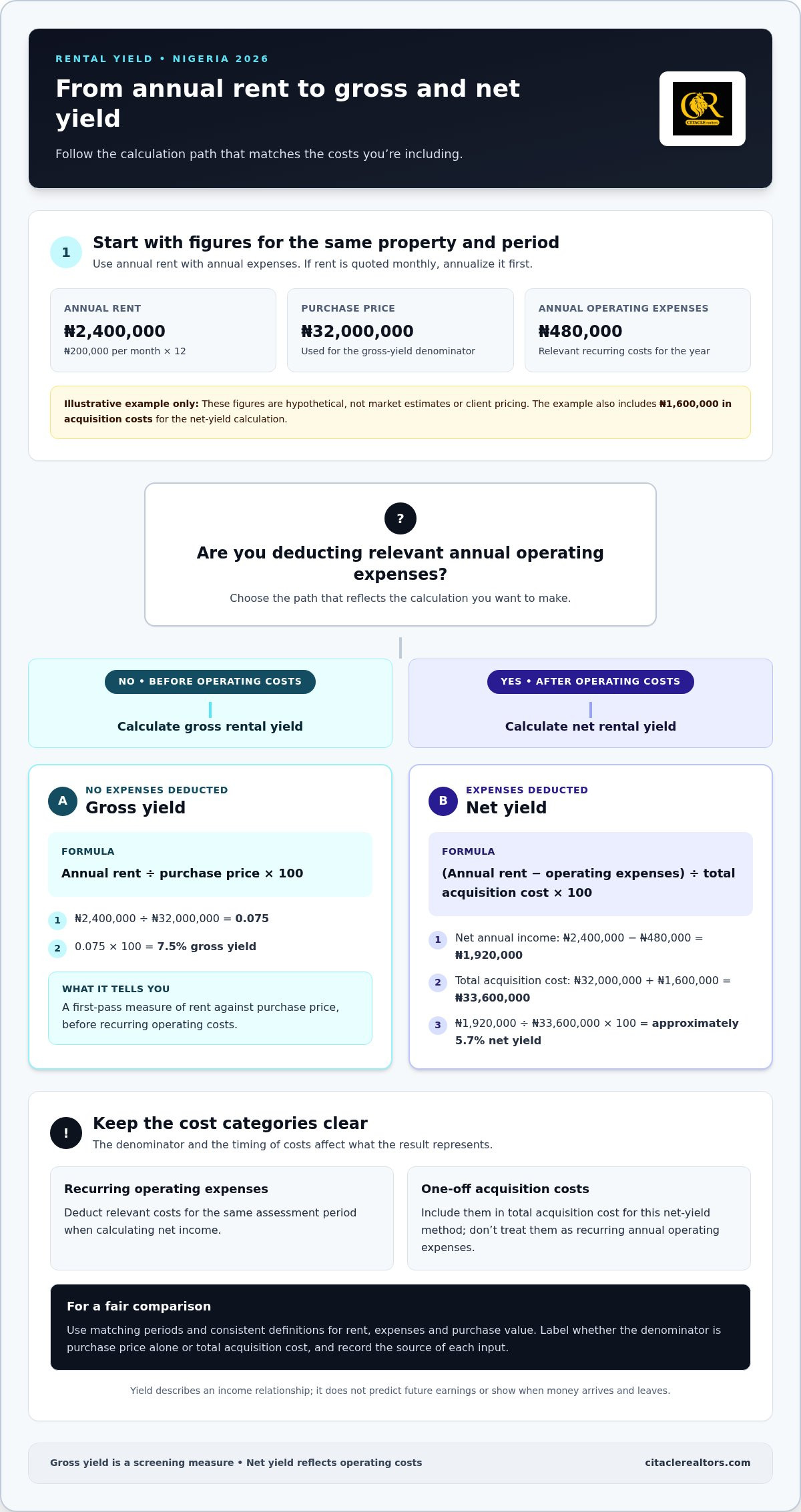
Illustrative example only: Assume a property is purchased for ₦32,000,000, brings in ₦2,400,000 in rent over a year, has ₦480,000 in relevant operating expenses for that year, and incurs ₦1,600,000 in acquisition costs. These figures are hypothetical, not market estimates or client pricing.
Calculate gross rental yield from annual rent
Gross yield compares annual rent with the property’s purchase price before recurring operating expenses. If rent is quoted monthly, annualize it for a full year, then use the formula: gross yield = annual rent ÷ purchase price × 100. Use the purchase price as the denominator for this measure. If you include acquisition costs, state that adjustment rather than presenting the result as the standard gross-yield calculation.
- Annual rent: ₦200,000 per month × 12 = ₦2,400,000.
- Divide annual rent by the purchase price: ₦2,400,000 ÷ ₦32,000,000 = 0.075.
- Multiply by 100: gross rental yield = 7.5%.
This is a first-pass result, not income after expenses. It excludes operating costs such as property upkeep and management expenses, so don’t read it as the amount the owner retains.
Calculate net rental yield after operating expenses
For net yield, deduct relevant operating expenses from rental income for the same period, then divide by total acquisition cost. In this method, total acquisition cost means the purchase price plus the acquisition costs included in your calculation. Keep one-off acquisition expenses in that denominator rather than treating them as recurring annual operating expenses.
Net rental yield relates annual rental income after relevant operating expenses to total acquisition cost, with each input defined for the same property and assessment period. For the example, net annual income is ₦2,400,000 − ₦480,000 = ₦1,920,000. Total acquisition cost is ₦32,000,000 + ₦1,600,000 = ₦33,600,000. Therefore, ₦1,920,000 ÷ ₦33,600,000 × 100 gives a net yield of approximately 5.7%.
When calculating rental yield in Nigeria 2026, record the source of each input and use the same denominator rules across properties. A consistent property management review can help organise rental and expense records. Read more about property management support.
Gross vs. net rental yield: compare Nigerian properties fairly
A headline yield is comparable only when the figures behind it are defined in the same way. Before ranking properties, align the assessment period, rent basis, cost categories and denominator. Label income as collected, contracted, projected or advertised. This helps you distinguish a percentage based on rental history from one that relies on an estimate still to be tested.
| Measure | Inputs | Best used for |
|---|---|---|
| Gross yield | Annual rent ÷ purchase price × 100 | Quick initial screening before operating costs |
| Net yield | Annual rental income after relevant operating expenses ÷ total acquisition cost × 100 | Comparing income performance after defined costs |
For a fair comparison, use the same 12-month period for each property and treat costs consistently. If one estimate uses rent actually collected and another uses advertised rent, make that difference clear rather than presenting the figures as equivalent. Likewise, don’t compare a net figure that includes management and maintenance with one that leaves them out.
A higher headline percentage doesn’t automatically make one investment better. It may rely on an ambitious rent estimate, exclude recurring costs or use a smaller denominator. A lower-yield property might have steadier collections or fewer operating demands, factors the headline yield won’t reveal. Treat yield as one comparison tool, then review the records and assumptions behind it.
Which costs belong in a net-yield comparison?
List relevant recurring costs consistently, such as property management, maintenance, insurance, vacancy-related costs and applicable charges. Separate these from one-off acquisition costs, which belong in the total acquisition-cost denominator if that is the method you’re using. Avoid counting the same item twice. Tax and statutory treatment can depend on the property and circumstances, so verify current Nigerian requirements against authoritative sources rather than applying one assumed rule to every investment.
How vacancy and rent collection change the comparison
Use rent collection records where available, and label projected or advertised income separately. For a hypothetical illustration, if a property’s estimated annual rent is ₦3,000,000 but it is vacant for one month, rent collected would be ₦2,750,000 before expenses, assuming equal monthly rent and no other collection issues. This is a calculation example, not a market occupancy assumption.
Arrears can also mean rent due differs from rent received during the assessment period. For a cautious comparison, show both the contracted or projected rent and the actual collection figure, then state which one feeds each yield calculation. This makes the effect of vacancy and collection gaps visible without presenting estimates as verified performance. Regular review through property management oversight can help keep comparisons organised over time.
Build a dependable 2026 rental-yield estimate from real records
A useful estimate starts with traceable inputs, not a single rent figure copied from an advert. When calculating rental yield in Nigeria 2026, create a simple record for each property that separates confirmed amounts from assumptions. Include the source and date for each entry so you can revisit the calculation when circumstances change.
- Record rental terms and receipts. Use the tenancy agreement for rent due and the payment schedule, then compare it with receipts or bank records showing what was actually collected. Note arrears, concessions, vacant periods and projected rent separately.
- Compile property expenses. Gather invoices, receipts and payment records for maintenance, insurance, management and other relevant operating costs. Mark estimates clearly, and keep recurring expenses separate from one-off acquisition costs.
- Choose a consistent value basis. For a purchase comparison, record the documented purchase price and any acquisition costs included in your method. If you’re reviewing current income against an updated property value, record the valuation date and basis instead. Property valuation guidance for sellers in Nigeria can help put valuation context into your review.
- Build an input log. For each number, note whether it is actual, estimated or projected, its source, the period it covers and the date recorded. This makes comparisons easier to audit and update.
Gather rent, expense, and property-value records
Keep the evidence together, whether it is a tenancy document, rent receipt, maintenance invoice or valuation record. Check that each item relates to the property and period you’re assessing. If a figure is missing, enter it as an estimate rather than treating it as confirmed. Using a consistent acquisition-cost or property-value basis makes the resulting yield easier to interpret and compare.
Test assumptions before relying on the result
A single estimate can hide uncertainty. Prepare conservative, expected and optimistic scenarios by changing assumptions about occupancy, rent collected and maintenance needs. These are planning cases, not forecasts or promises. Change one input at a time where practical to see what drives the result, then consider how several changes together could affect income.
For example, compare a case where rent is collected as planned with one that allows for a vacant period or delayed payment. Then test higher maintenance spending against the same rental income. Label each scenario, and don’t present an optimistic rent figure as actual performance. Recalculate when rent, expenses, occupancy or property value changes materially.
Tax and statutory charges, as well as market-based rent or occupancy assumptions, can change and may depend on the property and circumstances. Verify current requirements and market information against authoritative sources before using them in a published estimate or investment decision. Professional residential property management can support ongoing oversight of rental operations and records. Property management support can help keep income and expense reviews organised over time.
Turn rental-yield insights into stronger property decisions with Citacle Realtors
A yield calculation is most useful as a working measure, not a figure to file away after purchase. Rental income, operating expenses and property value can change, so periodic reviews help you assess whether your assumptions still reflect the property’s performance. When calculating rental yield in Nigeria 2026, keep dated records and use the same calculation method from one review to the next, noting any changes to the inputs.
Use management records to review rental performance
Organised rent and expense records make it easier to compare expected income with money received, identify arrears and track maintenance spending. Property management supports consistent oversight of these operational details, while facilities management focuses on the functionality of the property and its facilities. Together, these records can inform a periodic yield review, but they can’t guarantee a particular occupancy level, income or investment outcome.
At each review, note what has changed and why. A repair may raise expenses in one period, while a change in rent collected may affect income. Keep both visible rather than smoothing them away, so you can judge whether a movement in yield reflects a lasting change or a one-off event.
Bring valuation and renovation decisions into context
An asset valuation can provide a current reference point for interpreting rental income against assessed property value. Keep that view distinct from a calculation based on the original purchase price and acquisition costs: the two answer different questions. A valuation is a decision input, not a forecast of future rent or proof that an investment will perform well.
Renovations also deserve a measured review. Before proceeding, compare the expected renovation cost with plausible changes in rent, operating expenses and property condition. Treat any rent increase as an assumption until supported by evidence, and include renovation spending consistently in your investment review. The guide to increasing rental property value in Nigeria offers further context for weighing renovation decisions.
Citacle Realtors brings property and facilities management, asset valuation and renovation services together with the practical work of monitoring property performance. This gives you a structured way to revisit income, expenses and value as circumstances evolve, without treating one yield figure as the whole investment picture.
Read about Citacle Realtors’ property services for context on management, valuation and renovation.
Make your next property decision with greater clarity
Turn the yield calculation into a practical review routine. Keep a dated baseline, note what would change your decision, and revisit the figures as rental income, costs or property value shift. This gives you a steadier way to assess opportunities than relying on a percentage in isolation.
Used thoughtfully, calculating rental yield in Nigeria 2026 can help you ask sharper questions about an investment’s income potential and the assumptions behind it. It can also show where closer oversight, a valuation perspective or renovation analysis may be useful, without promising a particular return.
Citacle Realtors supports property decisions through property and facilities management, asset valuation and renovation services, alongside residential real estate services across Nigeria. Explore Citacle Realtors’ property management, valuation and real estate services as you consider your next step.
With a clear method and dependable records, you can move forward with greater confidence and a more considered view of each opportunity.
Frequently Asked Questions
Does rent paid in advance change how I calculate rental yield?
Yes, it changes the timing of the cash receipt, not the months the rent covers. If a tenant pays a full year upfront in January, allocate that amount to the tenancy year rather than treating it as income earned only in January. When calculating rental yield in Nigeria 2026, keep separate records of rent received and rent due, and state the assessment period. This helps prevent different payment schedules from distorting comparisons.
Can rental yield be negative?
Yes, net yield can fall below zero if relevant expenses for the measured period exceed rental income. Before drawing conclusions, check that you haven’t mixed annual costs with a shorter income period or entered an expense twice. Then review whether a one-off repair or an ongoing cost drove the result. A negative figure signals that income for the period didn’t cover the included costs, but it doesn’t by itself determine the property’s future value.
Is a high rental yield always a good investment?
No. A high percentage can depend on assumptions that may not hold, such as expected rent that hasn’t been achieved or expenses that are incomplete. Before relying on it, review the property’s condition, tenancy documents, collection history and work needed to keep it lettable. Then compare it with alternatives using the same period and calculation basis. Yield can help frame a decision, but it can’t establish suitability on its own.
How does inflation affect rental yield?
Inflation affects what rental income and expenses can buy, while a standard nominal yield uses stated amounts without adjusting for purchasing power. To discuss real performance, compare income and costs over matching periods and show the inflation measure and source used for any adjustment. Because rent and expenses can change at different rates, a past inflation figure shouldn’t be treated as a reliable guide to future rent changes or property costs.
Should I use advertised rent when calculating rental yield?
Use advertised rent as an estimate, not as evidence of income received. If the property is already let, compare the advert with the tenancy terms and payment records. Differences may reflect negotiation, concessions or changed terms. If there’s no rental history, document how you arrived at the assumed rent and test a lower amount in your analysis. Keeping the estimate labelled helps prevent a marketing figure from being mistaken for proven performance.
What happens if rent is reviewed during the year?
For a review of a past period, use the rent that applied during each part of that period. For example, if revised terms begin partway through the year, separate the months under the old rent from those under the new terms. For a future estimate, record the proposed review date and treat any unconfirmed change as an assumption. Update the calculation once the revised tenancy terms take effect and actual payments can be tracked.