

What if the biggest risk in renting out your house isn’t finding a tenant, but overlooking a requirement that varies by state? The legal requirements for renting out a house in Nigeria aren’t covered by one nationwide tenancy law, so a checklist that works in one location may not fit another.
Before advertising, make sure you can show that you have authority to let the property, identify the rules that apply to the tenancy, and prepare clear records. A written agreement, documented payments and a record of the home’s condition can help set expectations, but notice procedures and other legal requirements also need careful attention.
This checklist takes you through the key steps: checking your authority, preparing tenancy documents and payment records, and documenting responsibilities and the property’s condition. It also explains why you need to check the rules that apply where the property is located rather than assume requirements are the same across Nigeria. If coordinating tenant communication, records and ongoing property care is taking up too much time, professional property management can help organise that work.
Key Takeaways
- The legal requirements for renting out a house vary by state, so identify which local tenancy rules apply before setting terms.
- Separate proof that you have authority to let the property from practical checks that prepare the house for a tenant.
- Use a written tenancy agreement to make key terms and each party’s responsibilities easier to understand.
- Organise document checks, payment records and the property handover in a clear sequence, distinguishing legal duties from prudent record-keeping.
- Professional property management can help coordinate rental oversight and property care, while legal advice and landlord accountability remain important.
Legal Requirements for Renting Out a House in Nigeria: What Landlords Should Know
Preparing a house for rent is easier when you work through the checks in order. First, confirm that you have authority to let the property. Then identify the tenancy rules that apply where it is located, prepare the agreement and records, and keep meeting your relevant duties throughout the tenancy.
You can use the same general preparation process across Nigeria, but the legal requirements for renting out a house depend on the state and the circumstances of the tenancy. A national checklist can help organise your next steps, but it cannot establish that one state’s rules apply to a property elsewhere.
Which rules apply to a rental house in Nigeria?
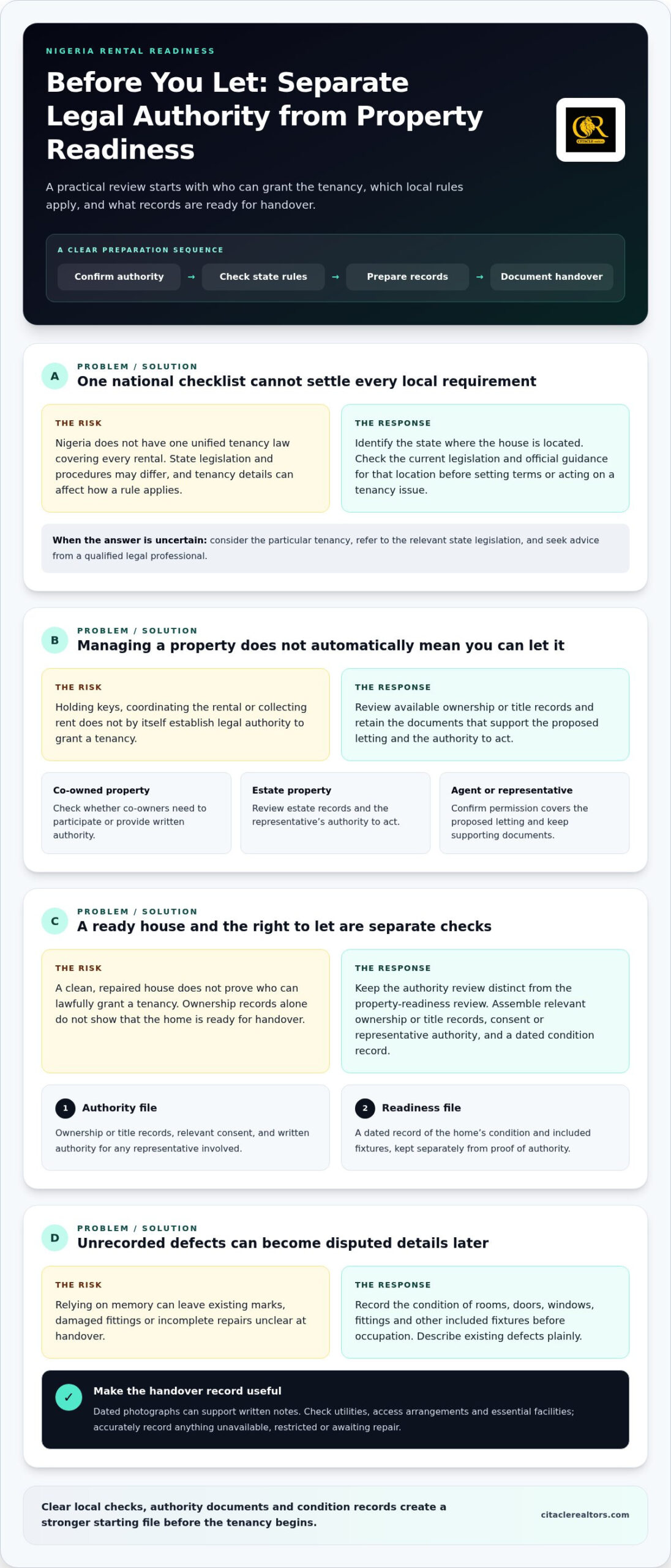
Nigeria does not have one unified tenancy law covering every rental. State legislation and procedures may differ, and the details of a tenancy can affect how a rule applies. Identify the state where the house is situated, then consult the current legislation and official guidance that apply there before setting terms or acting on a tenancy issue.
For a dispute or an uncertain legal question, refer to the relevant state legislation and seek advice from a qualified legal professional. The rules should be considered in the context of the particular tenancy, rather than relying on a general summary or assuming a procedure applies everywhere.
Who can legally rent out the property?
Before advertising the house or signing an agreement, establish who has legal authority to grant the tenancy. Ownership records are an important starting point, but the person coordinating the rental may be an authorised representative rather than the owner. Confirm that any authority to act covers the proposed letting and retain the supporting documents.
Take extra care where the house is co-owned, forms part of an estate, or is being let by someone acting for another person. Review the ownership or estate records and any written appointment, consent or authority supporting the proposed arrangement. Don’t assume that managing the property, holding keys or collecting rent automatically gives someone the right to grant a tenancy.
Keep legal authority separate from practical readiness. A house may be clean, repaired and ready for a tenant, but those preparations don’t establish who can lawfully let it. Likewise, proof of authority doesn’t show that the property is ready for handover. Treat these as distinct checks and keep copies of the records supporting each one.
A first review can include:
- Identifying the owner or owners named in the available property records.
- Checking whether co-owners or estate representatives need to participate or provide written authority.
- Confirming that any agent or other representative has permission to act for the landlord.
- Finding the current tenancy legislation and official guidance for the state where the house is located.
These steps provide a starting point, not a substitute for resolving a title question or interpreting a law in a specific dispute. Once authority and applicable rules are clearer, prepare the rental terms and handover records with greater confidence.
Confirm Your Authority and the House’s Legal Readiness Before Renting
Before advertising a house, check two things: whether you have authority to let it and whether it is ready to be occupied. These checks answer different questions. A well-maintained property does not establish the right to grant a tenancy, and ownership records alone do not show that the house is ready for handover.
The documents and permissions to review depend on the ownership structure and the law that applies to the property. Before marketing, assemble the relevant ownership or title records, any consent or representative authority, and a dated record of the house’s condition and included fixtures. This gives you a clear starting file and helps identify gaps while there is still time to resolve them.
Check ownership, consent and authority to let
Review the available title and ownership records to understand who holds an interest in the property and who can grant a tenancy. Don’t assume that possession of one document settles every question. Its legal significance depends on the circumstances and applicable law. If the records are unclear, obtain qualified legal review before offering the house for rent.
Pay particular attention to shared ownership and estate property. Co-owners may need to agree on the letting, while an executor, administrator or other representative may need to show authority to act. A relative or agent who handles day-to-day matters should not be treated as authorised to sign a tenancy agreement unless the relevant authority supports that role. A Nigerian university paper, Tenancy Disputes in Nigerian Property Law, provides further context on landlord and tenant obligations and disputes.
Prepare the house and document its condition
Once the authority review is underway, assess the property itself. Record the condition of rooms, doors, windows, fittings and other included fixtures before occupation. Describe existing defects plainly rather than relying on memory. Dated photographs can support written notes, especially where a mark, damaged fitting or incomplete repair might later be disputed.
Check practical details the tenant will rely on, including utilities, access arrangements and essential facilities. If something is unavailable, restricted or awaiting repair, describe its status accurately and record any agreed limitation. This creates a clearer basis for discussing the handover and responsibilities without presenting a maintenance issue as a legal conclusion.
Keep these records with the ownership and authority documents, then use them when preparing the rental details and handover. For owners who want help coordinating ongoing property oversight and care, professional residential property management can support a more organised approach.
These checks make the legal requirements for renting out a house easier to approach in sequence: establish who can let it, identify documents or consent questions that need attention, and prepare a factual record of the home. If ownership, estate authority or the effect of a document is disputed, pause the letting process and seek legal advice before proceeding. Consistent records support clear rental arrangements and responsible property care. For help coordinating that oversight, property management support can be part of a practical plan.
What a Nigerian Tenancy Agreement Should Clarify
A written tenancy agreement gives both landlord and tenant a record of what they have agreed. It can prevent avoidable misunderstandings about payment, repairs or moving out, but a clause does not override applicable legislation. Requirements may vary by state, so treat the agreement as a clear record of the arrangement, not a substitute for checking local rules.
A well-prepared tenancy agreement should address the rent, duration, payment method, responsibilities, deposits, renewal and notice process, with each term checked against the law that applies to the property. Here’s how clear wording differs from leaving important matters open:
| Topic | Clearly documented | Vague or incomplete |
|---|---|---|
| Rent and payment | States the amount, due date, payment method and how payment will be acknowledged. | Refers only to “agreed rent” or leaves the payment date uncertain. |
| Duration and renewal | Gives the tenancy start and end dates, with a process for discussing renewal. | Doesn’t make clear when the term ends or what happens next. |
| Repairs and utilities | Records how responsibilities for repairs, utilities and shared areas are allocated. | Uses broad phrases such as “tenant handles maintenance” without defining the scope. |
| Deposit and notices | Explains any deposit’s purpose and the agreed return process, and describes how notices will be handled subject to applicable law. | Doesn’t explain deductions, return arrangements or how a notice should be served. |
Record rent, duration, payment terms and responsibilities
Write the rent amount in naira and identify when and how it must be paid. State the tenancy duration and explain how the parties will handle a renewal discussion. Don’t imply renewal is automatic unless that is the agreed and legally sound arrangement. Keep the written terms consistent with receipts and other payment records.
Be precise about repairs, utility charges and shared spaces. For example, describe which areas are shared and how responsibilities for their upkeep will be coordinated. Avoid broad wording that could leave each party with a different understanding. Statutory limits on rent, advance payments or deposits must be checked for the property’s state and tenancy type rather than assumed to apply nationwide.
Formal paperwork can also matter for tenant records. Under the Nigeria Tax Act 2025, effective January 1, 2026, eligible tenants may deduct 20% of annual rent from taxable income, up to ₦500,000, with a formal rental agreement and proof of payment required. This is a tenant tax provision, not a landlord’s permission to set terms contrary to applicable law.
Clarify notices, deposits and dispute procedures
Set out how the parties should communicate about a notice or disagreement, but distinguish the contract’s process from notice periods required by legislation. There is no single notice period to assume for every tenancy across Nigeria. Check the applicable state law and the tenancy circumstances before relying on a stated period or taking action.
If a deposit is agreed, record its amount, purpose, handling and return process, including how any proposed deductions will be explained. Define a practical first step for resolving disagreements, such as written communication, while making clear that the agreement cannot remove legal rights or replace the proper legal process. Well-organised rental records and property oversight can support clear administration. Property management support can help owners coordinate that work.
A Before-You-Let Checklist for Documents, Payments and Handover
A dependable letting process is easier to manage when each step is completed in order. The checklist below separates points that require a legal check from prudent record-keeping. Because tenancy rules differ across Nigeria, verify the requirements for the state and the specific arrangement rather than treating every good practice as a statutory duty.
- Before advertising, legal check: Confirm who has authority to let the house and identify the current state rules that apply. Resolve any uncertainty about co-owners, estate representatives or an agent’s authority before making legal statements to prospective tenants.
- Before accepting a commitment, prepare accurate information: Describe the house, included fixtures, available facilities and any known limitations honestly. Draft proposed tenancy terms that cover rent, duration, payment arrangements, responsibilities and the handover. Check applicable rules on deposits, advance rent, receipts and disclosures before agreeing to or collecting payment. These requirements can depend on location and tenancy circumstances.
- Before signing, prudent record-keeping: Compare the final agreement with the terms discussed and make sure names, dates, payment details and responsibilities are consistent. Keep a dated copy of the version signed by the parties. If a representative signs, retain the document showing their authority alongside the agreement.
- At signing, prudent record-keeping: Give each party a complete copy of the signed tenancy documents and record payments with clear evidence, such as a receipt or transaction record. Keep payment evidence with the agreement rather than relying on messages or memory alone.
- At handover, prudent record-keeping: Walk through the house together and note its condition, existing defects, fixtures, meter readings, keys provided and any agreed limitations. A written inventory and dated photographs can help both parties refer to the same starting record.
For a condition record, a room-by-room inspection can make observations more precise: identify the room, describe the fixture or defect, and connect photographs to the written notes. The duplex inspection checklist for tenants offers a useful reference for documenting property condition. Keep the completed handover record with the signed agreement and payment evidence, and ensure both parties can access their copies.
Not every item above is automatically a legal requirement. The applicable law determines which steps are mandatory, while dated copies, payment records and a detailed inventory are prudent practices that help preserve a clear account of the arrangement. This distinction is central to following the legal requirements for renting out a house without confusing sound administration with a statutory duty.
Use this sequence to organise your documents and handover, then verify any state-specific legal questions before the tenancy begins. For support coordinating rental oversight and property records, explore Citacle Realtors’ property management.
How Property Management Can Support a Compliant Rental
Managing a rental yourself can work well if you have time to coordinate tenant communication, property care and records. Professional oversight may be useful when these tasks compete with work, family responsibilities or the demands of looking after several properties. The right approach depends on how much coordination you can manage consistently.
When does professional rental management make sense?
Self-management keeps decisions and follow-up directly in your hands, but it also means organising routine details: keeping records accessible, tracking maintenance matters and following up on agreed responsibilities. With more than one property, even straightforward tasks can become harder to coordinate. A manager can support rental oversight and property care, helping keep day-to-day administration organised.
Citacle Realtors provides property and facilities management for property owners in Nigeria. This professional oversight can support consistent attention to the property and its records. Make the scope of any management arrangement clear, including who handles operational tasks and how information is shared. Management is an administrative option, not a legal determination.
| Approach | Responsibilities and time | Record coordination |
|---|---|---|
| Self-management | The owner handles tenant communication, follow-up and property oversight directly. | The owner maintains agreements, payment evidence and property-care records. |
| Professional oversight | Management support can help coordinate rental operations and property care, according to the agreed arrangement. | Records and updates can be organised as part of ongoing oversight, while the owner remains accountable for their obligations. |
Neither approach removes the need to act responsibly. A property manager can support operational coordination, but cannot guarantee that a tenancy complies with every applicable rule or take over the landlord’s legal accountability. If a question concerns the meaning of a law, a disputed right or a proposed legal action, seek advice from a qualified legal professional familiar with the rules applicable to the property.
Choose the next step with a clear compliance record
Before a tenancy begins, identify unresolved questions that need a state-specific legal review. These might relate to the landlord’s authority, a term in the agreement, payment arrangements or the correct process for giving notice. Keep the applicable rules and any professional advice with the property file so decisions can be understood later.
Keep the signed agreement, payment records and condition documentation together in a consistent, dated file. Clear organisation makes it easier to respond to questions, coordinate property care and maintain a reliable account of the tenancy. It also gives an owner or manager a practical reference point when responsibilities need follow-up.
The legal requirements for renting out a house remain the landlord’s responsibility, whether the rental is self-managed or professionally overseen. If coordinating ongoing rental administration and property care would help you manage the workload, explore Citacle Realtors residential property management services.
Make Your Next Rental Decision with Confidence
Use your checklist as a working property file, not a one-time formality. As circumstances change, keep the records current and revisit legal questions against the rules that apply to the property. This steady approach can help you make informed decisions and protect the condition and value of your asset over the course of a tenancy.
If coordinating rental oversight alongside your other responsibilities is becoming difficult, professional support can help bring structure to the day-to-day work. Citacle provides property and facilities management for property owners across Nigeria, supporting organised property oversight. This complements, but doesn’t replace, your legal responsibilities or advice on a specific legal issue.
Take the next step with a clear plan. Explore professional residential property management and consider how ongoing oversight could fit your rental goals. Well-organised records and consistent property care can help you manage a tenancy with greater confidence.
Frequently Asked Questions
Do I need a written tenancy agreement to rent out a house in Nigeria?
A written agreement is a prudent way to record a tenancy, although the rules on form and enforceability depend on the applicable law and circumstances. It also matters for eligible tenants claiming the rent deduction provided under the Nigeria Tax Act 2025: they need a formal rental agreement and proof of payment. For landlords, a signed document helps establish what both parties agreed, rather than leaving important terms to memory or informal messages.
Can a landlord collect advance rent or a security deposit in Nigeria?
Rules can vary by state and tenancy type. Some state tenancy laws set limits on advance rent for particular types of tenants. Don’t assume those limits apply everywhere. Check local rules for advance rent and deposits, and record any deposit’s amount, purpose and return arrangements in writing.
How much notice must a landlord give a tenant in Nigeria?
There isn’t one notice period that applies to every tenancy nationwide. General guidance often relates notice to the payment cycle, with different periods for weekly, monthly, quarterly, half-yearly and yearly tenancies, but the applicable statute and circumstances matter. Before serving notice, check the property’s state rules, the tenancy terms and the reason for ending the tenancy. Incorrect notice can complicate the next steps, so get legal advice if the position is unclear.
What documents should a landlord prepare before renting out a house?
Prepare records showing the basis for your authority to let, the signed tenancy agreement, payment receipts or transaction evidence, and a property-condition record. If someone is acting for the owner, keep written evidence of that authority. Dated notes of meter readings and the keys handed over can help establish the starting point. Keep copies in an organised file so you can retrieve them if a payment or condition is later questioned.
Can a landlord increase rent during an existing tenancy?
A landlord shouldn’t assume rent can be changed unilaterally during a fixed term. The answer may depend on the tenancy agreement, any rent-review wording and the state’s applicable law. Check whether the agreement sets a review date or a process for proposing a change, and give any communication in writing. If the tenant disputes the increase, avoid treating the proposed amount as automatically payable until the legal and contractual position is clear.
What happens if a tenant refuses to leave after the tenancy ends?
A tenant’s refusal to leave doesn’t allow a landlord to remove them by changing locks, cutting access or taking other self-help measures. Follow the formal process that applies to the tenancy, including valid notice where required and court proceedings if necessary. The steps can depend on state law and the tenancy facts. Keep copies of the agreement, notices and relevant communication, and seek qualified legal advice before taking action.
Is a landlord responsible for repairs and safety in a rental house?
Landlords are generally responsible for major repairs and providing a habitable property, while tenants are expected to pay rent as agreed and maintain the home in good condition. The precise responsibilities can depend on the agreement, the defect and applicable law. For instance, a record of when a leak was reported and what action followed can clarify the repair history. Put repair requests and responses in writing, especially where an issue may affect use of the home.
Do tenancy laws differ between states in Nigeria?
Yes. Nigeria has no single unified tenancy law covering every state, so rules and procedures may differ based on where the property is located. Don’t assume that provisions applying in one state govern a property in another. Check current state legislation and official guidance for the property’s location. For a dispute or an unclear legal obligation, a qualified legal professional can interpret the relevant rules in context.