

An inherited home isn’t automatically yours to sell. What to do with inherited property in Nigeria starts with confirming whether there’s a valid will and who has legal authority to administer the estate. If the deceased left no surviving relatives, the property may escheat to the state under statutory laws.
It’s understandable to feel pressure to decide quickly, especially when family members have different expectations or the property needs attention. But inheritance rules can depend on the deceased’s marriage, background and applicable laws. Confirming who is entitled to inherit is essential before deciding whether to sell or rent the property.
This guide explains who may inherit without a will, how probate or letters of administration establish authority to manage an estate, and what to consider when selling or keeping the property. It also covers tax on rental income and sale proceeds, helping you approach the next step with greater clarity.
Key Takeaways
- Inheritance without a will depends on the laws that apply to the deceased, and Yoruba customary practice may treat children’s shares differently from other succession rules.
- Identify whether probate or letters of administration are needed to establish who can manage the estate and deal with its property.
- Before a sale, clarify the property’s title and prepare the documents needed to transfer ownership.
- Separate the tax treatment of inherited property from tax on rental income or sale proceeds before deciding whether to keep or sell.
Who Inherits Property When There Is No Will In Nigeria?
Without a will, intestate succession rules determine who may inherit, and the applicable framework depends on the deceased’s circumstances. If no surviving relatives can inherit, the property may escheat to the state under statutory laws.
Yoruba and Igbo Customary Inheritance
Yoruba and Igbo customary inheritance refers to community-based rules governing how an estate passes when someone dies intestate. Yoruba customary inheritance practices may shape how property is shared among children. Strict Igbo customary practices have favoured male children, especially the eldest son, in the distribution of property. These differences matter because the deceased’s community and applicable custom can shape family expectations, although discriminatory rules face constitutional scrutiny.
Statutory, Customary and Islamic Rules
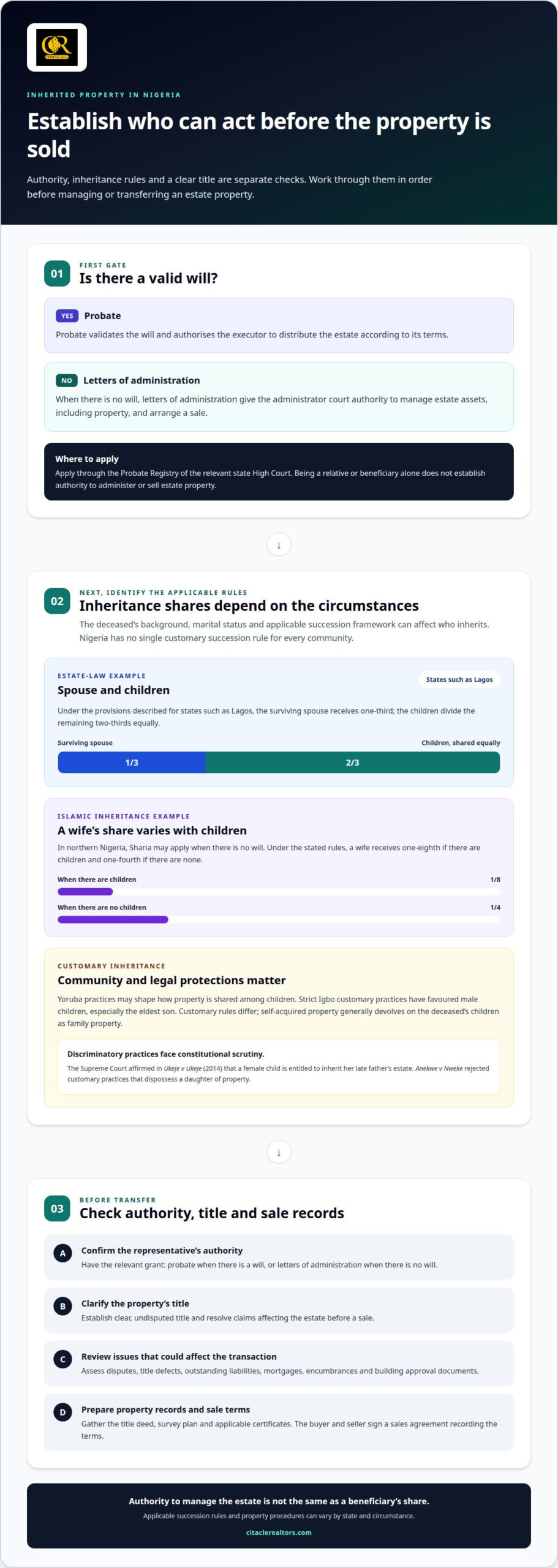
Nigeria’s inheritance framework can involve statutory, customary or Islamic law, depending on the deceased’s background and marital status. The applicable succession framework can vary, so statutory and customary rules may both be relevant. In northern Nigeria, Islamic inheritance law, or Sharia, may apply when there is no will; under the stated rules, a wife receives one-eighth if there are children and one-fourth if there are none. Identifying the applicable framework helps beneficiaries understand which claims and shares may apply.
Intestate Succession and Customary Law
Intestate succession is the distribution of an estate when its owner dies without a will. If a valid will exists, its terms govern the estate’s division; without one, the relevant succession laws determine who inherits. Under customary law, self-acquired property generally devolves on the deceased’s children as family property. The Supreme Court affirmed in Ukeje v Ukeje (2014) that a female child is entitled to inherit her late father’s estate. The distinction matters before beneficiaries claim or transfer property.
Customary Law and Property Disputes
Customary law and property disputes concern competing claims over who inherits and how land is recorded. Nigeria has no single customary succession rule for every community, and land registration procedures vary by state; the relevant state and property location shape the process. The Constitution’s section 42(1) bars discrimination on its stated grounds, while Anekwe v Nweke rejected customary practices dispossessing a daughter of property. Beneficiaries facing disagreement can pursue mediation or arbitration to seek resolution without lengthy litigation, or use court proceedings where necessary.
Probate and letters of administration
Legal authority is essential before an estate’s property can be managed or sold. The process depends on whether the deceased left a will and on the succession rules that apply in the relevant state.
Administration Without a Will
Letters of administration are court authority for managing an estate when someone dies without a will. The administrator can handle estate assets, including property, and arrange a sale. In Nigeria, the application is made through the Probate Registry of the relevant state High Court. This authority matters because being a relative or beneficiary alone does not establish the right to administer or sell estate property.
For Lagos intestate succession, Section 49(1) of the Administration of Estates Law sets out the priority order for people seeking letters of administration. Where family members disagree about who should administer the estate, the order helps frame the application and any resulting disputes.
Distribution Under Estate Law
The Administration of Estates Law governs distribution in many parts of southern Nigeria when there is no will. Under the provisions described for states such as Lagos, a surviving spouse receives one-third of the estate, while the children divide the remaining two-thirds equally. These shares illustrate why administration and distribution are separate: authority to manage the estate does not, by itself, settle each beneficiary’s entitlement.
If the deceased left a valid will, probate validates it and authorises the executor to distribute the estate according to its terms. In Lagos, Order 62 Rule 22 of the High Court Civil Procedure Rules 2019 sets out the priority order for people seeking probate on testate succession.
Documents for Property Claims
Documents for a property claim help establish the applicant’s authority and identify the asset. The relevant grant is probate when there is a will, or letters of administration when there is no will. Property records to prepare for a sale include the title deed, survey plan and any applicable certificates.
Keep estate documents together with property records. The Probate Registry application establishes authority over the estate; the title deed and survey plan relate to the property being claimed or transferred. Keeping these records distinct helps beneficiaries clarify who may act for the estate and respond to questions about the asset.
Completing the sale and transferring ownership
Before a sale, establish clear, undisputed title and resolve any claims affecting the estate. Being a beneficiary alone doesn’t establish authority to sell; probate or letters of administration authorise the estate representative to act.
Rental or development decisions should also account for the representative’s authority and the estate’s interests. Before proceeding, assess property disputes, title defects, outstanding liabilities, mortgages, encumbrances and building approval documents.
Selling or Transferring Family Property
A family-property sale transfers an estate asset to a buyer under agreed terms. Prepare the title deed, survey plan and applicable certificates, then ensure the property’s title is clear and undisputed. The buyer and seller sign a sales agreement recording the terms. Confirm that full payment has been received and processed before completing the transaction, so ownership isn’t transferred on an unpaid promise.
Vesting Assent and Title Transfer
Vesting assent is an estate document used to record property passing from an executor or administrator to a beneficiary. It helps distinguish the beneficiary’s entitlement from the deceased’s estate and supports the title-transfer process. Transfers of rights of occupancy from a deceased estate to beneficiaries require Governor’s Consent under the Land Use Act 1978. The relevant transfer documents and consent process therefore matter to beneficiaries and buyers.
In Lagos, Governor’s Consent processing for inherited-property transfers is stated to take 3-12 months (Q2 2026). The indicative fee is approximately 3% of assessed market value, while stamp duty is 0.75% of consideration (Q2 2026). These are transfer costs, distinct from inheritance tax.
Nigeria abolished Estate Duty in 1979, and beneficiaries don’t pay inheritance tax on property received. Rental income is taxable under the Personal Income Tax Act. Nigerian residential property sales by individuals aren’t subject to capital gains tax under the Capital Gains Tax Act. Separate these tax treatments when weighing whether to rent or sell, and resolve title or liability issues before closing.
Tax on inherited property, rental income and sales
Tax depends on whether you inherit the property, earn income from it or sell it. Keep these events separate when planning how to distribute the estate among beneficiaries.
Tax on Inherited Property
Tax on inherited property concerns the asset received by a beneficiary, not income later earned from it. Nigeria abolished Estate Duty in 1979, and no inheritance tax applies to property beneficiaries receive.
This distinction matters during estate administration. Inheritance rules determine who is entitled to the property, while tax treatment applies to later income or a sale. Since the applicable succession framework can differ among states, identify the rules governing the estate before dividing rental income.
For example, if a female beneficiary inherits a share alongside other children, the inheritance itself is distinct from rent earned after distribution. Islamic principles, statutory rules and customary succession can affect entitlement, but rental income from inherited property is taxable under the Personal Income Tax Act (PITA).
Tax on Property Sales
Tax on property sales concerns the proceeds or gain from disposing of inherited real estate. The stated general capital gains tax on property sales is 10% of the gain. However, Nigerian residential property sales by individuals are not subject to Nigerian capital gains tax under the Capital Gains Tax Act.
The type of transaction and the seller also matter. Separate a residential sale by an individual from other property disposals, and distinguish tax on sale proceeds from stamp duty or consent-related transfer costs. Those charges arise from transfer processes, not from inheritance tax.
For a rental decision, record rent separately from the inherited asset and consider its PITA treatment. For a sale, retain transaction records and identify whether the residential-property exemption applies. This helps beneficiaries plan distribution without treating every receipt as taxable in the same way.
If the inherited property will generate rent, explore inherited-property management support as part of your planning.
Citacle Realtors: Property Management
Citacle Realtors can help manage an inherited property once your authority to act for the estate is established. If you decide to keep the property and earn rental income, Property Management can support its ongoing oversight, while Facilities Management covers the property’s facilities.
These services may suit beneficiaries who live elsewhere, share ownership with relatives or prefer to retain the asset rather than sell immediately. If the property needs work before continued use, Property Renovations may also be relevant. The right option depends on your plans for the property and its condition.
For help managing an inherited property, contact Citacle Realtors.
Make a Clear Plan for the Property’s Next Chapter
Deciding what to do with inherited property in Nigeria is also an opportunity to shape how the asset will serve your family in the years ahead. Consider whether it should remain a shared home, provide rental income or form part of a longer-term property plan. Agreeing on a clear purpose can help beneficiaries move forward together.
Citacle Realtors can support your property plans through Property Management, Facilities Management and Residential Land Sales. These services may be relevant as you manage an inherited asset or consider future property decisions. Choose the direction that fits your family’s priorities, then take the next step with a clear plan.
Contact Citacle Realtors about inherited property to discuss your next step. With a thoughtful plan, you can approach the property’s future with greater clarity and confidence.
Frequently Asked Questions
What happens if the deceased has no surviving relatives?
If the deceased has no surviving relatives, the property may escheat to the state under statutory laws. This means the estate may pass to the state rather than to a family beneficiary. Before treating a property as unclaimed, establish whether a valid will exists or anyone has a succession claim. Estate and title records help clarify the property’s status.
How is inherited property distributed under Nigerian law?
A valid will governs distribution when it meets the applicable legal requirements; otherwise, intestacy rules apply. To decide what to do with inherited property in Nigeria, first identify the deceased’s marriage, background and governing succession law rather than assuming there is one nationwide formula. An estate may be subject to the Administration of Estates Law, customary rules or Islamic principles. This framework helps beneficiaries understand their respective claims.
How do customary and Islamic inheritance laws affect property in Nigeria?
Customary and Islamic rules can recognise different heirs and shares, so the deceased’s community, faith and marriage circumstances matter. The Yoruba customary practice described here divides property equally among children, regardless of gender. Under the stated Islamic inheritance principles, male heirs receive twice the share of female heirs in relevant circumstances, while a wife’s share depends on whether the deceased left children.
How do you obtain probate or letters of administration in Nigeria?
Apply for probate when a valid will names an executor, or letters of administration when there is no will. Applications go through the Probate Registry of the relevant state High Court. The grant establishes who may administer estate assets; it does not, by itself, resolve every question about property title. Keep the estate grant aligned with the records for the property being transferred or sold.
What are the probate fees, stamp duties, and taxes on inherited property in Nigeria?
Costs depend on the state registry and the transfer transaction, so distinguish probate charges from consent fees and stamp duty. In Lagos, the stated indicative Governor’s Consent fee is approximately 3% of assessed market value, and stamp duty is 0.75% of consideration (Q2 2026). No inheritance tax applies to received property; rental income is taxable under PITA.
How can heirs transfer inherited land or a house into their names in Nigeria?
A practical way to decide what to do with inherited property in Nigeria is to first establish who can act for the estate and what transfer records are needed. Prepare the title deed, survey plan and applicable certificates, then complete the relevant consent and title-registration process for the state where the property is located. In Lagos, transfers of rights of occupancy from a deceased estate to beneficiaries require Governor’s Consent under the Land Use Act 1978.