

Owning more property doesn’t automatically make an investment portfolio safer. A real estate portfolio is the group of property assets an investor holds, considered together in terms of income, appreciation, and risk. The most useful real estate portfolio management tips start with diversifying across property types and locations, then tracking each asset’s performance.
Look beyond a property’s potential rental income: local demand, vacancy, ongoing expenses, and market conditions all affect its contribution to your investment goals. A thoughtful approach shows where your assets are concentrated and where one setback could have an outsized effect.
This guide explains how to assess a portfolio, diversify across locations, property types, and lease terms, and manage risk through clear asset allocation and regular reviews. You’ll learn how to track performance and build a capable team to support your properties, helping you make informed decisions as your portfolio develops.
Key Takeaways
- View your properties as one portfolio, then track income, vacancy, appreciation, and expenses together to guide buy, hold, or sell decisions.
- Spread exposure across locations, property types, and lease terms so one local downturn or tenant change has less influence on your overall results.
- Build support around the work your properties require, including maintenance, tenant matters, financial records, and legal considerations.
- Review concentration, tenant stability, and cash reserves regularly to spot vulnerabilities and make measured adjustments before expanding.
1. Portfolio diversification by location, property type and lease terms
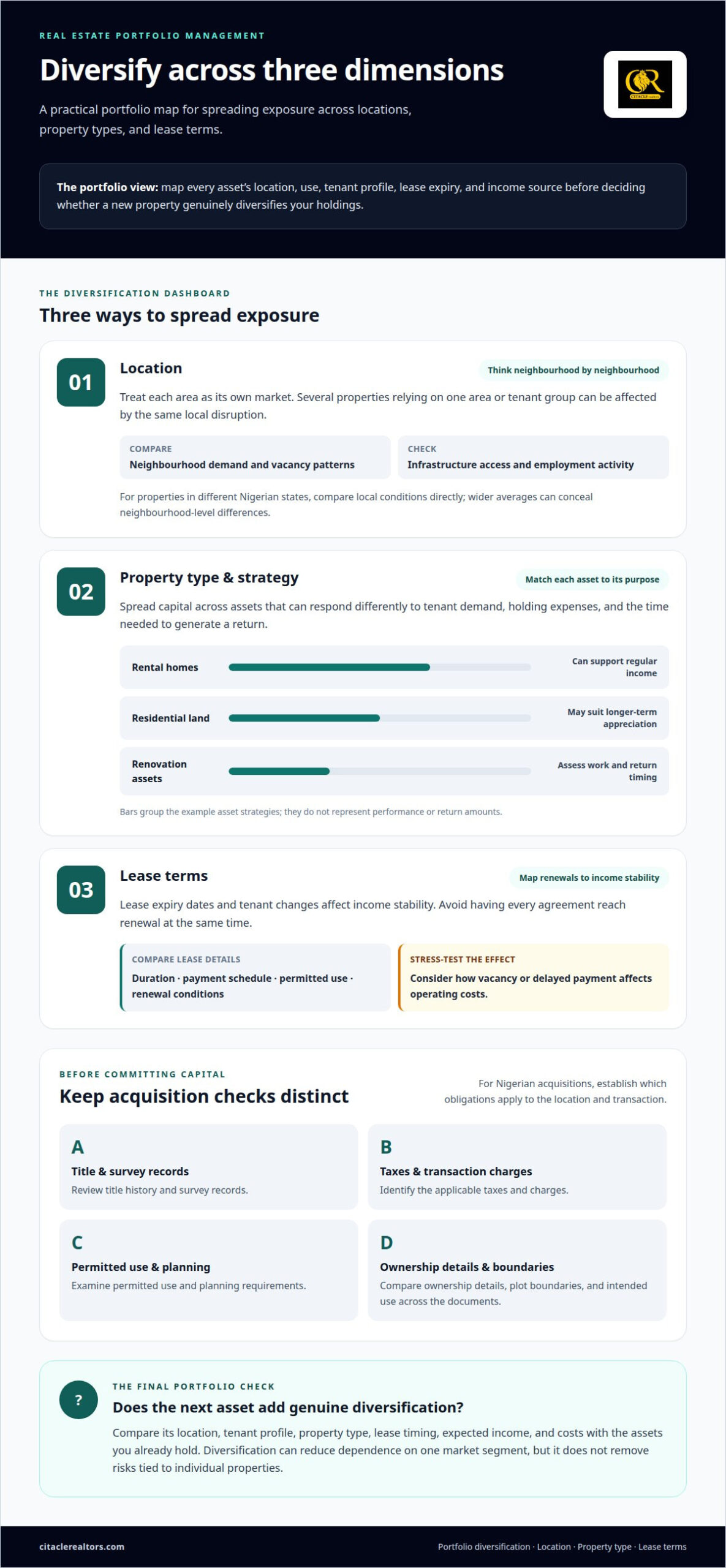
Start by mapping each property’s location, use, tenant profile, lease expiry, and income source. Review this map before your next purchase. If several assets rely on one area or tenant group, a local disruption can affect multiple rental streams at once. For example, an investor with residential properties in different Nigerian states can compare neighbourhood demand, vacancy patterns, infrastructure access, and employment activity before allocating capital. Treat each area as its own market, not as an interchangeable address. Check conditions at neighbourhood level, since wider averages can conceal local differences.
Next, spread capital across property types and investment strategies. A portfolio could combine rental homes, residential land, and properties bought for renovation rather than relying on one asset type. Each responds differently to tenant demand, holding expenses, and the time needed to generate a return. Compare expected income with costs and the purpose of each investment. A rental property may support regular income, while land may suit a longer-term appreciation strategy. Diversification can reduce dependence on one market segment, but it doesn’t remove risks tied to individual properties.
For Nigerian acquisitions, treat title, tax, and planning checks as separate due-diligence steps. Review title history and survey records, identify applicable taxes and transaction charges, and examine the property’s permitted use and planning requirements. These obligations can vary by location and transaction, so establish which apply before committing capital. Compare ownership details, plot boundaries, and intended use across the documents.
Lease terms matter because renewal dates and tenant changes affect income stability. Map lease expiries across your properties and avoid having every agreement reach renewal at the same time. Compare each lease’s duration, payment schedule, permitted use, and renewal conditions. Then consider how a vacancy or delayed payment would affect operating costs. These steps help you judge whether a new asset adds genuine diversification or increases exposure to the same location, tenant profile, or income pattern.
2. Building a team of contractors, accountants, lawyers, and property managers
Assign clear roles before a property’s first tenant moves in. A contractor can assess repairs and renovations, while an accountant organises rental income, expenses, and tax records. A lawyer can review contracts and ownership documents, and a property manager can coordinate maintenance and tenant issues. Keep invoices, inspection notes, lease dates, and payment records together for each property. Clear records help your team work from the same facts instead of relying on scattered messages.
Use a property manager when coordinating tenant communication, rent tracking, maintenance requests, and lease renewals takes time away from investment decisions. Management fees should be assessed against the agreed duties and reporting, not considered in isolation. A manager’s price depends on the case and is given after a quote request; property needs, service scope, and maintenance responsibilities affect the cost. Compare the responsibilities in the agreement with the work you need handled, then record the fee as an operating expense in your property metrics.
Renovations can support an asset strategy when they address a clear property need. Ask a contractor to identify priority repairs, separate essential work from optional upgrades, and estimate the effect on rentability and ongoing maintenance. Resolving a persistent plumbing issue, for instance, may improve tenant comfort and reduce repeat repair calls. Track completed work, invoices, and resulting rental performance. Don’t assume every improvement raises value or income; assess it against the property’s condition, local demand, and investment plan.
Apply a snowball approach by setting aside rental income after operating expenses, then directing available proceeds to the next priority. That could mean funding a repair reserve, completing planned improvements, or preparing for another acquisition. Review records with your accountant and compare actual income, expenses, vacancies, and maintenance against your business strategy. If your priority is stable rental income, reinvestment should support reliable occupancy and property upkeep. If growth is the aim, assess whether the next commitment fits your capital and management capacity.
3. What is a real estate portfolio?
A real estate portfolio is the set of properties and related investments you manage as one investment picture. It may include residential rentals, commercial buildings, or land in different locations. Assess each asset individually, then compare its income, expenses, and contribution to your wider goals. This view helps distinguish a property that performs well on its own from one that strengthens the portfolio as a whole.
Set an investment goal before choosing your next asset. You might prioritise rental income, long-term appreciation, diversification, or a combination. Then assess your risk tolerance by considering how much vacancy, repair work, and income fluctuation you can manage. For example, an investor relying on rent for regular income may favour predictable occupancy over a property requiring extensive renovation. Research local demand and economic trends to test whether an opportunity fits your goal.
Use consistent metrics to compare properties. Net Operating Income (NOI) is income after operating expenses; cash-on-cash return compares cash income with cash invested. Gross Rent Multiplier compares property value with gross rental income, while capitalization rate measures a property’s return. Internal Rate of Return estimates profitability while accounting for the time value of money. Track occupancy, tenant payments, maintenance, and vacancy alongside these measures. A cash-flow-positive rental earns more monthly income than its holding expenses.
To assess value and decide whether to buy, hold, or sell, combine market analysis, property inspections, and a review of local rules. Compare the asset’s current performance and condition with your goals, then weigh its likely income, expenses, and role in the portfolio before deciding.
Centralise property records in one report or spreadsheet, with a separate line for each asset. Record purchase details, current valuation, rental income, vacancy, expenses, and lease information. Update entries consistently so changes across locations or property types are visible. If one property’s costs rise while another’s income remains steady, the combined view helps you see the effect on total performance. Use the report during regular portfolio reviews to support clear buy, hold, or sell decisions.
4. Risk management and asset allocation
Set a clear goal first: income, long-term appreciation, or a balance of both. Allocate capital between residential and commercial properties according to their expected income, operating needs, and fit with that goal. The 5% portfolio rule suggests keeping any single high-risk property investment at or below 5% of your total net worth. Treat it as a risk-management guide, not a substitute for assessing each asset.
Concentration can also come from income, not just property type. If one tenant accounts for 50% of portfolio income, a vacancy or missed payment could sharply affect cash flow. Review tenant stability, property valuations, and market trends together. Then stress-test each asset: consider how a vacancy, major repair, or weaker rental demand could affect operations and your ability to meet payments.
Cash reserves can help absorb unexpected costs. The 3-3-3 rule advises keeping three months of mortgage payments, three months of operating expenses, and 3% of the property’s value in cash reserves. Use this as a planning framework, then compare the proposed reserve with your actual costs and commitments. Debt Service Coverage Ratio also helps assess whether a property’s income can cover its loan payments.
For Nigerian property owners, consider insurance protection in light of each building’s structure, contents, use, and exposure to hazards. Review policy limits, exclusions, excesses, and the claims process to ensure the cover aligns with the risks you’re managing. Needs differ between a residential rental and a commercial property, so assess each asset rather than applying one assumption across the portfolio.
Review asset allocation alongside property-level operations. If one asset repeatedly needs repairs while another produces steadier income, compare their roles against your goals before redirecting capital. A careful property valuation review can help inform those allocation decisions. Reassess the portfolio when tenant stability, valuations, or market conditions change, and pursue new opportunities only when they fit your risk capacity.
Citacle Realtors: Property Management
Citacle Realtors provides Property Management for owners seeking support with their portfolios. It can be a practical next step when overseeing tenants, maintenance needs, and property records takes attention away from investment decisions. Clear oversight keeps each property’s responsibilities visible and helps you consider how operations fit your wider plans.
Before seeking support, outline the properties you manage and the tasks that need attention. Note tenant matters, maintenance coordination, and the records you use to monitor each asset. This gives you a focused starting point for discussing how property management can meet your needs. Investors balancing several properties can also use Facilities Management for building-related operations.
For your next step, contact Citacle Realtors or visit citaclerealtors.com to discuss your property management needs.
Put your next portfolio decision into motion
Your next step doesn’t have to be a new acquisition. Choose one priority for your next review, such as improving reporting, addressing an operational bottleneck, or assessing a prospective asset against your goals. Use these real estate portfolio management tips as a decision framework: define the outcome you want, then focus on actions that support it. Record the decision and its outcome to inform future reviews.
Citacle Realtors provides Property Management and Facilities Management for property operations, alongside Residential Land Sales for investors considering land acquisition. Match the support you need to the decision ahead, whether you’re refining oversight of existing holdings or exploring a new asset. This keeps your next move aligned with your portfolio’s direction.
Ready to discuss your property plans? Start a conversation with Citacle Realtors and take your next step with confidence.
Frequently Asked Questions
What is a real estate portfolio?
A real estate portfolio is the group of property assets an investor owns or manages, viewed as a combined investment. It might include rental homes, commercial premises, and land held for different purposes. For example, an owner can assess whether rental income from one property offsets the upkeep demands of another. This wider view connects individual property decisions with overall investment priorities.
Which properties have the best outlook for long-term appreciation?
No property type guarantees long-term appreciation. Assess each opportunity through local rental demand, employment activity, infrastructure access, property condition, and comparable transactions in the same area. For example, a well-maintained home near established services may appeal to a wider tenant pool than a property with limited access. Review ownership documents and permitted use, then consider whether the likely holding period suits your plans.
What are the key steps for managing a real estate portfolio effectively?
A practical way to apply real estate portfolio management tips is to keep a current asset register. Record ownership documents, leases, payment history, maintenance records, and operating costs for every property. Give each asset a clear role, such as generating income or supporting longer-term appreciation. Review actual performance against that purpose and document decisions. Repeated repair issues, for instance, may warrant an inspection before you decide what to do.
How do you evaluate rental property cash flow, ROI, cap rate, and net operating income?
Calculate net operating income by subtracting operating expenses from property income, before debt payments. Cash flow accounts for financing and other cash obligations, showing what remains after those payments. Cap rate is net operating income divided by property value, while ROI compares gains with the investment made. Use consistent periods and include vacancy, repairs, and recurring costs to make comparisons meaningful.
How can investors find reliable tenants and reduce vacancy rates?
Use a consistent screening process that reviews an applicant’s identity, rental history, references, and ability to meet agreed payment terms. Explain lease obligations clearly and document the property’s condition at handover. To limit vacancy, respond promptly to maintenance concerns, discuss renewal options early, and keep the property presentable. Resolving a recurring water issue, for example, may improve the tenant experience and help prevent avoidable turnover.
What are the best practices for budgeting repairs, maintenance, and capital improvements?
One of the most useful real estate portfolio management tips is to separate routine maintenance, urgent repairs, and larger capital improvements in your records. Inspect each property, log recurring faults, and prioritise work affecting essential services or continued occupancy. Before approving an upgrade, define its purpose and compare the scope with the building’s condition and rental demand. Keep invoices and completion notes to guide future budgets.