

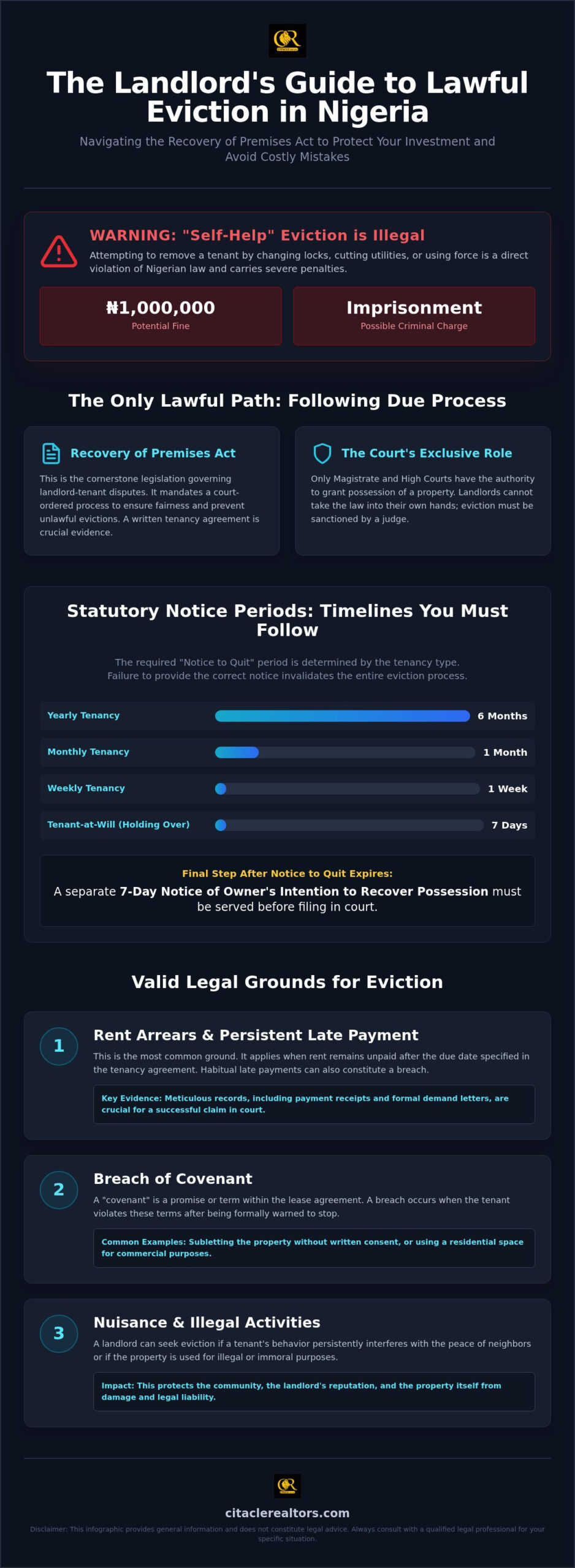
Attempting to reclaim your property through “self-help” methods like changing locks isn’t just risky; it’s a fast track to a ₦1 million fine or even imprisonment under modern Nigerian regulations. We understand the weight of responsibility that comes with being a landlord, and it’s frustrating when a tenant stops paying or violates your agreement. You might feel that the law is stacked against you while your rental income vanishes. Understanding the specific legal grounds for eviction in Nigeria is the only way to protect your investment without falling into a costly legal trap.
We’re here to guide you through this process with professional reliability. This 2026 guide will help you master the statutory requirements and valid reasons for tenant removal to ensure a legally sound recovery of your premises. We’ll walk you through the mandatory notice periods, the essential 7-day Notice of Owner’s Intention to Recover Possession, and the specific scenarios where the law supports your right to reclaim your asset. You’ll gain the peace of mind that comes from knowing your property is managed with excellence and legal precision.
Key Takeaways
- Understand the essential legal framework provided by the Recovery of Premises Act to ensure your property rights are always upheld through proper channels.
- Master the specific legal grounds for eviction in Nigeria to confidently address rent arrears and lease violations without the risk of legal repercussions.
- Determine the exact notice periods required for your specific tenancy cycle to maintain a seamless and valid recovery process from start to finish.
- Explore how professional property management and renovation services can be utilized to legally recover and enhance the long-term value of your assets.
- Safeguard your reputation and finances by understanding why adhering to court-ordered possession is the only reliable path to a successful eviction.
Understanding the Legal Framework for Eviction in Nigeria
We believe that property ownership should be a source of peace, not a cause for anxiety. To achieve this, you must view the Legal Framework in Nigeria as a protective shield rather than a hurdle. The law regulates the landlord and tenant relationship strictly to prevent arbitrary homelessness and maintain social order. This means that even if a tenant is in the wrong, you can’t simply eject them. You must follow the path laid out by the statutes to ensure your recovery is permanent and legally airtight. Eviction isn’t a right of “might” or physical force; it’s a methodical process of law that rewards patience and documentation.
The Recovery of Premises Act
The Recovery of Premises Act serves as the cornerstone for property reclamation across the federation. While state-specific laws exist, this Act provides the standard operating procedure for most disputes. We always encourage our clients to maintain clear, written agreements through professional property management. Oral tenancies are technically binding, but they often lead to messy “he-said, she-said” scenarios in court. When you have a professional lease, identifying the legal grounds for eviction in Nigeria becomes much easier. If a dispute escalates, the Magistrate and High Courts are the only venues where possession can be granted. They act as impartial referees to ensure every statutory step is followed perfectly. It’s a journey we’re eager to help you manage with total confidence.
Fixed-Term vs. Periodic Tenancies
Your legal strategy depends entirely on the type of agreement you have. A fixed-term tenancy expires on a specific date, while periodic tenancies, such as weekly, monthly, or yearly arrangements, continue until one party gives notice. The type of tenancy dictates your required notice period. For example, a yearly tenant is typically entitled to six months’ notice, while a monthly tenant requires one month.
If a tenant stays after the lease expires without a new agreement, they’re “holding over.” This doesn’t mean they’ve earned a new year of residency. Instead, they often become a “tenant-at-will.” While they still have rights, their status is more precarious and the notice period is significantly shorter. Understanding these nuances ensures you don’t accidentally grant a tenant more time than they’re entitled to. Mastering the legal grounds for eviction in Nigeria starts with knowing exactly which category your tenant falls into, as this dictates your entire recovery timeline. We’re committed to ensuring your investment remains secure throughout these transitions.
The 4 Valid Legal Grounds for Eviction in Nigeria
Reclaiming your property is a significant decision that requires a clear, strategic approach. While the law protects tenants, it also safeguards your rights as an owner when specific conditions are met. Understanding the legal grounds for eviction in Nigeria is the first step toward a successful and stress-free recovery. There are four primary pillars that justify a landlord’s request for possession in a court of law, and we’re here to help you navigate each one with confidence.
Rent Arrears and Persistent Late Payment
Rent arrears remain the most common reason landlords seek to recover their premises. In 2026, “arrears” refers to any rent that remains unpaid after the due date specified in your written agreement. We always advise our partners to maintain meticulous records; payment receipts and formal demand letters are your strongest evidence if a matter reaches the court. When you focus on increasing rental property value, consistent and timely payments become the fuel for your investment’s growth. If a tenant habitually pays late, it disrupts your financial planning and may serve as a valid ground for termination.
Breach of Covenant
Every tenancy agreement contains “covenants” or promises that both parties must keep. A breach occurs when a tenant violates these specific terms, such as subletting the property without your written consent or using a residential duplex for commercial manufacturing. These violations represent a breakdown of the professional relationship. If the tenant fails to correct the breach after receiving a formal warning, you have a solid legal basis to move forward with recovery proceedings.
Nuisance and Illegal Activities
Your property should be a sanctuary for everyone in the community. A “legal nuisance” occurs when a tenant’s behavior persistently interferes with the peace, health, or comfort of neighbors. This might include excessive noise at odd hours, improper waste disposal, or aggressive behavior toward other residents. Documenting complaints from neighbors is essential for building a persuasive case. Furthermore, if criminal activity like fraud or drug trafficking occurs on the premises, the legal implications are immediate. The law supports a landlord’s swift action to protect their asset’s reputation and the safety of the public.
Personal Use and Substantial Renovations
Sometimes, you may need the property back for your own family’s use or to perform major structural changes that cannot be done while the tenant is present. However, the burden of proof lies with you to show the court that this need is “bonafide” or genuine. You cannot use this ground as a mere pretext to swap one tenant for another. If you’re planning significant upgrades to modernize your asset, Citacle Realtors renovation services can help you execute these changes legally and efficiently. Managing these delicate transitions requires a blend of legal knowledge and human empathy. If you’re feeling overwhelmed, our professional property management team is ready to help you protect your investment with grace.
The Statutory Notice Process: Timelines You Must Follow
Establishing valid legal grounds for eviction in Nigeria is only half the battle. The other half is won through meticulous timing and the precise delivery of statutory notices. We’ve seen many well-meaning landlords lose their cases in court simply because a date was off by twenty-four hours or a notice was served incorrectly. The law views these timelines as sacred protections for the tenant; therefore, your adherence to them must be flawless. Think of this process as a professional roadmap that leads to the successful recovery of your property while maintaining your reputation as a disciplined investor.
Standard Notice Periods Explained
The first step in any legal recovery is issuing a valid “Notice to Quit.” This document formally informs the tenant that their right to occupy the premises will end on a specific date. Unless your written tenancy agreement specifies a different duration, the Recovery of Premises Act dictates these minimum periods:
- Weekly Tenants: One week’s notice.
- Monthly Tenants: One month’s notice.
- Quarterly Tenants: Three months’ notice.
- Yearly Tenants: Six months’ notice.
It’s vital to remember that the notice must end on the eve of the anniversary of the tenancy. For example, if a yearly tenancy started on January 1st, the notice should ideally be served at least six months before December 31st. We always suggest serving these notices early to avoid any last-minute complications that could stall your progress.
The 7-Day Notice of Intention
Once the “Notice to Quit” expires and the tenant remains on the property, you don’t head straight to court. You must serve a second document: the “7-Day Notice of Owner’s Intention to Recover Possession.” We often describe this as the “final warning” before litigation begins. This notice must clearly state that if the tenant doesn’t vacate within seven days, you’ll proceed to the Magistrate or High Court to sue for possession and any outstanding rent. If the tenant still refuses to move after the seventh day, you finally have the legal green light to file your claim.
Service is just as important as the content itself. While “Personal Service” (handing the notice directly to the tenant) is the gold standard, some tenants may try to evade service. In such cases, the law allows for “Substituted Service,” which often involves pasting the notice on a prominent part of the premises, like the front door. We recommend documenting this with a photograph or a witness to ensure you have proof for the court. Avoid the common mistake of miscounting the days; the seven days must be clear days, excluding the day of service itself. Precision here isn’t just a suggestion; it’s the foundation of your success in establishing legal grounds for eviction in Nigeria.
The Dangers of “Self-Help” and Illegal Eviction
It’s tempting to take matters into your own hands when a tenant refuses to leave. You own the building. You pay the taxes. Why should you wait months for a court date? However, taking shortcuts is a dangerous trap that can dismantle your investment overnight. In the eyes of the Nigerian judiciary, a “bad” tenant quickly becomes a victim the moment you bypass the law. Even if you have solid legal grounds for eviction in Nigeria, using “self-help” methods can turn a simple recovery case into a nightmare of criminal charges and massive financial penalties. We’re here to help you avoid these pitfalls and maintain your status as a respected, professional landlord.
What Constitutes Illegal Eviction?
Illegal eviction isn’t always about physically dragging someone out of the door. It often takes the form of “constructive eviction,” where a landlord intentionally makes the property uninhabitable. This includes removing the roof, locking the main gates, or cutting off essential utilities like water and electricity. Such actions are strictly prohibited and viewed as a breach of the tenant’s right to quiet enjoyment. If you use threats, intimidation, or hire “touts” to harass a resident, you’re opening yourself up to criminal liability for assault and harassment. The law is designed to prevent chaos; therefore, any attempt to reclaim possession without a court-ordered bailiff is considered a violation of public order.
The Financial Risk of Lawsuits
The financial consequences of an illegal eviction often far outweigh the cost of lost rent. When a landlord uses self-help, the court may award “Punitive Damages” to the tenant. These are heavy fines intended to punish the landlord’s behavior rather than just compensate the tenant. You might also lose your right to recover “Mesne Profits,” which is the money a tenant owes you for staying in the property after their notice has expired. Instead of receiving the rent you’re owed, you could find yourself paying out millions of Naira in legal defense fees and damages.
Professional mediation or a managed exit is almost always faster and cheaper than a drawn-out legal battle or a botched forced entry. We believe in protecting your assets through excellence and decorum, ensuring that your property remains a source of steady, peaceful income. If you’re facing a difficult tenant situation, it’s safer to let experts handle the transition. Our professional property management team can guide you through a managed exit that protects your asset while ensuring you stay firmly on the right side of the legal grounds for eviction in Nigeria.
How Professional Property Management Minimizes Eviction Risks
While the law provides a clear path for recovery, we believe that the best eviction is the one that never has to happen. Reclaiming a property is often a sign that the initial relationship wasn’t built on a solid foundation. By shifting from a reactive approach to proactive, professional oversight, you can protect your investment and your peace of mind simultaneously. Our goal is to ensure that you rarely need to rely on the legal grounds for eviction in Nigeria because your properties are occupied by reliable, vetted individuals who value your asset as much as you do.
The Value of Expert Tenant Screening
Rigorous tenant vetting is your first and most effective line of defense. We don’t just look at a potential tenant’s ability to pay the first year’s rent; we look for a history of reliability across the Nigerian market. This involves verifying income levels, checking previous rental references, and identifying “red flag” behaviors that often lead to future disputes. When you have a professional team handling this process, you eliminate the emotional bias that sometimes leads landlords to accept the wrong occupant.
Our facility management services play a crucial role here as well. By monitoring how a property is being used on a day-to-day basis, we can spot early warning signs of “Breach of Covenant” or “Nuisance” before they escalate into legal battles. If a residential duplex is being converted into a noisy warehouse, our team identifies it early, allowing for a polite but firm correction that keeps the tenancy on track and the neighbors happy.
Transitioning to Professional Oversight
If a situation does arise where a tenant must leave, having a professional buffer makes all the difference. We take the heat out of sensitive negotiations, acting as a “friendly guide” who remains a consummate professional. We handle the entire statutory notice process on your behalf, ensuring every document is served correctly and every timeline is met with surgical precision. This removes the anxiety of potential court battles and ensures that your recovery of the premises is legally sound from day one.
Maintaining property value through proactive residential property management also involves regular asset valuation. By ensuring your rent stays at a fair market rate, you reduce the risk of sudden turnover and financial strain on the tenant. We’re eager to help you build a portfolio that thrives on stability rather than conflict. When your lease agreements are drafted with clear, modern termination clauses, you stay firmly in control of your destiny. If you’re ready to secure your investment and leave the stress of tenant disputes behind, it’s time to Partner with Citacle Realtors for Stress-Free Property Management. We’ll handle the complexities of the legal grounds for eviction in Nigeria so you can focus on growing your wealth.
Securing Your Property’s Future with Professional Excellence
Reclaiming your property shouldn’t be a source of stress or legal peril. By mastering the statutory notice timelines and identifying the specific legal grounds for eviction in Nigeria, you position yourself as a disciplined and successful investor. You’ve learned that patience and documentation are your greatest allies; these ensure that every step you take is backed by the weight of the law and protects your reputation within the community.
We invite you to experience a more seamless journey in property ownership. As visionary local experts, Citacle Realtors provides full-service management that covers everything from rigorous tenant vetting to high-standard renovations. We’re committed to maintaining your property’s value while acting as a stable partner in your investment journey. Protect your investment with Citacle Realtors Property Management and enjoy the steady assurance that your assets are in expert hands. We look forward to helping you achieve your real estate goals with total confidence and peace of mind.
Frequently Asked Questions
How long does the eviction process take in Nigeria in 2026?
The timeline typically ranges from six to eighteen months. This includes the statutory notice period, which is six months for yearly tenants, followed by the mandatory seven-day notice of intention to sue. Once the matter reaches the Magistrate or High Court, the duration depends on the court’s schedule and whether the tenant contests the claim. Professional management helps avoid technical errors that often cause lengthy and expensive delays in the recovery process.
Can I evict a tenant if there is no written tenancy agreement?
Yes, you can recover your property even without a written contract. Nigerian law recognizes oral tenancies, but they fall under the default regulations of the Recovery of Premises Act. This means you must still provide the full statutory notice periods based on how the rent is paid. For example, a tenant paying annually is entitled to six months’ notice. We recommend professional lease drafting to clearly outline the legal grounds for eviction in Nigeria for future security.
What is a “Notice to Quit” and who should sign it?
A Notice to Quit is a formal legal document that ends the tenancy relationship on a specific date. It must be signed by the landlord or a person authorized in writing, such as a lawyer or a professional property manager. The notice must be served personally or through substituted service to be valid. If the signature is unauthorized or the dates are calculated incorrectly, the court will likely dismiss your case, forcing you to start the process again.
Can I increase the rent while the tenant is still in arrears?
You can technically review rent, but doing so while a tenant owes money is often counterproductive. Courts may view a rent increase during an active dispute as a form of harassment or an attempt to force an illegal eviction. It is usually more effective to focus on recovering the outstanding debt or using the non-payment as one of the valid legal grounds for eviction in Nigeria to reclaim the premises through the proper legal channels.
What happens if a tenant refuses to leave after receiving a court order?
You must never attempt to physically eject a tenant yourself, even with a court order in hand. Instead, you must apply for a Warrant of Possession, which authorizes court bailiffs to enforce the judgment. These officials will visit the property to remove the tenant and their belongings legally. This process ensures that the recovery is handled with the necessary decorum and minimizes the risk of physical altercations or future lawsuits against the landlord.
Is it legal to use the police to evict a tenant?
No, using the police to forcibly remove a tenant is illegal and highly risky. Eviction is strictly a civil matter handled by the courts and their bailiffs. Involving the police for a civil dispute can lead to a fundamental rights lawsuit against you, resulting in heavy fines and punitive damages. The police should only be called if there is a clear criminal act, such as a breach of peace, assault, or intentional property damage.
What is the difference between a tenant and a lodger under Nigerian law?
The primary difference lies in “exclusive possession.” A tenant has the legal right to exclude others, including the landlord, from the property and is protected by statutory notice requirements. A lodger merely has permission to occupy a room while the owner retains control over the premises. Lodgers generally have fewer legal protections and can often be removed with shorter notice. Understanding this distinction is vital for choosing the correct legal path for property recovery.
Can I recover my property for my own use even if the tenant is paying rent?
Yes, personal use is a recognized legal ground for reclaiming your property. You must issue the correct statutory notices and prove to the court that your need is genuine and not a pretext for a higher-paying tenant. While the tenant’s compliance with rent is commendable, it does not strip you of your right to use your asset for yourself or your family. Following the legal process ensures your transition is smooth and permanent.