

What if the greatest threat to your real estate investment isn’t a leaking roof or a fluctuating market, but a single misunderstood clause in a tenancy agreement? Many property owners view themselves strictly as investors, but the legal framework views you as a professional partner in a highly regulated sector. It’s natural to feel a sense of uneance when faced with the prospect of “professional tenants” or the requirements of the Nigeria Tax Act 2025. You’ve worked hard to build your portfolio, and you deserve to see that value grow without the friction of legal disputes or maintenance crises.
Mastering your landlord responsibilities in Nigeria is the most reliable way to transform your property from a source of stress into a secure, high-performing asset. By embracing your statutory duties with confidence, you create a foundation for professional relationships that protect both your reputation and your financial interests. This 2026 essential checklist provides a definitive guide to your legal and ethical obligations, offering a clear path toward seamless property oversight and structural integrity. We explore everything from tax compliance to the strategic importance of professional asset valuation in maintaining your competitive edge.
Key Takeaways
- Understand the hierarchy of Nigerian laws and why a well-drafted tenancy agreement is your most powerful asset for professional conflict resolution.
- Discover how to maintain the “fit for habitation” standard and fulfill your landlord responsibilities in Nigeria to protect your property’s long-term market value.
- Learn the essential requirements for statutory receipts and how to navigate withholding tax (WHT) to ensure complete financial transparency and tax compliance.
- Master the balance between property oversight and the tenant’s right to quiet enjoyment to foster a respectful, friction-free relationship.
- Gain clarity on the mandatory legal sequence for property recovery, including how to calculate precise notice periods to avoid the risks of unlawful eviction.
Understanding the Legal Framework of Tenancy in Nigeria
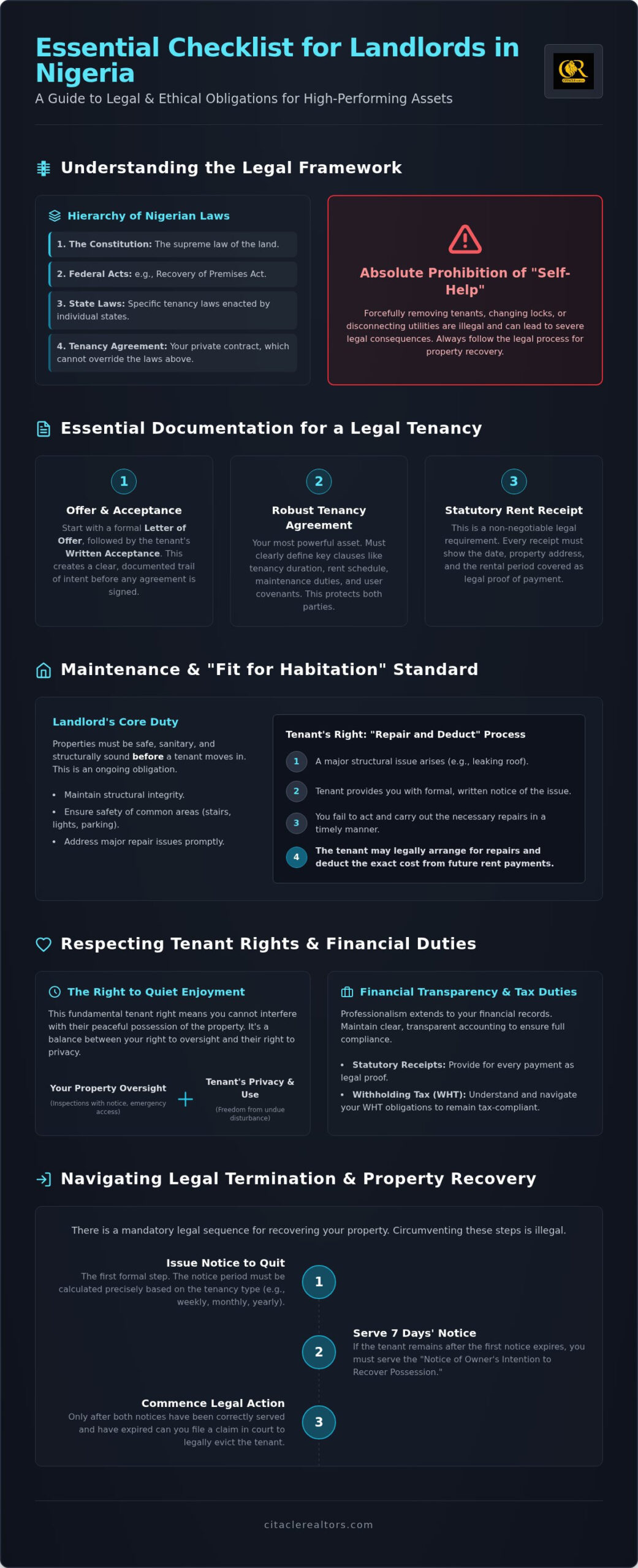
The foundation of any successful property investment lies in a deep respect for the law. In Nigeria, the legal landscape is a sophisticated hierarchy that begins with the Constitution, followed by federal acts and specific state legislations. Understanding these landlord-tenant legal frameworks is essential because they define the boundaries of your authority and your obligations. While the Tenancy Agreement serves as a binding private contract between you and your tenant, it cannot override statutory requirements. If a clause in your lease contradicts a state law, that clause is often void. You must balance what you want in your contract with what the law demands from you.
Under Nigerian law, the term ‘Landlord’ extends beyond the person who holds the title deed. It includes agents, legal representatives, and anyone entitled to receive rent. This broad definition means that if you appoint a property management firm, their actions are legally viewed as your own. Consequently, ensuring your representatives understand landlord responsibilities in Nigeria is vital for your protection. It’s about building a team that reflects your commitment to excellence and professional reliability.
The Recovery of Premises Act vs. State Laws
Across the federation, the Recovery of Premises Act serves as the default legislation for regions that haven’t enacted their own specific tenancy laws. This creates a uniform standard for how possession should be regained. One universal truth across all jurisdictions is the absolute prohibition of “self-help.” Forcefully removing a tenant, changing locks, or disconnecting utilities are illegal acts that can lead to severe litigation. Respecting the local jurisdiction ensures that your investment remains a source of peace rather than a legal liability. We always recommend a methodical approach to recovery to maintain your status as a consummate professional.
Essential Documentation for a Legal Tenancy
A professional relationship begins with clear, written communication. It’s standard practice to issue a formal Letter of Offer, which the prospective tenant must respond to with a written Acceptance. This creates a clear trail of intent. Every robust agreement should include specific clauses that safeguard your asset while respecting the tenant’s rights. Key elements include:
- The exact duration of the tenancy term.
- Specific maintenance obligations for both parties.
- User covenants that define how the property should be utilised.
- The precise rent amount and payment schedule.
Beyond the agreement, the Rent Receipt is a non-negotiable statutory requirement. It’s not just a courtesy; it’s a legal proof of payment that must contain the date, the period covered, and the property address. Proper documentation is the hallmark of a visionary landlord who values transparency and security.
Maintenance and Structural Integrity Obligations
A property’s market value is fundamentally rooted in its structural safety and functional reliability. In the Nigerian real estate sector, the “Fit for Habitation” standard represents the baseline of your duty as a property owner. This means that before a tenant crosses the threshold, the premises must be safe, sanitary, and structurally sound. These Maintenance and Structural Integrity Obligations are ongoing; they don’t expire once the first month’s rent is paid. Fulfilling your landlord responsibilities in Nigeria involves a proactive commitment to the building’s core, ensuring that the living environment remains secure throughout the tenancy.
When managing multi-tenant buildings or residential duplexes, your remit extends to all common areas. This includes shared stairwells, external lighting, and parking facilities. Keeping these spaces well-maintained prevents accidents and preserves the prestige of your investment. While tenants are generally responsible for internal cleanliness, they do possess a legal right to “Repair and Deduct” under specific circumstances. If a major structural issue arises and you fail to address it after receiving formal notice, a tenant may carry out the repairs themselves and deduct the cost from future rent. Clear communication and prompt action are your best defences against such friction.
Defining ‘Major’ vs. ‘Minor’ Repairs
Understanding the distinction between structural duties and internal wear is essential for a harmonious relationship. You are responsible for the “bones” of the building, such as the foundation, external walls, and roofing. Conversely, tenants typically handle minor items like replacing light bulbs or interior painting. Emergency repairs, such as burst water mains or hazardous electrical faults, require your immediate intervention to prevent catastrophic property damage. Maintaining structural integrity is the landlord’s non-negotiable duty.
The Role of Professional Facility Management
Adopting a preventive maintenance schedule is the most effective way to satisfy your legal obligations while protecting your asset’s value. Engaging facility management services Nigeria allows you to identify potential structural failures before they become expensive crises. Regular property renovations also play a vital role in keeping your duplexes or residential units modern and attractive to high-quality tenants. If you are looking to professionalise your oversight, our property management team offers the steady assurance you need to thrive as an investor.
Financial Transparency and Statutory Tax Duties
Financial clarity is the hallmark of a stable professional partnership. Issuing a statutory receipt is one of the most fundamental landlord responsibilities in Nigeria. It isn’t just a courtesy; it’s a legal requirement that must include the date, the amount paid, the specific period covered, and the property address. Proper receipting provides a clear audit trail that protects your reputation and ensures your records are beyond reproach. For serviced duplexes and apartments, transparency in service charges is equally vital. You should provide a clear breakdown of costs for communal power, security, and waste management to maintain trust and avoid disputes.
Tax compliance is another pillar of modern property ownership. Under the Nigeria Tax Act 2025, there’s an ₦800,000 tax-free threshold for personal income, which includes your rental earnings. If you have corporate tenants, they’re legally required to withhold 10% of the rent as Withholding Tax (WHT) and remit it to the authorities. You’re also responsible for paying the Land Use Charge and Ground Rent to the state government. Remember that the law requires stamp duty on tenancy agreements to be paid within a strict 30-day deadline. Staying ahead of these duties ensures your asset remains a source of pride rather than a target for regulatory penalties.
Rent Regulation and Increases
Setting the right price for your property requires a balance between profitability and fairness. While you have the right to review rent, you must adhere to the concept of “Fair Market Value.” Arbitrary or excessive hikes can lead to legal challenges. Many successful owners use a professional property valuation for sellers Nigeria to justify rent reviews based on current market trends and improvements. This data-driven approach provides a polite but firm basis for discussion. Always provide the statutory notice periods required by your state laws before implementing any changes.
Handling Security Deposits and Caution Fees
Caution fees are a standard feature in many Nigerian agreements, serving as a safety net for potential damages. It’s essential to understand that these funds are held in trust. State legislations, such as the Lagos State Tenancy Law, provide frameworks for how these deposits should be managed and eventually refunded. To protect yourself, always document the property’s condition at the start of the term with photos and a signed inventory. This evidence is necessary if you need to justify legal deductions for repairs that go beyond normal wear and tear at the end of the tenancy.
Respecting Tenant Rights: Privacy and Quiet Enjoyment
The Covenant of Quiet Enjoyment is a cornerstone of the landlord-tenant relationship. It isn’t merely about noise levels; it’s a legal guarantee that the tenant can use the property without unreasonable interference from the landlord. While you retain the title to the asset, the right of possession belongs to the tenant for the duration of the lease. Respecting this boundary is one of the most critical landlord responsibilities in Nigeria, as it fosters a relationship built on mutual respect and professional decorum. Interference, even if well-intentioned, can lead to claims of harassment or breach of contract.
One of the most dangerous paths a property owner can take is the attempt at “self-help.” Regardless of the circumstances, even in cases of non-payment, you cannot legally remove doors, disconnect utilities, or block access to the premises. These actions are viewed as a violation of the tenant’s fundamental rights and can result in significant legal penalties against you. When handling a tenant who has become a nuisance to neighbours, your role is to act as a firm yet fair arbiter, using the formal channels provided by the law rather than personal confrontation.
The Protocol for Property Inspections
Maintaining your property’s condition requires regular oversight, but this must be balanced against the tenant’s right to privacy. Standard practice dictates providing a notice period of 24 to 48 hours before any routine visit. The only exception to this rule is a genuine emergency, such as a fire, a major flood, or an imminent structural danger that threatens the safety of the occupants. To keep these visits professional and objective, many landlords utilise a duplex inspection checklist for tenants. This ensures that both parties are on the same page regarding the property’s state and any necessary repairs.
Navigating Tenant Disputes Peacefully
Disputes are sometimes inevitable, but they don’t have to escalate into costly litigation. In many states, the Citizens Mediation Centre offers a collaborative environment where issues can be resolved without the hostility of a courtroom. As a landlord, you also have a duty to provide a secure environment, which includes ensuring that gates, locks, and fencing are in excellent working order. Professional residential property management services act as a vital buffer in these situations, handling delicate communications and ensuring all interactions remain within legal bounds. If you’re ready to professionalise your property oversight and enjoy true peace of mind, contact our expert team to learn how we can protect your investment today.
Navigating Legal Termination and Property Recovery
Recovering possession of your property is a sensitive transition that demands absolute legal precision. While it’s often a difficult decision to end a tenancy, understanding the statutory sequence for termination is a core part of landlord responsibilities in Nigeria. The process begins with a formal Notice to Quit, followed by a 7-Day Notice of Owner’s Intention to Recover Possession. These documents must be served correctly to be valid in a court of law. Grounds for termination vary, but they typically include persistent rent arrears, a significant breach of agreement covenants, or the landlord’s genuine requirement of the premises for personal use.
Notice periods are determined by the nature of the tenancy itself. For a weekly tenant, a seven-day notice is sufficient, while monthly tenants require one month of notice. If you have a yearly tenant, the law generally requires six months’ notice to quit. It’s vital to calculate these dates accurately; a single day’s error can lead to a case being struck out of court, resulting in months of wasted time and lost revenue. Professional oversight ensures these timelines are managed with the steady assurance your investment deserves.
Step-by-Step Guide to Legal Eviction
Serving the Notice to Quit is a formal process that requires proof of service. If a tenant remains on the premises after the notice expires, you must then serve the 7-Day Notice, which acts as a final warning. If possession isn’t surrendered, the next step is filing a claim in the appropriate court. Only a court-issued Writ of Possession grants the legal authority to physically remove a tenant and their belongings. Attempting to bypass this through personal force is never an option for a professional landlord who values their legal standing.
Protecting Your Asset During Transitions
The period between tenancies is a strategic window to protect and enhance your property’s worth. Conducting a thorough move-out inspection and creating a detailed dilapidation report allows you to identify necessary repairs before the next occupant arrives. This void period is also the perfect time to increase rental property value through modern renovations or aesthetic upgrades. Professional management reduces these void times by streamlining the transition and marketing the property effectively, ensuring your asset continues to perform at its peak without unnecessary delays.
Future-Proofing Your Real Estate Journey
Transitioning from being a property owner to a professional landlord requires a shift in perspective. You’ve seen how staying ahead of maintenance and respecting tenant rights isn’t just about avoiding litigation; it’s about preserving the long-term market value of your asset. By mastering landlord responsibilities in Nigeria, you transform potential legal risks into a predictable, high-performing portfolio that stands the test of time. A proactive approach to documentation and tax compliance ensures that your investment remains a source of steady, reliable growth.
Navigating the complexities of the 2026 legal landscape doesn’t have to be a solitary journey. Whether you require expert asset valuation for fair market pricing or dedicated facility management for high-value duplexes, our team offers national coverage across Nigeria to support your ambitions. We invite you to secure your investment with Citacle Realtors’ professional property management and experience the steady assurance of a visionary partner. Your success in the Nigerian real estate market is within reach, and we’re eager to help you achieve it with excellence and personal connection.
Frequently Asked Questions
What is the standard notice period for a yearly tenant in Nigeria?
A yearly tenant is entitled to a full six-month notice to quit before you can begin the recovery process. This statutory period is specifically designed to provide the occupant with sufficient time to secure alternative accommodation. It’s essential to ensure that this notice expires on the eve of the anniversary of the tenancy. Accurate timing is a key part of managing landlord responsibilities in Nigeria, as errors can invalidate legal proceedings.
Can a landlord increase rent every year in Nigeria?
Yes, you can review rent annually, provided the increase reflects the fair market value of the property. However, arbitrary or excessive hikes are often contestable in court. We recommend using professional asset valuation to justify any reviews. This ensures your request is grounded in data and maintains a respectful relationship with your tenants while protecting your investment’s yield and long-term capital growth.
Is it legal for a landlord to lock out a tenant for owing rent?
No, locking out a tenant or using “self-help” measures is strictly illegal under Nigerian law. Regardless of rent arrears, you must follow the statutory sequence of serving a Notice to Quit and a 7-Day Notice before approaching the court for a Writ of Possession. Taking the law into your own hands can lead to criminal charges and civil suits against you, which may compromise your reputation.
Who is responsible for painting the house: the landlord or the tenant?
Responsibility for painting typically depends on the terms of your tenancy agreement. Generally, the landlord handles external painting and structural maintenance to preserve the property’s integrity. Tenants are often responsible for internal painting and decorative wear and tear. Clearly defining these duties in a written contract prevents confusion and ensures your asset remains in pristine condition throughout the lease, favouring a smooth transition between occupants.
What happens if there is no written tenancy agreement?
In the absence of a written agreement, an oral tenancy is still legally binding and governed by the relevant state or federal laws. However, this often leads to disputes over maintenance and notice periods. We strongly advise using a formal contract to professionalise the relationship and provide clear evidence of each party’s obligations. This documentation is vital for effective property management and provides a secure foundation for both parties.
Can a landlord collect more than one year’s rent in advance?
While some jurisdictions restrict advance rent to one year for new tenants, the rules vary across the federation. It’s important to consult local legislations to ensure compliance. Collecting excessive advance rent can carry penalties in certain regions. Maintaining transparency in your financial dealings is a hallmark of a professional landlord and helps in building long-term trust with your occupants while ensuring your business practices remain beyond reproach.
What is a ‘Notice of Owner’s Intention to Recover Possession’?
This is a formal 7-day notice served to a tenant after the initial Notice to Quit has expired. It serves as a final legal warning that you intend to apply to the court to recover possession of the premises. This step is a mandatory requirement in the statutory eviction process. Skipping this stage can result in your case being struck out by the magistrate or judge, causing unnecessary delays in your recovery programme.
How do I legally evict a tenant who refuses to leave after their notice expires?
Once the statutory notices have expired, you must file a claim in the appropriate court to obtain a judgment for possession. Only a court-appointed bailiff can physically remove a tenant following the issuance of a Writ of Possession. Following this methodical legal path is the only way to recover your property while staying within the bounds of your landlord responsibilities in Nigeria and maintaining your professional decorum.